
期刊文章
过刊浏览
- Volumes 108-119 (2025)
-
Volumes 96-107 (2025)
-
Volume 107
Pages 1-376 (December 2025)
-
Volume 106
Pages 1-336 (November 2025)
-
Volume 105
Pages 1-356 (October 2025)
-
Volume 104
Pages 1-332 (September 2025)
-
Volume 103
Pages 1-314 (August 2025)
-
Volume 102
Pages 1-276 (July 2025)
-
Volume 101
Pages 1-166 (June 2025)
-
Volume 100
Pages 1-256 (May 2025)
-
Volume 99
Pages 1-242 (April 2025)
-
Volume 98
Pages 1-288 (March 2025)
-
Volume 97
Pages 1-256 (February 2025)
-
Volume 96
Pages 1-340 (January 2025)
-
Volume 107
-
Volumes 84-95 (2024)
-
Volume 95
Pages 1-392 (December 2024)
-
Volume 94
Pages 1-400 (November 2024)
-
Volume 93
Pages 1-376 (October 2024)
-
Volume 92
Pages 1-316 (September 2024)
-
Volume 91
Pages 1-378 (August 2024)
-
Volume 90
Pages 1-580 (July 2024)
-
Volume 89
Pages 1-278 (June 2024)
-
Volume 88
Pages 1-350 (May 2024)
-
Volume 87
Pages 1-338 (April 2024)
-
Volume 86
Pages 1-312 (March 2024)
-
Volume 85
Pages 1-334 (February 2024)
-
Volume 84
Pages 1-308 (January 2024)
-
Volume 95
-
Volumes 72-83 (2023)
-
Volume 83
Pages 1-258 (December 2023)
-
Volume 82
Pages 1-204 (November 2023)
-
Volume 81
Pages 1-188 (October 2023)
-
Volume 80
Pages 1-202 (September 2023)
-
Volume 79
Pages 1-172 (August 2023)
-
Volume 78
Pages 1-146 (July 2023)
-
Volume 77
Pages 1-152 (June 2023)
-
Volume 76
Pages 1-176 (May 2023)
-
Volume 75
Pages 1-228 (April 2023)
-
Volume 74
Pages 1-200 (March 2023)
-
Volume 73
Pages 1-138 (February 2023)
-
Volume 72
Pages 1-144 (January 2023)
-
Volume 83
-
Volumes 60-71 (2022)
-
Volume 71
Pages 1-108 (December 2022)
-
Volume 70
Pages 1-106 (November 2022)
-
Volume 69
Pages 1-122 (October 2022)
-
Volume 68
Pages 1-124 (September 2022)
-
Volume 67
Pages 1-102 (August 2022)
-
Volume 66
Pages 1-112 (July 2022)
-
Volume 65
Pages 1-138 (June 2022)
-
Volume 64
Pages 1-186 (May 2022)
-
Volume 63
Pages 1-124 (April 2022)
-
Volume 62
Pages 1-104 (March 2022)
-
Volume 61
Pages 1-120 (February 2022)
-
Volume 60
Pages 1-124 (January 2022)
-
Volume 71
- Volumes 54-59 (2021)
- Volumes 48-53 (2020)
- Volumes 42-47 (2019)
- Volumes 36-41 (2018)
- Volumes 30-35 (2017)
- Volumes 24-29 (2016)
- Volumes 18-23 (2015)
- Volumes 12-17 (2014)
- Volume 11 (2013)
- Volume 10 (2012)
- Volume 9 (2011)
- Volume 8 (2010)
- Volume 7 (2009)
- Volume 6 (2008)
- Volume 5 (2007)
- Volume 4 (2006)
- Volume 3 (2005)
- Volume 2 (2004)
- Volume 1 (2003)
Volume 115
Abdelaal, A. T., El-Makaty, F. M., Kelland, M. A., & Mady, M. F. (2026). Surface-engineered magnetic nanoparticles with carboxymethyl inulin coating for interface-controlled mineral scale inhibition. Particuology, 115, 15-24. https://doi.org/10.1016/j.partic.2026.05.004
Surface-engineered magnetic nanoparticles with carboxymethyl inulin coating for interface-controlled mineral scale inhibition (Open Access)
Abdelrahman T. Abdelaal a, Farah M. El-Makaty b, Malcolm A. Kelland a, Mohamed F. Mady b *
a Department of Chemistry, Bioscience and Environmental Engineering, Faculty of Science and Technology, University of Stavanger, Stavanger, N-4036, Norway
b Department of Chemistry and Earth Sciences, College of Arts and Sciences, Qatar University, P.O. Box 2713, Doha, Qatar
10.1016/j.partic.2026.05.004
Volume 115,
August 2026,
Pages 15-24
Received 16 February 2026, Revised 16 April 2026, Accepted 2 May 2026, Available online 16 May 2026, Version of Record 21 May 2026.
E-mail:
mmady@qu.edu.qa
Highlights
• Recyclable Fe3O4@CMI magnetic nanoparticles developed as scale inhibitors.
• Complete gypsum inhibition achieved at 1–5 ppm under static and HPHT conditions.
• CMI coating preserves magnetite structure and superparamagnetic behavior.
• Scale inhibition governed by interface-controlled disruption of crystal growth.
• Enhanced calcium compatibility enables stable performance in saline brines.
Abstract
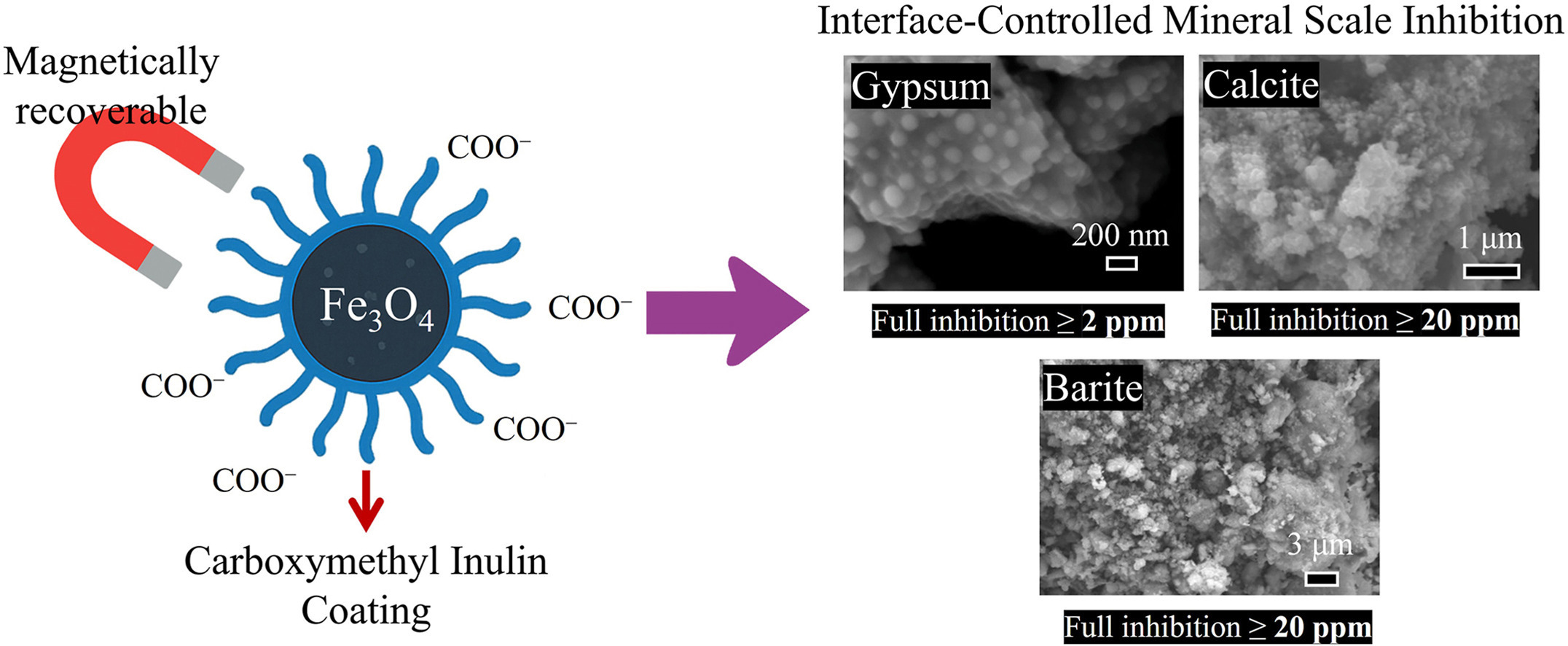
In this study, magnetite nanoparticles (Fe3O4) were surface-engineered with a biobased carboxymethyl inulin (CMI) coating to develop a recyclable inhibitor for controlling mineral scale formation through interfacial interactions. The Fe3O4@CMI nanocomposite was synthesized via co-precipitation, achieving a uniform ∼59 wt% polymer layer without altering the cubic spinel structure of magnetite. Comprehensive surface and interface characterization by XRD, FTIR, TGA, VSM, and SEM confirmed the preservation of superparamagnetic properties and effective polymer anchoring via carboxylate–iron interactions. The coated nanoparticles exhibited strong affinity for scaling ions, disrupting crystal nucleation and growth at the solid–liquid interface, as evidenced by morphological transformations of gypsum, calcite, and barite deposits. Under both static and high-pressure-high-temperature dynamic conditions, Fe3O4@CMI achieved complete gypsum inhibition at concentrations as low as 1–5 ppm and maintained full efficiency over multiple magnetic recovery cycles. Enhanced calcium compatibility in saline brines further underscores the stability of the modified surface, preventing secondary precipitation and enabling reliable reuse. These results highlight the critical role of interface engineering in tailoring nanoparticle–scale crystal interactions for sustainable and low-discharge chemicals for oilfield scale management.
Graphical abstract
Keywords
Magnetic nanoparticles; Carboxymethyl inulin; Scale inhibition; Recycling; Oilfield management
文章导读