
期刊文章
过刊浏览
- Volumes 108-119 (2025)
-
Volumes 96-107 (2025)
-
Volume 107
Pages 1-376 (December 2025)
-
Volume 106
Pages 1-336 (November 2025)
-
Volume 105
Pages 1-356 (October 2025)
-
Volume 104
Pages 1-332 (September 2025)
-
Volume 103
Pages 1-314 (August 2025)
-
Volume 102
Pages 1-276 (July 2025)
-
Volume 101
Pages 1-166 (June 2025)
-
Volume 100
Pages 1-256 (May 2025)
-
Volume 99
Pages 1-242 (April 2025)
-
Volume 98
Pages 1-288 (March 2025)
-
Volume 97
Pages 1-256 (February 2025)
-
Volume 96
Pages 1-340 (January 2025)
-
Volume 107
-
Volumes 84-95 (2024)
-
Volume 95
Pages 1-392 (December 2024)
-
Volume 94
Pages 1-400 (November 2024)
-
Volume 93
Pages 1-376 (October 2024)
-
Volume 92
Pages 1-316 (September 2024)
-
Volume 91
Pages 1-378 (August 2024)
-
Volume 90
Pages 1-580 (July 2024)
-
Volume 89
Pages 1-278 (June 2024)
-
Volume 88
Pages 1-350 (May 2024)
-
Volume 87
Pages 1-338 (April 2024)
-
Volume 86
Pages 1-312 (March 2024)
-
Volume 85
Pages 1-334 (February 2024)
-
Volume 84
Pages 1-308 (January 2024)
-
Volume 95
-
Volumes 72-83 (2023)
-
Volume 83
Pages 1-258 (December 2023)
-
Volume 82
Pages 1-204 (November 2023)
-
Volume 81
Pages 1-188 (October 2023)
-
Volume 80
Pages 1-202 (September 2023)
-
Volume 79
Pages 1-172 (August 2023)
-
Volume 78
Pages 1-146 (July 2023)
-
Volume 77
Pages 1-152 (June 2023)
-
Volume 76
Pages 1-176 (May 2023)
-
Volume 75
Pages 1-228 (April 2023)
-
Volume 74
Pages 1-200 (March 2023)
-
Volume 73
Pages 1-138 (February 2023)
-
Volume 72
Pages 1-144 (January 2023)
-
Volume 83
-
Volumes 60-71 (2022)
-
Volume 71
Pages 1-108 (December 2022)
-
Volume 70
Pages 1-106 (November 2022)
-
Volume 69
Pages 1-122 (October 2022)
-
Volume 68
Pages 1-124 (September 2022)
-
Volume 67
Pages 1-102 (August 2022)
-
Volume 66
Pages 1-112 (July 2022)
-
Volume 65
Pages 1-138 (June 2022)
-
Volume 64
Pages 1-186 (May 2022)
-
Volume 63
Pages 1-124 (April 2022)
-
Volume 62
Pages 1-104 (March 2022)
-
Volume 61
Pages 1-120 (February 2022)
-
Volume 60
Pages 1-124 (January 2022)
-
Volume 71
- Volumes 54-59 (2021)
- Volumes 48-53 (2020)
- Volumes 42-47 (2019)
- Volumes 36-41 (2018)
- Volumes 30-35 (2017)
- Volumes 24-29 (2016)
- Volumes 18-23 (2015)
- Volumes 12-17 (2014)
- Volume 11 (2013)
- Volume 10 (2012)
- Volume 9 (2011)
- Volume 8 (2010)
- Volume 7 (2009)
- Volume 6 (2008)
- Volume 5 (2007)
- Volume 4 (2006)
- Volume 3 (2005)
- Volume 2 (2004)
- Volume 1 (2003)
Volume 115
Chen, K., Zhang, D., Jiang, F., Shen, N.-L., Yan, X.-H., Ren, K.-F., . . . Cheng, X.-B. (2026). Hydrogen-free cyclized polyacrylonitrile binder enables thermally robust lithium-ion batteries. Particuology, 115, 25-34. https://doi.org/10.1016/j.partic.2026.05.005
Hydrogen-free cyclized polyacrylonitrile binder enables thermally robust lithium-ion batteries
Kai Chen a, Dian Zhang a, Feng Jiang a, Nai-Lu Shen a, Xiao-Hui Yan a, Ke-Feng Ren b, Xin Shen a *, Lungang Chen c, He Liu b *, Faxing Wang a, Shengjie Peng a, Yuping Wu a, Xin-Bing Cheng a *
a Z Energy Storage Center, School of Energy and Environment, Southeast University, Nanjing, 211189, China
b Jiangsu Key Laboratory of New Energy Devices & Interface Science, School of Chemistry and Materials Science, Nanjing University of Information Science and Technology, Nanjing, 210044, China
c Key Laboratory of Energy Thermal Conversion and Control of Ministry of Education, School of Energy and Environment, Southeast University, Nanjing, 211189, China
10.1016/j.partic.2026.05.005
Volume 115,
August 2026,
Pages 25-34
Received 15 April 2026, Revised 8 May 2026, Accepted 9 May 2026, Available online 16 May 2026, Version of Record 22 May 2026.
E-mail:
shenx25@seu.edu.cn; liuhe@nuist.edu.cn; chengxb@seu.edu.cn
Highlights
• Cyclized polyacrylonitrile binder can inhibit the generation of hydrogen.
• Cyclized polyacrylonitrile binder serves as a lithium-ion storage material.
• Cyclized polyacrylonitrile binder suppresses side reactions of the electrolyte.
Abstract
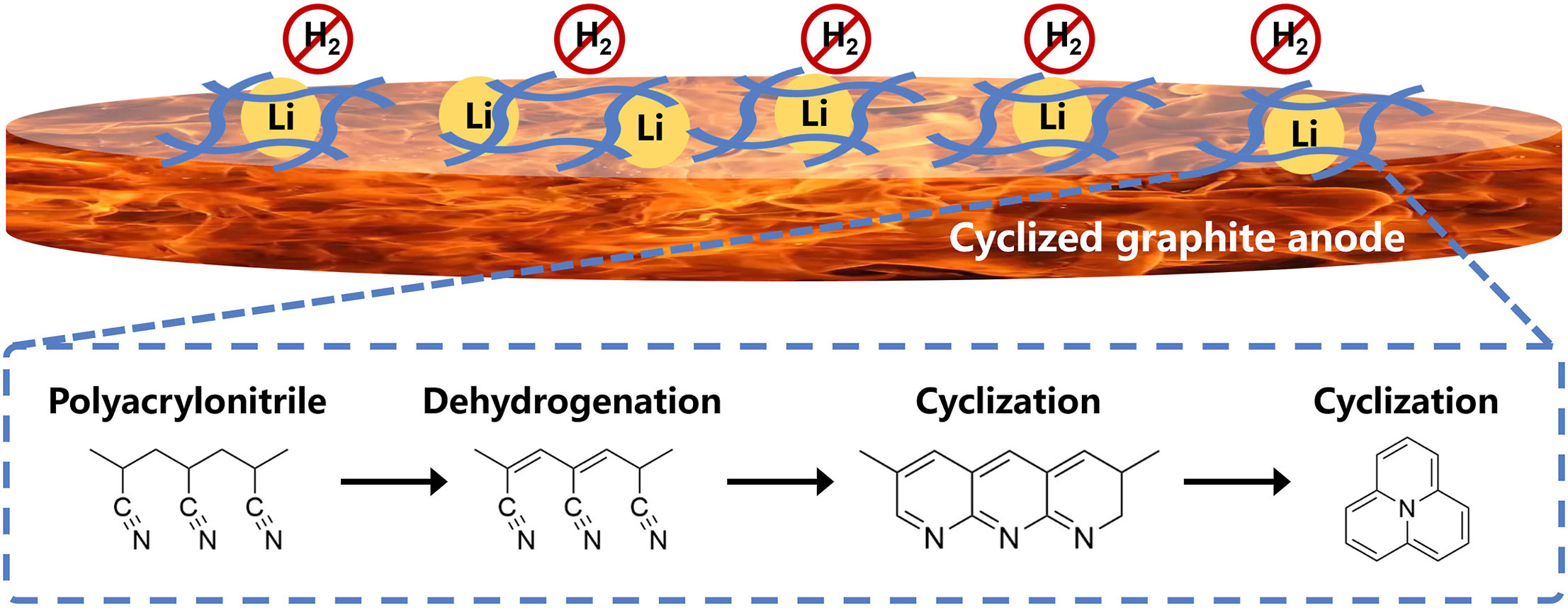
Hydrogen generation during thermal runaway significantly elevates the risk of explosive combustion in lithium-ion batteries. Although hydrogen generated from binders constitutes a minor fraction, its absolute quantity remains substantial in large-scale stationary energy storage systems. Moreover, binder decomposition occurs during the later stages of thermal runaway with rapid reaction rates, further raising the danger level. Herein, graphite anode with polyacrylonitrile binder is in situ cyclized to eliminate the active hydrogen, while maintaining superior cohesiveness. On one hand, cyclized polyacrylonitrile with largely reduced hydrogen atoms can prevent binder-induced hydrogen generation and realize a reduction of hydrogen fraction by over 23%. As the three-dimensional cross-linking binders increase the thermal stability of anodes, the peak decomposition temperature of solid electrolyte interphase is increased from 150 to 200 °C to above 200 °C, while the peak reaction temperature between lithiated graphite and the electrolyte is delayed by at least 15 °C. On the other hand, the transformation from linear to cyclic molecular structures of cyclized polyacrylonitrile enables uniform and tight encapsulation of graphite and enhanced cohesiveness. Capacity retentions of 97% after 200 cycles in half cells and 72% after 800 cycles in full cells are achieved.
Graphical abstract
Keywords
Lithium-ion battery; Thermal runaway; Hydrogen; Binder; Cyclized polyacrylonitrile
文章导读