
期刊文章
过刊浏览
- Volumes 108-119 (2025)
-
Volumes 96-107 (2025)
-
Volume 107
Pages 1-376 (December 2025)
-
Volume 106
Pages 1-336 (November 2025)
-
Volume 105
Pages 1-356 (October 2025)
-
Volume 104
Pages 1-332 (September 2025)
-
Volume 103
Pages 1-314 (August 2025)
-
Volume 102
Pages 1-276 (July 2025)
-
Volume 101
Pages 1-166 (June 2025)
-
Volume 100
Pages 1-256 (May 2025)
-
Volume 99
Pages 1-242 (April 2025)
-
Volume 98
Pages 1-288 (March 2025)
-
Volume 97
Pages 1-256 (February 2025)
-
Volume 96
Pages 1-340 (January 2025)
-
Volume 107
-
Volumes 84-95 (2024)
-
Volume 95
Pages 1-392 (December 2024)
-
Volume 94
Pages 1-400 (November 2024)
-
Volume 93
Pages 1-376 (October 2024)
-
Volume 92
Pages 1-316 (September 2024)
-
Volume 91
Pages 1-378 (August 2024)
-
Volume 90
Pages 1-580 (July 2024)
-
Volume 89
Pages 1-278 (June 2024)
-
Volume 88
Pages 1-350 (May 2024)
-
Volume 87
Pages 1-338 (April 2024)
-
Volume 86
Pages 1-312 (March 2024)
-
Volume 85
Pages 1-334 (February 2024)
-
Volume 84
Pages 1-308 (January 2024)
-
Volume 95
-
Volumes 72-83 (2023)
-
Volume 83
Pages 1-258 (December 2023)
-
Volume 82
Pages 1-204 (November 2023)
-
Volume 81
Pages 1-188 (October 2023)
-
Volume 80
Pages 1-202 (September 2023)
-
Volume 79
Pages 1-172 (August 2023)
-
Volume 78
Pages 1-146 (July 2023)
-
Volume 77
Pages 1-152 (June 2023)
-
Volume 76
Pages 1-176 (May 2023)
-
Volume 75
Pages 1-228 (April 2023)
-
Volume 74
Pages 1-200 (March 2023)
-
Volume 73
Pages 1-138 (February 2023)
-
Volume 72
Pages 1-144 (January 2023)
-
Volume 83
-
Volumes 60-71 (2022)
-
Volume 71
Pages 1-108 (December 2022)
-
Volume 70
Pages 1-106 (November 2022)
-
Volume 69
Pages 1-122 (October 2022)
-
Volume 68
Pages 1-124 (September 2022)
-
Volume 67
Pages 1-102 (August 2022)
-
Volume 66
Pages 1-112 (July 2022)
-
Volume 65
Pages 1-138 (June 2022)
-
Volume 64
Pages 1-186 (May 2022)
-
Volume 63
Pages 1-124 (April 2022)
-
Volume 62
Pages 1-104 (March 2022)
-
Volume 61
Pages 1-120 (February 2022)
-
Volume 60
Pages 1-124 (January 2022)
-
Volume 71
- Volumes 54-59 (2021)
- Volumes 48-53 (2020)
- Volumes 42-47 (2019)
- Volumes 36-41 (2018)
- Volumes 30-35 (2017)
- Volumes 24-29 (2016)
- Volumes 18-23 (2015)
- Volumes 12-17 (2014)
- Volume 11 (2013)
- Volume 10 (2012)
- Volume 9 (2011)
- Volume 8 (2010)
- Volume 7 (2009)
- Volume 6 (2008)
- Volume 5 (2007)
- Volume 4 (2006)
- Volume 3 (2005)
- Volume 2 (2004)
- Volume 1 (2003)
Volume 115
Wang, Z., Li, B., Yang, X., Lu, J., Zhang, J., Zhou, C., . . . Zhao, T. (2026). Elucidation of the dispersion characterization of lithium-ion battery slurry under effects of both composite conductive agent amount and carbon nanotubes to graphene mass ratio. Particuology, 115, 35-46. https://doi.org/10.1016/j.partic.2026.05.006
Elucidation of the dispersion characterization of lithium-ion battery slurry under effects of both composite conductive agent amount and carbon nanotubes to graphene mass ratio
Zhilong Wang a, Bingjia Li a, Xiao Yang a, Jianhang Lu a, Jiatan Zhang a, Chunguo Zhou a, Irfan Bahiuddin b, Bo Sun a, Tong Zhao a c *
a Faculty of Mechanical and Precision Instrument Engineering, Xi'an University of Technology, Xi'an, 710048, China
b Department of Mechanical Engineering, Universitas Gadjah Mada, Yogyakarta, 55281, Indonesia
c Key Laboratory of Green and Intelligent Development and Efficient Utilization of Strategic Mineral Resources of Xinjiang Production and Construction Corps, Faculty of Electromechanical and Automation, Xinjiang University of Technology, Hotan City, 848000, China
10.1016/j.partic.2026.05.006
Volume 115,
August 2026,
Pages 35-46
Received 24 March 2026, Revised 8 May 2026, Accepted 11 May 2026, Available online 17 May 2026, Version of Record 22 May 2026.
E-mail:
tongzhao@xaut.edu.cn
Highlights
• LiCoO2 particles are well dispersed within LIB slurry when φcom2 = 0.5%.
• Both LiCoO2 particles and the composite conductive agent are well dispersed to form network when mCNTS: mGr = 4:1.
• The best synergistic effect between CNTs and Gr provides a solid foundation for LIB production.
Abstract
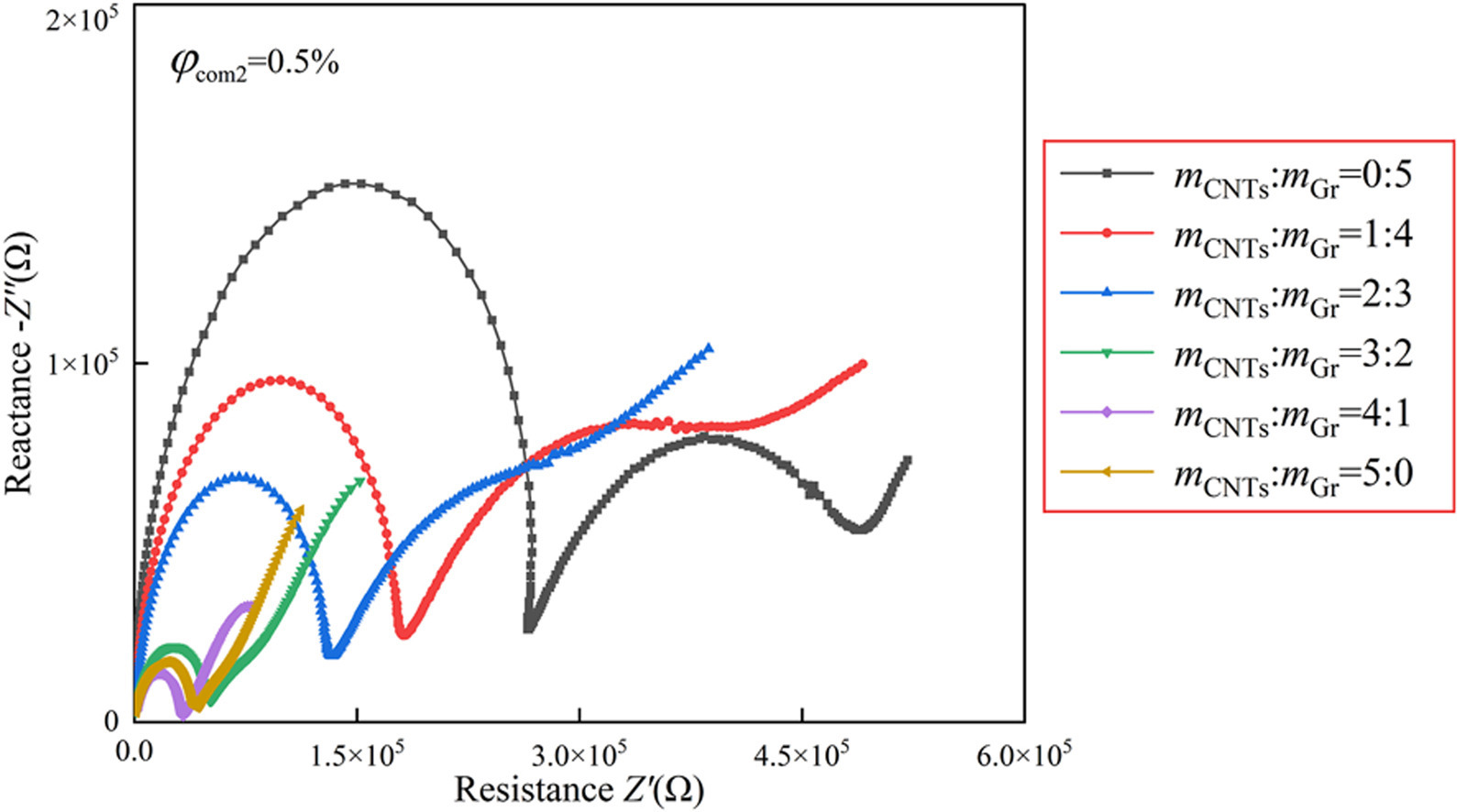
This manuscript mainly proposed an effective method to well disperse the composite conductive agent which is composed of carbon nanotubes (CNTs) and graphene (Gr) in lithium-ion battery (LIB) slurry. Electrochemical Impedance Spectroscopy (EIS), Scanning Electron Microscopy (SEM) and gravitational sedimentation (GS) are employed to characterize the electrochemical, morphological and stability characterizations of LIB slurry, respectively. Specifically, electrochemical characterizations of LIB electrode slurries are performed by fitting Nyquist plots with a 10-parameter EEC, and quantitative morphological analysis of SEM images is conducted using a Mask R-CNN instance segmentation algorithm, both of which were proposed in our prior published research works. Consequently, the dispersion characterizations of LIB slurry are able to be summarized as follows: LiCoO2 particles are well dispersed in LIB slurry at φcom2 = 0.5%, by contrast, the composite conductive agent achieves superior coating and networking of LiCoO2 particles under the conditions of both φcom2 = 0.5% and mCNTs:mGr = 4:1, due to the maximized CNTs-Gr synergistic effect. Meanwhile, the formed three-dimensional “long-range” conductive network maintains the stability of its internal skeleton structure during the sedimentation of LIB slurry. This finding holds significant potential to advance the application of CNTs/Gr composite conductive agents in LIB slurry.
Graphical abstract
Keywords
Composite conductive agent; Lithium-ion battery slurry; Carbon nanotubes; Graphene
文章导读