
期刊文章
过刊浏览
- Volumes 108-119 (2025)
-
Volumes 96-107 (2025)
-
Volume 107
Pages 1-376 (December 2025)
-
Volume 106
Pages 1-336 (November 2025)
-
Volume 105
Pages 1-356 (October 2025)
-
Volume 104
Pages 1-332 (September 2025)
-
Volume 103
Pages 1-314 (August 2025)
-
Volume 102
Pages 1-276 (July 2025)
-
Volume 101
Pages 1-166 (June 2025)
-
Volume 100
Pages 1-256 (May 2025)
-
Volume 99
Pages 1-242 (April 2025)
-
Volume 98
Pages 1-288 (March 2025)
-
Volume 97
Pages 1-256 (February 2025)
-
Volume 96
Pages 1-340 (January 2025)
-
Volume 107
-
Volumes 84-95 (2024)
-
Volume 95
Pages 1-392 (December 2024)
-
Volume 94
Pages 1-400 (November 2024)
-
Volume 93
Pages 1-376 (October 2024)
-
Volume 92
Pages 1-316 (September 2024)
-
Volume 91
Pages 1-378 (August 2024)
-
Volume 90
Pages 1-580 (July 2024)
-
Volume 89
Pages 1-278 (June 2024)
-
Volume 88
Pages 1-350 (May 2024)
-
Volume 87
Pages 1-338 (April 2024)
-
Volume 86
Pages 1-312 (March 2024)
-
Volume 85
Pages 1-334 (February 2024)
-
Volume 84
Pages 1-308 (January 2024)
-
Volume 95
-
Volumes 72-83 (2023)
-
Volume 83
Pages 1-258 (December 2023)
-
Volume 82
Pages 1-204 (November 2023)
-
Volume 81
Pages 1-188 (October 2023)
-
Volume 80
Pages 1-202 (September 2023)
-
Volume 79
Pages 1-172 (August 2023)
-
Volume 78
Pages 1-146 (July 2023)
-
Volume 77
Pages 1-152 (June 2023)
-
Volume 76
Pages 1-176 (May 2023)
-
Volume 75
Pages 1-228 (April 2023)
-
Volume 74
Pages 1-200 (March 2023)
-
Volume 73
Pages 1-138 (February 2023)
-
Volume 72
Pages 1-144 (January 2023)
-
Volume 83
-
Volumes 60-71 (2022)
-
Volume 71
Pages 1-108 (December 2022)
-
Volume 70
Pages 1-106 (November 2022)
-
Volume 69
Pages 1-122 (October 2022)
-
Volume 68
Pages 1-124 (September 2022)
-
Volume 67
Pages 1-102 (August 2022)
-
Volume 66
Pages 1-112 (July 2022)
-
Volume 65
Pages 1-138 (June 2022)
-
Volume 64
Pages 1-186 (May 2022)
-
Volume 63
Pages 1-124 (April 2022)
-
Volume 62
Pages 1-104 (March 2022)
-
Volume 61
Pages 1-120 (February 2022)
-
Volume 60
Pages 1-124 (January 2022)
-
Volume 71
- Volumes 54-59 (2021)
- Volumes 48-53 (2020)
- Volumes 42-47 (2019)
- Volumes 36-41 (2018)
- Volumes 30-35 (2017)
- Volumes 24-29 (2016)
- Volumes 18-23 (2015)
- Volumes 12-17 (2014)
- Volume 11 (2013)
- Volume 10 (2012)
- Volume 9 (2011)
- Volume 8 (2010)
- Volume 7 (2009)
- Volume 6 (2008)
- Volume 5 (2007)
- Volume 4 (2006)
- Volume 3 (2005)
- Volume 2 (2004)
- Volume 1 (2003)
Volume 115
Aghamohammadi, H., Khazaeli, A., & Eslami-Farsani, R. (2026). Lithium content effects on the phase evolution, microstructure and morphology of hydrothermally synthesized Li4Ti5O12-TiO2 nanocomposites. Particuology, 115, 47-54. https://doi.org/10.1016/j.partic.2026.05.003
Lithium content effects on the phase evolution, microstructure and morphology of hydrothermally synthesized Li4Ti5O12-TiO2 nanocomposites
Hamed Aghamohammadi a *, Atousa Khazaeli b, Reza Eslami-Farsani b
a Department of Advanced Materials and New Technologies, Iranian Research Organization for Science and Technology (IROST), Tehran, Iran <>
b Faculty of Materials Science and Engineering, K. N. Toosi University of Technology, Tehran, Iran
10.1016/j.partic.2026.05.003
Volume 115,
August 2026,
Pages 47-54
Received 12 April 2026, Revised 6 May 2026, Accepted 8 May 2026, Available online 12 May 2026, Version of Record 22 May 2026.
E-mail:
aghamohammadi@irost.ir; hamed.aghamohammadi@outlook.com
Highlights
• Effects of different LiOH·H2O:TBT ratios on the hydrothermal synthesis of LTO-TiO2 investigated.
• Phase, microstructure, and morphology of the samples were studied.
• Phase evolution occurred by increasing the Li precursors ratios.
• LTO crystallite size reduced from 40nm to 20–21 nm with increasing Li content.
• Higher Li ratios favor LTO-TiO2 rutile nanocomposites with refined morphology.
Abstract
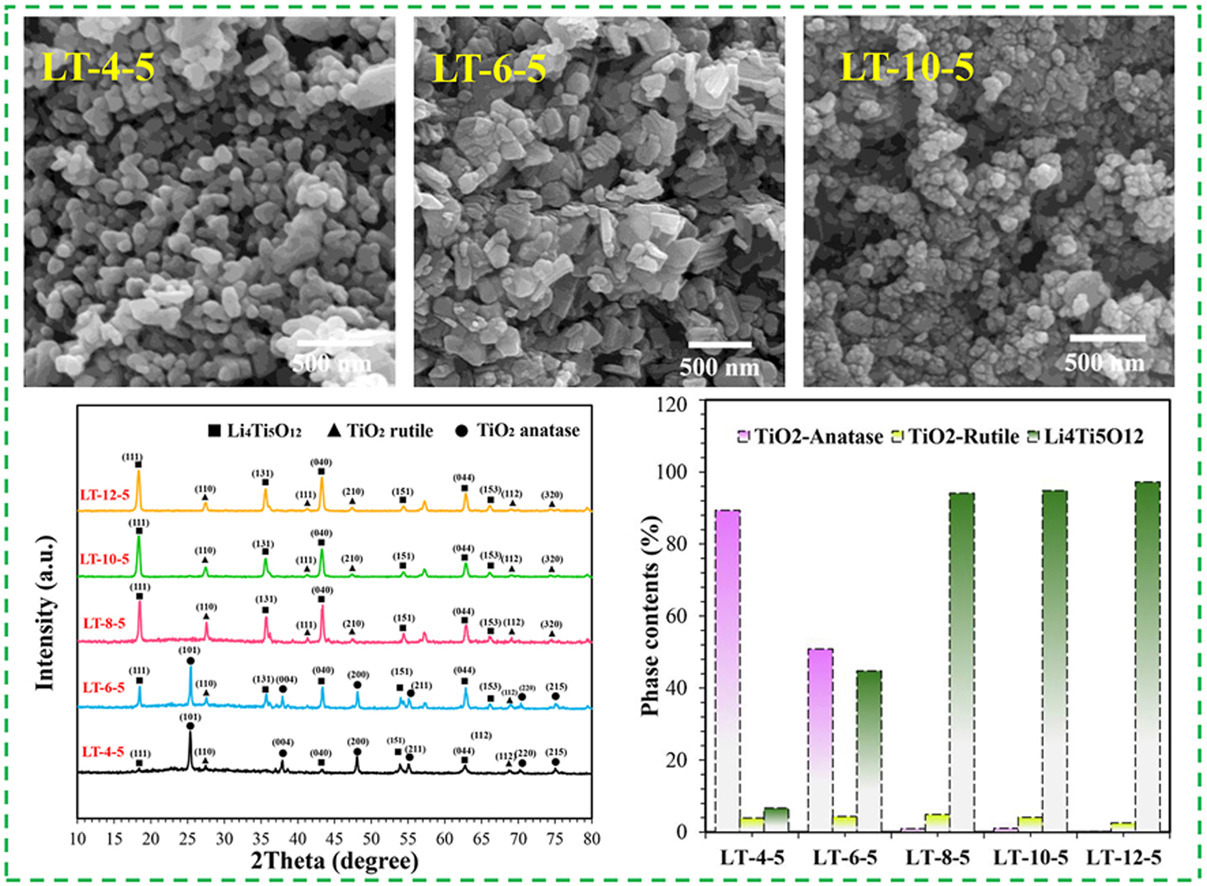
Li4Ti5O12-TiO2 nanocomposites represent highly promising materials for energy storage applications owing to their attractive electrochemical properties. However, precisely optimizing their morphology and compositions is essential. In this study, the effects of lithium content on the synthesis of the Li4Ti5O12-TiO2 nanocomposites prepared by the hydrothermal method were investigated. The samples were prepared using different molar ratios of LiOH·H2O: tertbutyl titanate (TBT) (4:5, 6:5, 8:5, 10:5, and 12:5) using a hydrothermal process at 180 °C for 12 h, followed by a calcination step. The microstructure, phase analysis, and morphology of the samples were investigated using X-ray diffraction (XRD), Raman spectroscopy, and field-emission scanning electron microscopy (FESEM) analyses. XRD results showed a phase evolution from an anatase-rich TiO2 (at a ratio of 4:5) to a Li4Ti5O12-dominated nanocomposite (at a ratio of 12:5) with a minor TiO2 rutile phase. Also, the crystallite size of the Li4Ti5O12 phase first increased to a maximum value of 47.3 nm and then decreased to 20–21 nm at higher ratios. FESEM images revealed a growth in particle size of the samples from 138 to 196 nm, by increasing the ratio from 4:5 to 6:5, and then a reduction of particle size to about 55 nm by using higher ratios. The results showed that for achieving Li4Ti5O12-TiO2 rutile nanocomposites with nanoscale particles, higher LiOH·H2O:TBT ratios are preferred.
Graphical abstract
Keywords
Li4Ti5O12-TiO2 nanocomposite; Hydrothermal synthesis; Lithium precursor ratio; Microstructure; Morphology
文章导读