
期刊文章
过刊浏览
- Volumes 108-119 (2025)
-
Volumes 96-107 (2025)
-
Volume 107
Pages 1-376 (December 2025)
-
Volume 106
Pages 1-336 (November 2025)
-
Volume 105
Pages 1-356 (October 2025)
-
Volume 104
Pages 1-332 (September 2025)
-
Volume 103
Pages 1-314 (August 2025)
-
Volume 102
Pages 1-276 (July 2025)
-
Volume 101
Pages 1-166 (June 2025)
-
Volume 100
Pages 1-256 (May 2025)
-
Volume 99
Pages 1-242 (April 2025)
-
Volume 98
Pages 1-288 (March 2025)
-
Volume 97
Pages 1-256 (February 2025)
-
Volume 96
Pages 1-340 (January 2025)
-
Volume 107
-
Volumes 84-95 (2024)
-
Volume 95
Pages 1-392 (December 2024)
-
Volume 94
Pages 1-400 (November 2024)
-
Volume 93
Pages 1-376 (October 2024)
-
Volume 92
Pages 1-316 (September 2024)
-
Volume 91
Pages 1-378 (August 2024)
-
Volume 90
Pages 1-580 (July 2024)
-
Volume 89
Pages 1-278 (June 2024)
-
Volume 88
Pages 1-350 (May 2024)
-
Volume 87
Pages 1-338 (April 2024)
-
Volume 86
Pages 1-312 (March 2024)
-
Volume 85
Pages 1-334 (February 2024)
-
Volume 84
Pages 1-308 (January 2024)
-
Volume 95
-
Volumes 72-83 (2023)
-
Volume 83
Pages 1-258 (December 2023)
-
Volume 82
Pages 1-204 (November 2023)
-
Volume 81
Pages 1-188 (October 2023)
-
Volume 80
Pages 1-202 (September 2023)
-
Volume 79
Pages 1-172 (August 2023)
-
Volume 78
Pages 1-146 (July 2023)
-
Volume 77
Pages 1-152 (June 2023)
-
Volume 76
Pages 1-176 (May 2023)
-
Volume 75
Pages 1-228 (April 2023)
-
Volume 74
Pages 1-200 (March 2023)
-
Volume 73
Pages 1-138 (February 2023)
-
Volume 72
Pages 1-144 (January 2023)
-
Volume 83
-
Volumes 60-71 (2022)
-
Volume 71
Pages 1-108 (December 2022)
-
Volume 70
Pages 1-106 (November 2022)
-
Volume 69
Pages 1-122 (October 2022)
-
Volume 68
Pages 1-124 (September 2022)
-
Volume 67
Pages 1-102 (August 2022)
-
Volume 66
Pages 1-112 (July 2022)
-
Volume 65
Pages 1-138 (June 2022)
-
Volume 64
Pages 1-186 (May 2022)
-
Volume 63
Pages 1-124 (April 2022)
-
Volume 62
Pages 1-104 (March 2022)
-
Volume 61
Pages 1-120 (February 2022)
-
Volume 60
Pages 1-124 (January 2022)
-
Volume 71
- Volumes 54-59 (2021)
- Volumes 48-53 (2020)
- Volumes 42-47 (2019)
- Volumes 36-41 (2018)
- Volumes 30-35 (2017)
- Volumes 24-29 (2016)
- Volumes 18-23 (2015)
- Volumes 12-17 (2014)
- Volume 11 (2013)
- Volume 10 (2012)
- Volume 9 (2011)
- Volume 8 (2010)
- Volume 7 (2009)
- Volume 6 (2008)
- Volume 5 (2007)
- Volume 4 (2006)
- Volume 3 (2005)
- Volume 2 (2004)
- Volume 1 (2003)
Volume 115
Yang, G., Chen, B., Ma, L., Feng, Y., Duan, L., Xia, Z., & Li, C. (2026). Laser ignition and combustion process of single boron agglomerate in steam. Particuology, 115, 55-67. https://doi.org/10.1016/j.partic.2026.05.007
Laser ignition and combustion process of single boron agglomerate in steam
Gan Yang a, Binbin Chen a *, Likun Ma a, Yunchao Feng a, Lian Duan b, Zhixun Xia a, Chaolong Li c
a Advanced Propulsion Technology Laboratory, National University of Defense Technology, Changsha, 410073, China
b School of Mechanical Engineering and Mechanics, Xiangtan University, Xiangtan, 411105, China
c Test Center, National University of Defense Technology, Xi'an, 710106, China
10.1016/j.partic.2026.05.007
Pages 55-67,
August 2026,
Volume 115
Received 2 March 2026, Revised 23 April 2026, Accepted 5 May 2026, Available online 20 May 2026, Version of Record 26 May 2026.
E-mail:
chenbinbin11@nudt.edu.cn
Highlights
• A single-particle laser ignition system is established to study boron combustion in steam.
• Boron agglomerates in steam undergo four distinct combustion stages.
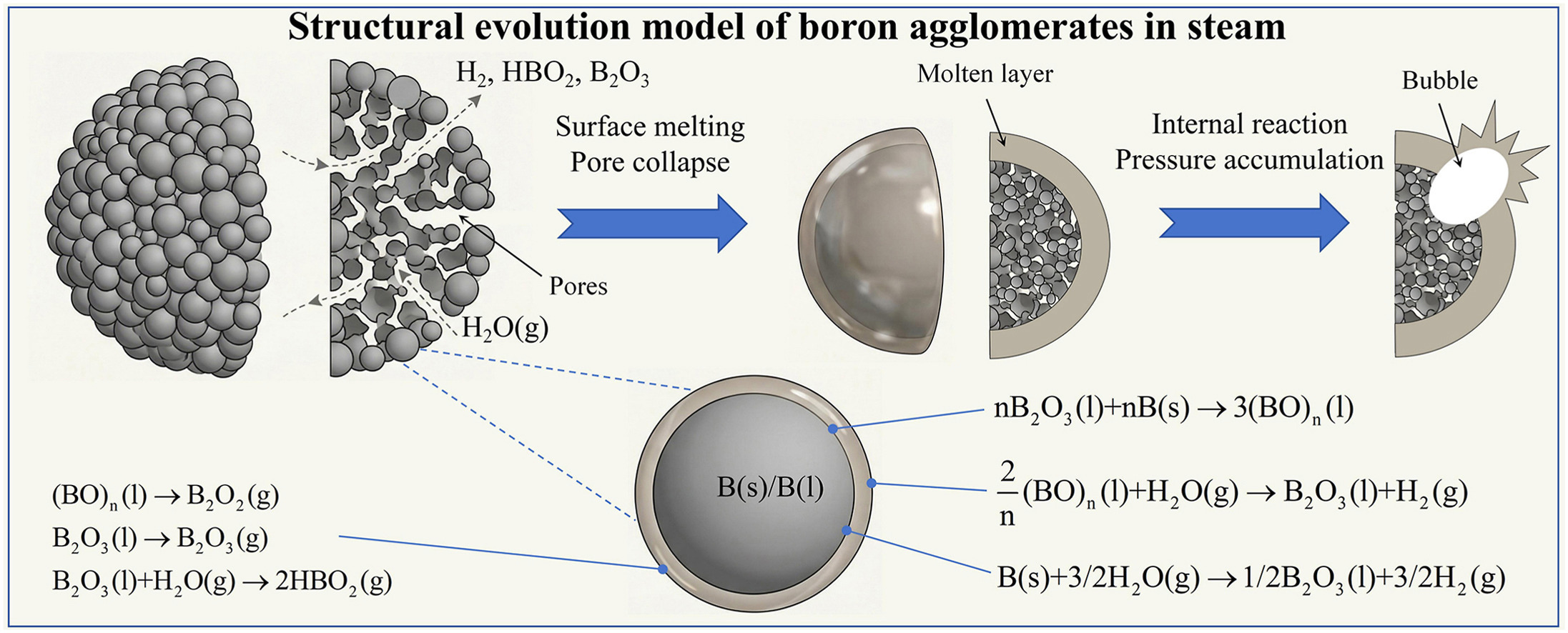
• Steam triggers a unique micro-explosion mode with sustained jetting rather than expansion.
• Quasi-steady combustion in steam is diffusion-controlled with a rate constant comparable to air.
• Boron achieves ∼39.1% combustion efficiency in pure steam, confirming its potential as oxidizer.
Abstract
To investigate the ignition and combustion mechanisms of boron agglomerates in oxygen-free steam for water ramjet applications, a laser ignition single-particle experimental system was established. The combustion process was found to comprise four sequential stages: preheating and structural loosening, molten collapse, micro-explosion combustion, and quasi-steady combustion. The results indicate that steam can act as an oxidizer to support vigorous boron combustion. Its unique chemical role (reacting with B2O3 to form volatile HBO2) effectively accelerates the removal of the surface oxide layer, resulting in a relatively thin molten shell. Entrapped steam continuously reacts with internal boron, generating gaseous products (H2, etc.) that trigger a distinct micro-explosion mode characterized by sustained ejection rather than the expansion-dominated behavior observed in air. Kinetic analysis reveals that the quasi-steady combustion stage is diffusion-controlled, with a burning rate constant comparable to that in air. A quantitative evaluation based on volume change yields a final combustion efficiency of approximately 39.1% in pure steam. These single-particle-level observations provide essential experimental evidence for understanding boron combustion mechanisms and for designing boron-based water-reactive fuel systems.
Graphical abstract
Keywords
Boron agglomerate; Laser ignition; Steam atmosphere; Micro-explosion; Combustion kinetics; Single particle
文章导读