
期刊文章
过刊浏览
- Volumes 108-119 (2025)
-
Volumes 96-107 (2025)
-
Volume 107
Pages 1-376 (December 2025)
-
Volume 106
Pages 1-336 (November 2025)
-
Volume 105
Pages 1-356 (October 2025)
-
Volume 104
Pages 1-332 (September 2025)
-
Volume 103
Pages 1-314 (August 2025)
-
Volume 102
Pages 1-276 (July 2025)
-
Volume 101
Pages 1-166 (June 2025)
-
Volume 100
Pages 1-256 (May 2025)
-
Volume 99
Pages 1-242 (April 2025)
-
Volume 98
Pages 1-288 (March 2025)
-
Volume 97
Pages 1-256 (February 2025)
-
Volume 96
Pages 1-340 (January 2025)
-
Volume 107
-
Volumes 84-95 (2024)
-
Volume 95
Pages 1-392 (December 2024)
-
Volume 94
Pages 1-400 (November 2024)
-
Volume 93
Pages 1-376 (October 2024)
-
Volume 92
Pages 1-316 (September 2024)
-
Volume 91
Pages 1-378 (August 2024)
-
Volume 90
Pages 1-580 (July 2024)
-
Volume 89
Pages 1-278 (June 2024)
-
Volume 88
Pages 1-350 (May 2024)
-
Volume 87
Pages 1-338 (April 2024)
-
Volume 86
Pages 1-312 (March 2024)
-
Volume 85
Pages 1-334 (February 2024)
-
Volume 84
Pages 1-308 (January 2024)
-
Volume 95
-
Volumes 72-83 (2023)
-
Volume 83
Pages 1-258 (December 2023)
-
Volume 82
Pages 1-204 (November 2023)
-
Volume 81
Pages 1-188 (October 2023)
-
Volume 80
Pages 1-202 (September 2023)
-
Volume 79
Pages 1-172 (August 2023)
-
Volume 78
Pages 1-146 (July 2023)
-
Volume 77
Pages 1-152 (June 2023)
-
Volume 76
Pages 1-176 (May 2023)
-
Volume 75
Pages 1-228 (April 2023)
-
Volume 74
Pages 1-200 (March 2023)
-
Volume 73
Pages 1-138 (February 2023)
-
Volume 72
Pages 1-144 (January 2023)
-
Volume 83
-
Volumes 60-71 (2022)
-
Volume 71
Pages 1-108 (December 2022)
-
Volume 70
Pages 1-106 (November 2022)
-
Volume 69
Pages 1-122 (October 2022)
-
Volume 68
Pages 1-124 (September 2022)
-
Volume 67
Pages 1-102 (August 2022)
-
Volume 66
Pages 1-112 (July 2022)
-
Volume 65
Pages 1-138 (June 2022)
-
Volume 64
Pages 1-186 (May 2022)
-
Volume 63
Pages 1-124 (April 2022)
-
Volume 62
Pages 1-104 (March 2022)
-
Volume 61
Pages 1-120 (February 2022)
-
Volume 60
Pages 1-124 (January 2022)
-
Volume 71
- Volumes 54-59 (2021)
- Volumes 48-53 (2020)
- Volumes 42-47 (2019)
- Volumes 36-41 (2018)
- Volumes 30-35 (2017)
- Volumes 24-29 (2016)
- Volumes 18-23 (2015)
- Volumes 12-17 (2014)
- Volume 11 (2013)
- Volume 10 (2012)
- Volume 9 (2011)
- Volume 8 (2010)
- Volume 7 (2009)
- Volume 6 (2008)
- Volume 5 (2007)
- Volume 4 (2006)
- Volume 3 (2005)
- Volume 2 (2004)
- Volume 1 (2003)
Volume 115
Qiao, X., Jin, H., Su, H., & Guo, L. (2026). An adaptive lattice Boltzmann method for wake effect on drag force of interactive particles in supercritical water. Particuology, 115, 68-77. https://doi.org/10.1016/j.partic.2026.04.026
An adaptive lattice Boltzmann method for wake effect on drag force of interactive particles in supercritical water
Xue Qiao, Hui Jin, Haozhe Su, Liejin Guo *
State Key Laboratory of Multiphase Flow in Power Engineering (SKLMFPE), Xi'an Jiaotong University, Xi'an, 710049, China
10.1016/j.partic.2026.04.026
August 2026,
Received 2 December 2025, Revised 21 April 2026, Accepted 23 April 2026, Available online 12 May 2026, Version of Record 26 May 2026.,
Pages 68-77
Volume 115
E-mail:
lj-guo@mail.xjtu.edu.cn
Highlights
• A multi-segment Boussinesq approximation for supercritical water density is employed in the lattice Boltzmann equation to characterize its density variation under supercritical conditions.
• Boudary lattice based on density gradient was developed to ensure stability of simulation.
• Significant enhancement in boundary convergence and adaptability to thermophysical properties of supercritical water using adaptive LBM scheme.
• A correlation was derived to quantify the wake effect on drag force of interactive particles.
Abstract
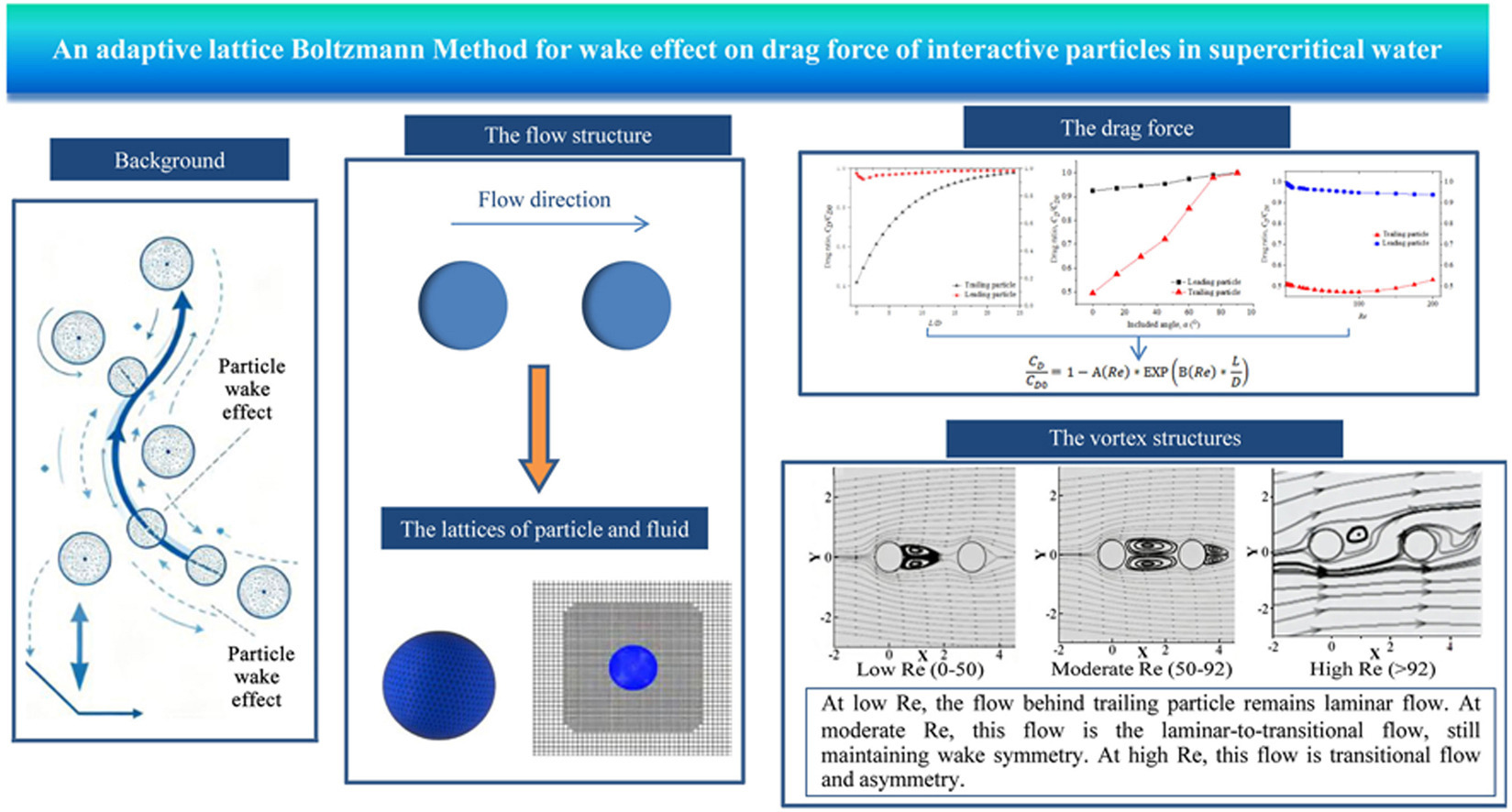
Supercritical water gasification (SCWG) is a highly promising technology. A fundamental aspect of SCWG involves the flow of supercritical water (SCW) around interactive particles, which is inherently complex due to the presence of the wake effect. This study numerically investigates particle wake characteristics and wake-particle interactions in high-viscosity supercritical water (SCW) via an adaptive lattice Boltzmann method (LBM, N/D = 30, coarse-fine ratio 0.025:0.060) to support supercritical water gasification (SCWG) reactor optimization. The adaptive LBM effectively balances accuracy and efficiency, resolving SCW's steep viscosity gradients and fine wake structures well. Interparticle distance (L/D) is the dominant factor for particle drag, affecting trailing particles far more significantly, with three interaction regimes (strong: L/D = 0–2, moderate: 2–4, weak: ≥4). SCW's high viscosity amplifies wake overlap at L/D ≤ 2, minimizing trailing particle pressure drag and suppressing vortex shedding; increasing L/D weakens shielding, elevates drag, and makes trailing particles behave like isolated ones. Interparticle angle raises drag ratios, inducing distinct vortex structures at 30°–60° and 60°–90°, with identical drag at 90°. SCW wake symmetry and vortex shedding show Re-dependent transitions, with critical Re = 92 corresponding to the minimum trailing particle drag ratio. A drag ratio correlation with L/D and Re is also established. This work provides a reliable numerical tool for SCW particle interactions and theoretical guidance for SCWG reactor optimization, with future work focusing on particle swarms and experimental validation.
Graphical abstract
Keywords
Lattice Boltzmann method; Boussinesq approximation; Wake effect; Drag force; Numerical simulation
文章导读