
期刊文章
过刊浏览
- Volumes 108-119 (2025)
-
Volumes 96-107 (2025)
-
Volume 107
Pages 1-376 (December 2025)
-
Volume 106
Pages 1-336 (November 2025)
-
Volume 105
Pages 1-356 (October 2025)
-
Volume 104
Pages 1-332 (September 2025)
-
Volume 103
Pages 1-314 (August 2025)
-
Volume 102
Pages 1-276 (July 2025)
-
Volume 101
Pages 1-166 (June 2025)
-
Volume 100
Pages 1-256 (May 2025)
-
Volume 99
Pages 1-242 (April 2025)
-
Volume 98
Pages 1-288 (March 2025)
-
Volume 97
Pages 1-256 (February 2025)
-
Volume 96
Pages 1-340 (January 2025)
-
Volume 107
-
Volumes 84-95 (2024)
-
Volume 95
Pages 1-392 (December 2024)
-
Volume 94
Pages 1-400 (November 2024)
-
Volume 93
Pages 1-376 (October 2024)
-
Volume 92
Pages 1-316 (September 2024)
-
Volume 91
Pages 1-378 (August 2024)
-
Volume 90
Pages 1-580 (July 2024)
-
Volume 89
Pages 1-278 (June 2024)
-
Volume 88
Pages 1-350 (May 2024)
-
Volume 87
Pages 1-338 (April 2024)
-
Volume 86
Pages 1-312 (March 2024)
-
Volume 85
Pages 1-334 (February 2024)
-
Volume 84
Pages 1-308 (January 2024)
-
Volume 95
-
Volumes 72-83 (2023)
-
Volume 83
Pages 1-258 (December 2023)
-
Volume 82
Pages 1-204 (November 2023)
-
Volume 81
Pages 1-188 (October 2023)
-
Volume 80
Pages 1-202 (September 2023)
-
Volume 79
Pages 1-172 (August 2023)
-
Volume 78
Pages 1-146 (July 2023)
-
Volume 77
Pages 1-152 (June 2023)
-
Volume 76
Pages 1-176 (May 2023)
-
Volume 75
Pages 1-228 (April 2023)
-
Volume 74
Pages 1-200 (March 2023)
-
Volume 73
Pages 1-138 (February 2023)
-
Volume 72
Pages 1-144 (January 2023)
-
Volume 83
-
Volumes 60-71 (2022)
-
Volume 71
Pages 1-108 (December 2022)
-
Volume 70
Pages 1-106 (November 2022)
-
Volume 69
Pages 1-122 (October 2022)
-
Volume 68
Pages 1-124 (September 2022)
-
Volume 67
Pages 1-102 (August 2022)
-
Volume 66
Pages 1-112 (July 2022)
-
Volume 65
Pages 1-138 (June 2022)
-
Volume 64
Pages 1-186 (May 2022)
-
Volume 63
Pages 1-124 (April 2022)
-
Volume 62
Pages 1-104 (March 2022)
-
Volume 61
Pages 1-120 (February 2022)
-
Volume 60
Pages 1-124 (January 2022)
-
Volume 71
- Volumes 54-59 (2021)
- Volumes 48-53 (2020)
- Volumes 42-47 (2019)
- Volumes 36-41 (2018)
- Volumes 30-35 (2017)
- Volumes 24-29 (2016)
- Volumes 18-23 (2015)
- Volumes 12-17 (2014)
- Volume 11 (2013)
- Volume 10 (2012)
- Volume 9 (2011)
- Volume 8 (2010)
- Volume 7 (2009)
- Volume 6 (2008)
- Volume 5 (2007)
- Volume 4 (2006)
- Volume 3 (2005)
- Volume 2 (2004)
- Volume 1 (2003)
Volume 115
Zhou, X.-L., Zhu, H.-W., Fu, H., Zhou, C.-H., Pan, D.-W., Deng, Y.-C., . . . Chu, L.-Y. (2026). Controllable microfluidic fabrication of monodisperse PCL microspheres for soft tissue augmentation. Particuology, 115, 78-90. 、https://doi.org/10.1016/j.partic.2026.04.027
Controllable microfluidic fabrication of monodisperse PCL microspheres for soft tissue augmentation
Xing-Long Zhou a, Hao-Wen Zhu a, Han Fu a, Chang-Hai Zhou a, Da-Wei Pan a b, Yu-Chao Deng a, Wei Wang a b, Zhuang Liu a b, Rui Xie a b, Xiao-Jie Ju a b *, Liang-Yin Chu a b
a School of Chemical Engineering, Sichuan University, Chengdu, 610065, China
b National Key Laboratory of Advanced Polymer Materials, Sichuan University, Chengdu, 610065, China
10.1016/j.partic.2026.04.027
Volume 115,
August 2026,
Pages 78-90
Received 2 January 2026, Revised 25 March 2026, Accepted 27 April 2026, Available online 13 May 2026, Version of Record 27 May 2026.
E-mail:
juxiaojie@scu.edu.cn
Highlights
• Monodisperse PCL microspheres with precise size regulation are fabricated via droplet-based microfluidics.
• PCL microspheres exhibit superior long-term stability and excellent biocompatibility.
• Monodisperse 42 μm PCL microspheres exhibit the most superior ability to stimulate collagen neogenesis.
Abstract
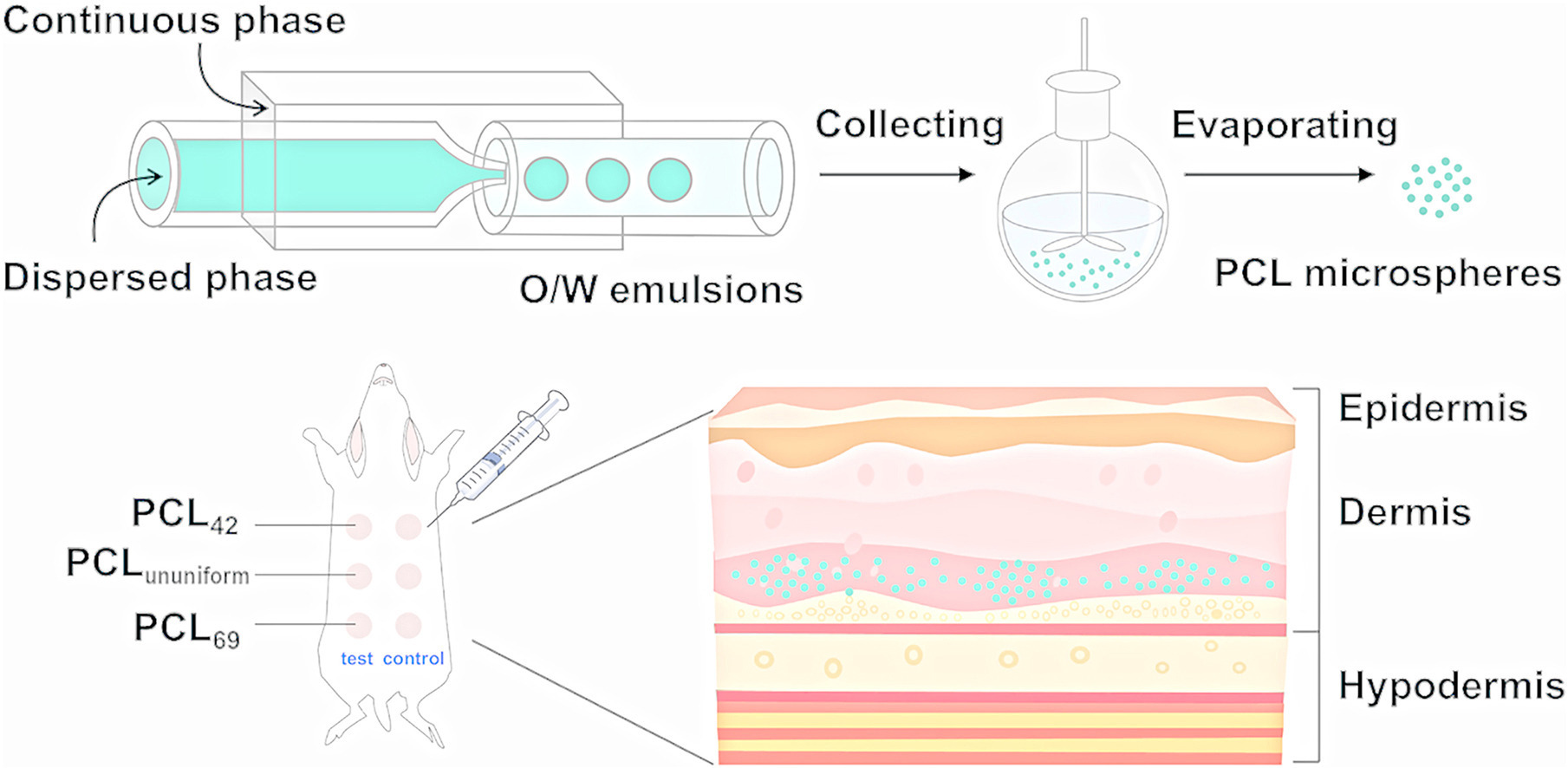
Polycaprolactone (PCL) microspheres are emerging as versatile biomaterials for minimally invasive soft tissue augmentation due to their tunable biodegradability and favorable biocompatibility. Nevertheless, the extent to which monodispersity governs the functional performance of PCL microspheres, particularly in modulating host tissue responses and regenerative efficacy, remains poorly understood. Herein, we propose a method to controllably prepare monodisperse oil-in-water (O/W) droplet templates using coaxial flow-focusing microfluidics, and then obtaining monodisperse PCL microspheres with programmable sizes via solvent evaporation. The droplet dimensions are inversely regulated by the outer-to-inner phase flow rate ratio, while PCL concentration in the organic phase exerts minimal influence on initial droplet size but markedly reduces the volume shrinkage during solidification, yielding microspheres that better retain their geometries. Notably, the resultant PCL microspheres can maintain structural integrity and size uniformity over two-month period under physiologically mimetic conditions. Comprehensive biocompatibility assessments reveal that PCL microspheres exhibit negligible hemolytic activity and cytotoxicity, demonstrating excellent hemocompatibility and cytocompatibility. Notably, in a rabbit soft tissue implantation model, monodisperse PCL microspheres with an average diameter of 42 μm elicit attenuated foreign body reactions and potentiate endogenous collagen deposition relative to the polydisperse microsphere control group. These results provide useful guidance for the application of PCL microspheres in soft tissue augmentation.
Graphical abstract
Keywords
Polycaprolactone; Microfluidics; Monodisperse microspheres; Collagen regeneration
文章导读