
期刊文章
过刊浏览
- Volumes 108-119 (2025)
-
Volumes 96-107 (2025)
-
Volume 107
Pages 1-376 (December 2025)
-
Volume 106
Pages 1-336 (November 2025)
-
Volume 105
Pages 1-356 (October 2025)
-
Volume 104
Pages 1-332 (September 2025)
-
Volume 103
Pages 1-314 (August 2025)
-
Volume 102
Pages 1-276 (July 2025)
-
Volume 101
Pages 1-166 (June 2025)
-
Volume 100
Pages 1-256 (May 2025)
-
Volume 99
Pages 1-242 (April 2025)
-
Volume 98
Pages 1-288 (March 2025)
-
Volume 97
Pages 1-256 (February 2025)
-
Volume 96
Pages 1-340 (January 2025)
-
Volume 107
-
Volumes 84-95 (2024)
-
Volume 95
Pages 1-392 (December 2024)
-
Volume 94
Pages 1-400 (November 2024)
-
Volume 93
Pages 1-376 (October 2024)
-
Volume 92
Pages 1-316 (September 2024)
-
Volume 91
Pages 1-378 (August 2024)
-
Volume 90
Pages 1-580 (July 2024)
-
Volume 89
Pages 1-278 (June 2024)
-
Volume 88
Pages 1-350 (May 2024)
-
Volume 87
Pages 1-338 (April 2024)
-
Volume 86
Pages 1-312 (March 2024)
-
Volume 85
Pages 1-334 (February 2024)
-
Volume 84
Pages 1-308 (January 2024)
-
Volume 95
-
Volumes 72-83 (2023)
-
Volume 83
Pages 1-258 (December 2023)
-
Volume 82
Pages 1-204 (November 2023)
-
Volume 81
Pages 1-188 (October 2023)
-
Volume 80
Pages 1-202 (September 2023)
-
Volume 79
Pages 1-172 (August 2023)
-
Volume 78
Pages 1-146 (July 2023)
-
Volume 77
Pages 1-152 (June 2023)
-
Volume 76
Pages 1-176 (May 2023)
-
Volume 75
Pages 1-228 (April 2023)
-
Volume 74
Pages 1-200 (March 2023)
-
Volume 73
Pages 1-138 (February 2023)
-
Volume 72
Pages 1-144 (January 2023)
-
Volume 83
-
Volumes 60-71 (2022)
-
Volume 71
Pages 1-108 (December 2022)
-
Volume 70
Pages 1-106 (November 2022)
-
Volume 69
Pages 1-122 (October 2022)
-
Volume 68
Pages 1-124 (September 2022)
-
Volume 67
Pages 1-102 (August 2022)
-
Volume 66
Pages 1-112 (July 2022)
-
Volume 65
Pages 1-138 (June 2022)
-
Volume 64
Pages 1-186 (May 2022)
-
Volume 63
Pages 1-124 (April 2022)
-
Volume 62
Pages 1-104 (March 2022)
-
Volume 61
Pages 1-120 (February 2022)
-
Volume 60
Pages 1-124 (January 2022)
-
Volume 71
- Volumes 54-59 (2021)
- Volumes 48-53 (2020)
- Volumes 42-47 (2019)
- Volumes 36-41 (2018)
- Volumes 30-35 (2017)
- Volumes 24-29 (2016)
- Volumes 18-23 (2015)
- Volumes 12-17 (2014)
- Volume 11 (2013)
- Volume 10 (2012)
- Volume 9 (2011)
- Volume 8 (2010)
- Volume 7 (2009)
- Volume 6 (2008)
- Volume 5 (2007)
- Volume 4 (2006)
- Volume 3 (2005)
- Volume 2 (2004)
- Volume 1 (2003)
Volume 115
Akbas, S., Mezhericher, M., Hoffmann, T., Razorenov, N., Pan, Z., & Tsotsas, E. (2026). Fine-tuning particle coatings: A comparative study of liquid atomization methods in fluidized bed processes. Particuology, 115, 91-105. https://doi.org/10.1016/j.partic.2026.05.008
Fine-tuning particle coatings: A comparative study of liquid atomization methods in fluidized bed processes (Open Access)
Serap Akbas a *, Maksim Mezhericher b, Torsten Hoffmann a, Nikolay Razorenov c, Zehao Pan b, Evangelos Tsotsas a
a Thermal Process Engineering, Otto von Guericke University, Universitätsplatz 2, 39106, Magdeburg, Germany
b Mechanical and Aerospace Engineering, Princeton University, Princeton, NJ, 08544, USA
c Mechanical Engineering, Shamoon College of Engineering, Beer Sheva, 84100, Israel
10.1016/j.partic.2026.05.008
Volume 115,
August 2026,
Pages 91-105
Received 17 July 2025, Revised 27 April 2026, Accepted 12 May 2026, Available online 21 May 2026, Version of Record 27 May 2026.
E-mail:
serap.akbas@ovgu.de
Highlights
• A newly developed three-channel coaxial nozzle was applied in fluidized bed particle coating.
• The new nozzle generates droplets ∼10 μm, bridging the gap between aerosol generators and conventional nozzles.
• Non-porous glass and porous γ-Al2O3 particles were coated using an aqueous sodium benzoate solution.
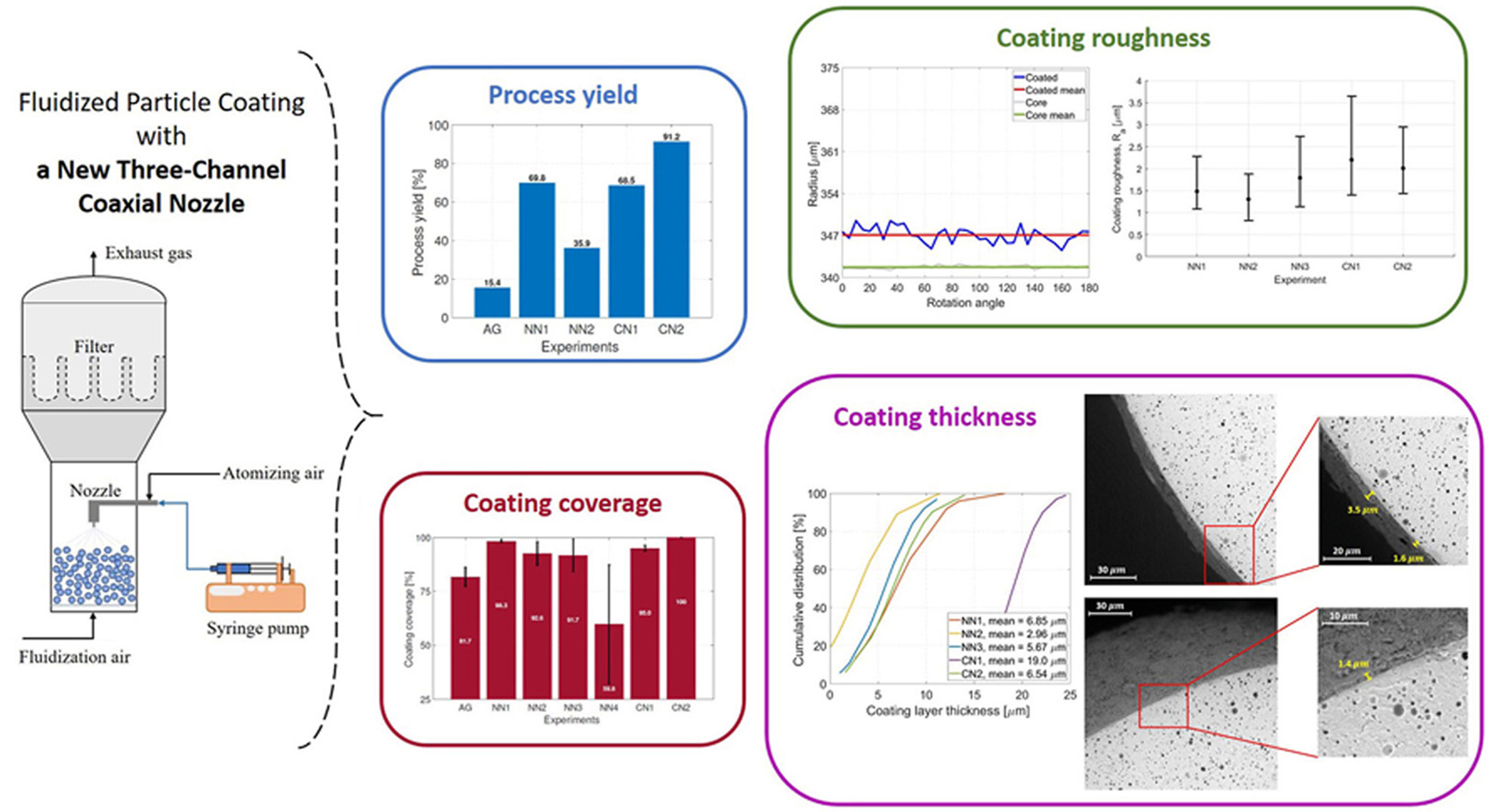
• Process yield, coating coverage, coating thickness, and surface roughness were evaluated.
• The new nozzle shows strong potential as an alternative to conventional nozzles by producing finer droplets.
Abstract
This study compares the performance of a new three-channel coaxial nozzle with a conventional Schlick nozzle in fluidized bed particle coating. The new nozzle produces droplets with a Sauter mean diameter of around 10 μm, offering a middle ground between aerosol and conventional nozzles. Yields of processes, coating coverages of particles, coating thickness and surface roughness were compared for the same experimental conditions of these nozzles. Non-porous glass particles (mean diameter 653 μm) and porous γ-Al2O3 particles (mean diameter 610 μm) were used as cores, with an aqueous sodium benzoate (NaB) solution as the coating liquid. A scanning electron microscope (SEM) was utilized to capture images of the particles after each experiment. To analyze the coverage on the particle surfaces, MATLAB image processing was applied to SEM images of coated particles. Moreover, these images were used to determine the surface roughness of the coating. In addition to manual measurements of coating thickness on particles by image processing, some coated γ-Al2O3 particles were sectioned to measure the coating thickness by ImageJ. The manual thickness measurements were supplemented by results obtained by laser scattering. The coating process by means of the new nozzle was also compared with an aerosol coating process which has droplet size with a mean diameter of around 1 μm, in terms of process yield, product coating coverage and thickness. The new nozzle acts as an intermediate between the aerosol generator and the conventional Schlick nozzle in terms of droplet size. These findings suggest that the new nozzle has significant potential for use in fluidized particle coating, as an alternative to conventional nozzle, offering smaller droplet size.
Graphical abstract
Keywords
Fluidized bed; Coating particles; Atomization; Process yield; Coverage; Layer thickness; Coating surface roughness
文章导读