
期刊文章
过刊浏览
- Volumes 108-119 (2025)
-
Volumes 96-107 (2025)
-
Volume 107
Pages 1-376 (December 2025)
-
Volume 106
Pages 1-336 (November 2025)
-
Volume 105
Pages 1-356 (October 2025)
-
Volume 104
Pages 1-332 (September 2025)
-
Volume 103
Pages 1-314 (August 2025)
-
Volume 102
Pages 1-276 (July 2025)
-
Volume 101
Pages 1-166 (June 2025)
-
Volume 100
Pages 1-256 (May 2025)
-
Volume 99
Pages 1-242 (April 2025)
-
Volume 98
Pages 1-288 (March 2025)
-
Volume 97
Pages 1-256 (February 2025)
-
Volume 96
Pages 1-340 (January 2025)
-
Volume 107
-
Volumes 84-95 (2024)
-
Volume 95
Pages 1-392 (December 2024)
-
Volume 94
Pages 1-400 (November 2024)
-
Volume 93
Pages 1-376 (October 2024)
-
Volume 92
Pages 1-316 (September 2024)
-
Volume 91
Pages 1-378 (August 2024)
-
Volume 90
Pages 1-580 (July 2024)
-
Volume 89
Pages 1-278 (June 2024)
-
Volume 88
Pages 1-350 (May 2024)
-
Volume 87
Pages 1-338 (April 2024)
-
Volume 86
Pages 1-312 (March 2024)
-
Volume 85
Pages 1-334 (February 2024)
-
Volume 84
Pages 1-308 (January 2024)
-
Volume 95
-
Volumes 72-83 (2023)
-
Volume 83
Pages 1-258 (December 2023)
-
Volume 82
Pages 1-204 (November 2023)
-
Volume 81
Pages 1-188 (October 2023)
-
Volume 80
Pages 1-202 (September 2023)
-
Volume 79
Pages 1-172 (August 2023)
-
Volume 78
Pages 1-146 (July 2023)
-
Volume 77
Pages 1-152 (June 2023)
-
Volume 76
Pages 1-176 (May 2023)
-
Volume 75
Pages 1-228 (April 2023)
-
Volume 74
Pages 1-200 (March 2023)
-
Volume 73
Pages 1-138 (February 2023)
-
Volume 72
Pages 1-144 (January 2023)
-
Volume 83
-
Volumes 60-71 (2022)
-
Volume 71
Pages 1-108 (December 2022)
-
Volume 70
Pages 1-106 (November 2022)
-
Volume 69
Pages 1-122 (October 2022)
-
Volume 68
Pages 1-124 (September 2022)
-
Volume 67
Pages 1-102 (August 2022)
-
Volume 66
Pages 1-112 (July 2022)
-
Volume 65
Pages 1-138 (June 2022)
-
Volume 64
Pages 1-186 (May 2022)
-
Volume 63
Pages 1-124 (April 2022)
-
Volume 62
Pages 1-104 (March 2022)
-
Volume 61
Pages 1-120 (February 2022)
-
Volume 60
Pages 1-124 (January 2022)
-
Volume 71
- Volumes 54-59 (2021)
- Volumes 48-53 (2020)
- Volumes 42-47 (2019)
- Volumes 36-41 (2018)
- Volumes 30-35 (2017)
- Volumes 24-29 (2016)
- Volumes 18-23 (2015)
- Volumes 12-17 (2014)
- Volume 11 (2013)
- Volume 10 (2012)
- Volume 9 (2011)
- Volume 8 (2010)
- Volume 7 (2009)
- Volume 6 (2008)
- Volume 5 (2007)
- Volume 4 (2006)
- Volume 3 (2005)
- Volume 2 (2004)
- Volume 1 (2003)
Volume 115
Yang, S.-J., Yue, A.-L., Yuan, H., Xu, M.-X., Zuo, Z.-H., Wu, D.-C., . . . Huang, J.-Q. (2026). Unveiling the size-dependent electro-chemo-mechanical failure mechanisms of silicon anodes in sulfide-based all-solid-state batteries. Particuology, 115, 118-125. https://doi.org/10.1016/j.partic.2026.04.028
Unveiling the size-dependent electro-chemo-mechanical failure mechanisms of silicon anodes in sulfide-based all-solid-state batteries
Shi-Jie Yang a b 1, Ao-Long Yue a b 1, Hong Yuan a b c *, Ming-Xuan Xu a b, Zi-Hao Zuo a b, Di-Chen Wu b c, Yao-Hui Zhu b c, Chen Ling a b, Jia-Qi Huang a b c *
a School of Materials Science & Engineering, Beijing Institute of Technology, Beijing, 100081, China
b School of Interdisciplinary Science, Beijing Institute of Technology, Beijing, 100081, China
c School of Interdisciplinary Science, Beijing Institute of Technology, Zhuhai, 519088, China
10.1016/j.partic.2026.04.028
Volume 115,
August 2026,
Pages 118-125
Received 2 April 2026, Revised 28 April 2026, Accepted 29 April 2026, Available online 20 May 2026, Version of Record 29 May 2026.
E-mail:
yuanhong@bit.edu.cn; jqhuang@bit.edu.cn
Highlights
• Electrochemical performance of Si-anodes with different particle sizes.
• Establishing the interfacial structural evolution of Si anodes.
• Unveiling the electro-chemo-mechanical failure mechanisms of Si anodes.
Abstract
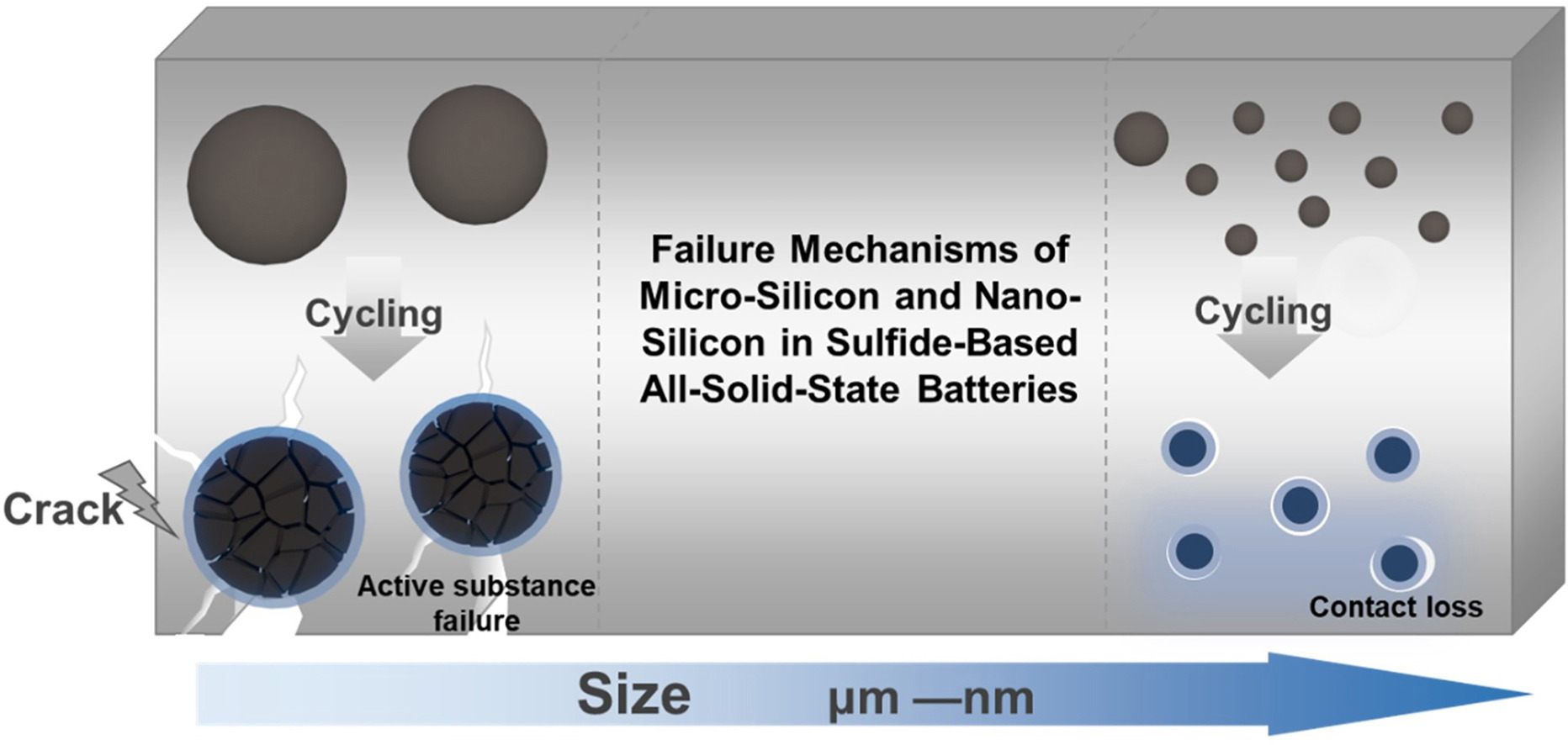
High-capacity silicon anodes hold great promise for safe and energy-dense all-solid-state lithium batteries (ASSLBs), yet their practical application is hindered by interfacial degradation and mechanical fracture, which severely limit their cycle life. Herein, we unravel the particle-size-dependent electro-chemo-mechanical failure mechanisms of Si anodes in sulfide-based ASSLBs. The micro-sized Si (μm-Si) anode exhibits favorable initial Coulombic efficiency (ICE, 79.15%) and reversible capacity (2260.5 mAh g−1) but succumbs to progressive particle fracture under prolonged cycling due to cumulative mechanical stress from large volume swings. By contrast, the nano-sized Si (nm-Si) anode suffers from severe interfacial side reactions and irreversible volume expansion due to its larger specific area and dense electrode structure, resulting in lower initial performance (ICE of 72.21%, 1372.7 mAh g−1). In subsequent cycles, the nm-Si anode experiences continuous interfacial side reactions, leading to substantial accumulation of interfacial decomposition byproducts and sustained capacity decay. These contrasting failure pathways establish electro-chemo-mechanical coupling as the governing principle and provide a particle-size-dependent design framework for high-performance Si-based ASSLBs.
Graphical abstract
Keywords
All-solid-state batteries; Silicon anode; Failure mechanisms; Particle size; Solid electrolyte interphase
文章导读