
期刊文章
过刊浏览
- Volumes 108-119 (2025)
-
Volumes 96-107 (2025)
-
Volume 107
Pages 1-376 (December 2025)
-
Volume 106
Pages 1-336 (November 2025)
-
Volume 105
Pages 1-356 (October 2025)
-
Volume 104
Pages 1-332 (September 2025)
-
Volume 103
Pages 1-314 (August 2025)
-
Volume 102
Pages 1-276 (July 2025)
-
Volume 101
Pages 1-166 (June 2025)
-
Volume 100
Pages 1-256 (May 2025)
-
Volume 99
Pages 1-242 (April 2025)
-
Volume 98
Pages 1-288 (March 2025)
-
Volume 97
Pages 1-256 (February 2025)
-
Volume 96
Pages 1-340 (January 2025)
-
Volume 107
-
Volumes 84-95 (2024)
-
Volume 95
Pages 1-392 (December 2024)
-
Volume 94
Pages 1-400 (November 2024)
-
Volume 93
Pages 1-376 (October 2024)
-
Volume 92
Pages 1-316 (September 2024)
-
Volume 91
Pages 1-378 (August 2024)
-
Volume 90
Pages 1-580 (July 2024)
-
Volume 89
Pages 1-278 (June 2024)
-
Volume 88
Pages 1-350 (May 2024)
-
Volume 87
Pages 1-338 (April 2024)
-
Volume 86
Pages 1-312 (March 2024)
-
Volume 85
Pages 1-334 (February 2024)
-
Volume 84
Pages 1-308 (January 2024)
-
Volume 95
-
Volumes 72-83 (2023)
-
Volume 83
Pages 1-258 (December 2023)
-
Volume 82
Pages 1-204 (November 2023)
-
Volume 81
Pages 1-188 (October 2023)
-
Volume 80
Pages 1-202 (September 2023)
-
Volume 79
Pages 1-172 (August 2023)
-
Volume 78
Pages 1-146 (July 2023)
-
Volume 77
Pages 1-152 (June 2023)
-
Volume 76
Pages 1-176 (May 2023)
-
Volume 75
Pages 1-228 (April 2023)
-
Volume 74
Pages 1-200 (March 2023)
-
Volume 73
Pages 1-138 (February 2023)
-
Volume 72
Pages 1-144 (January 2023)
-
Volume 83
-
Volumes 60-71 (2022)
-
Volume 71
Pages 1-108 (December 2022)
-
Volume 70
Pages 1-106 (November 2022)
-
Volume 69
Pages 1-122 (October 2022)
-
Volume 68
Pages 1-124 (September 2022)
-
Volume 67
Pages 1-102 (August 2022)
-
Volume 66
Pages 1-112 (July 2022)
-
Volume 65
Pages 1-138 (June 2022)
-
Volume 64
Pages 1-186 (May 2022)
-
Volume 63
Pages 1-124 (April 2022)
-
Volume 62
Pages 1-104 (March 2022)
-
Volume 61
Pages 1-120 (February 2022)
-
Volume 60
Pages 1-124 (January 2022)
-
Volume 71
- Volumes 54-59 (2021)
- Volumes 48-53 (2020)
- Volumes 42-47 (2019)
- Volumes 36-41 (2018)
- Volumes 30-35 (2017)
- Volumes 24-29 (2016)
- Volumes 18-23 (2015)
- Volumes 12-17 (2014)
- Volume 11 (2013)
- Volume 10 (2012)
- Volume 9 (2011)
- Volume 8 (2010)
- Volume 7 (2009)
- Volume 6 (2008)
- Volume 5 (2007)
- Volume 4 (2006)
- Volume 3 (2005)
- Volume 2 (2004)
- Volume 1 (2003)
Volume 115
Poyraz, B., & Gezgin, A. T. (2026). A DEM-based study of particle-shape effects on compressibility and contact-scale response in idealized granular assemblies. Particuology, 115, 126-147. https://doi.org/10.1016/j.partic.2026.05.010
A DEM-based study of particle-shape effects on compressibility and contact-scale response in idealized granular assemblies
Betül Poyraz, Ahmet Talha Gezgin *
Department of Civil Engineering, Bursa Uludag University, Nilüfer, Bursa, Turkey
10.1016/j.partic.2026.05.010
Volume 115,
August 2026,
Pages 126-147
Received 26 February 2026, Revised 3 May 2026, Accepted 12 May 2026, Available online 22 May 2026, Version of Record 29 May 2026.
E-mail:
ahmettalhagezgin@uludag.edu.tr
Highlights
• A DEM-based comparative framework is used to examine shape-dependent compressibility in idealized granular assemblies.
• Stress-normalized macro- and micro-scale indicators clarify particle-shape effects under different vertical stress levels.
• The normalized macro-scale stiffness response shows a non-monotonic trend with particle shape factor.
• Contact-scale statistics quantify force partitioning, coordination distribution, and local overlap characteristics.
• Shape-dependent compressibility is governed by combined contact-network, force-transfer, and deformation mechanisms.
Abstract
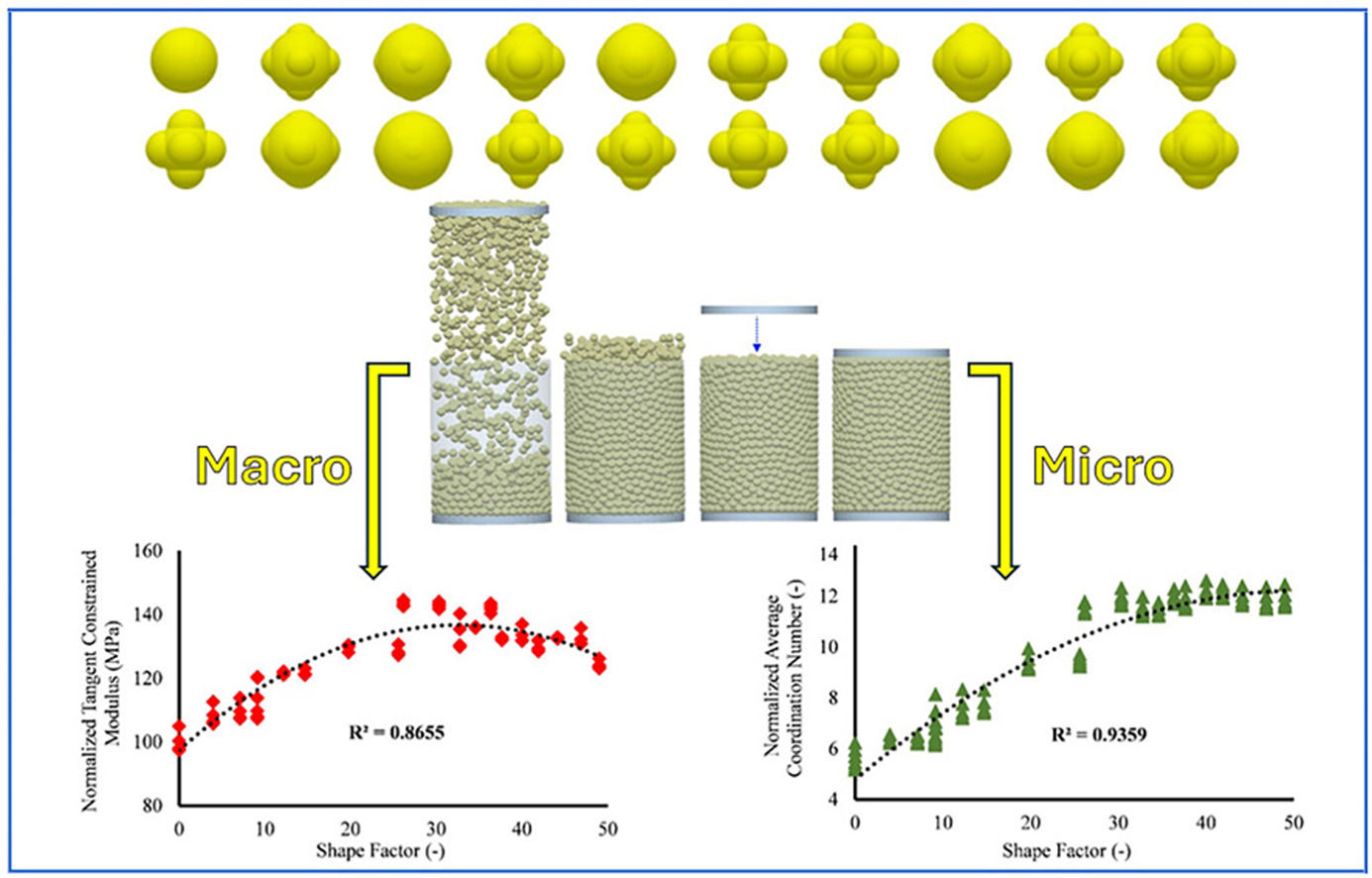
This study employs a benchmarked Discrete Element Method model to investigate the influence of particle shape on the compressibility behavior of granular assemblies within a controlled comparative framework. Twenty idealized particle geometries with different shape characteristics were analyzed under constrained compression at vertical stress levels ranging from 0.1 to 3.2 MPa. Macro- and micro-scale responses were evaluated using constrained modulus and average coordination number, together with additional contact-scale analyses to improve the interpretation of particle-scale behavior. The results indicate that both macro- and micro-scale responses remain strongly stress-dependent, suggesting that conventional indicators alone cannot fully isolate particle-shape effects. A stress-normalized scaling approach was therefore applied to reduce the dominant influence of stress and clarify geometry-related trends. The analyses demonstrate that increasing particle irregularity promotes denser contact networks, redistributes contact forces across more contacts, and alters local deformation mechanisms. The findings provide a comparative DEM-based assessment of shape-dependent compressibility and contact-scale force–deformation behavior in idealized granular assemblies.
Graphical abstract
Keywords
Discrete element modeling; Particle shape; Compressibility; Coordination number; Stress normalization; Contact force
文章导读