
期刊文章
过刊浏览
- Volumes 108-119 (2025)
-
Volumes 96-107 (2025)
-
Volume 107
Pages 1-376 (December 2025)
-
Volume 106
Pages 1-336 (November 2025)
-
Volume 105
Pages 1-356 (October 2025)
-
Volume 104
Pages 1-332 (September 2025)
-
Volume 103
Pages 1-314 (August 2025)
-
Volume 102
Pages 1-276 (July 2025)
-
Volume 101
Pages 1-166 (June 2025)
-
Volume 100
Pages 1-256 (May 2025)
-
Volume 99
Pages 1-242 (April 2025)
-
Volume 98
Pages 1-288 (March 2025)
-
Volume 97
Pages 1-256 (February 2025)
-
Volume 96
Pages 1-340 (January 2025)
-
Volume 107
-
Volumes 84-95 (2024)
-
Volume 95
Pages 1-392 (December 2024)
-
Volume 94
Pages 1-400 (November 2024)
-
Volume 93
Pages 1-376 (October 2024)
-
Volume 92
Pages 1-316 (September 2024)
-
Volume 91
Pages 1-378 (August 2024)
-
Volume 90
Pages 1-580 (July 2024)
-
Volume 89
Pages 1-278 (June 2024)
-
Volume 88
Pages 1-350 (May 2024)
-
Volume 87
Pages 1-338 (April 2024)
-
Volume 86
Pages 1-312 (March 2024)
-
Volume 85
Pages 1-334 (February 2024)
-
Volume 84
Pages 1-308 (January 2024)
-
Volume 95
-
Volumes 72-83 (2023)
-
Volume 83
Pages 1-258 (December 2023)
-
Volume 82
Pages 1-204 (November 2023)
-
Volume 81
Pages 1-188 (October 2023)
-
Volume 80
Pages 1-202 (September 2023)
-
Volume 79
Pages 1-172 (August 2023)
-
Volume 78
Pages 1-146 (July 2023)
-
Volume 77
Pages 1-152 (June 2023)
-
Volume 76
Pages 1-176 (May 2023)
-
Volume 75
Pages 1-228 (April 2023)
-
Volume 74
Pages 1-200 (March 2023)
-
Volume 73
Pages 1-138 (February 2023)
-
Volume 72
Pages 1-144 (January 2023)
-
Volume 83
-
Volumes 60-71 (2022)
-
Volume 71
Pages 1-108 (December 2022)
-
Volume 70
Pages 1-106 (November 2022)
-
Volume 69
Pages 1-122 (October 2022)
-
Volume 68
Pages 1-124 (September 2022)
-
Volume 67
Pages 1-102 (August 2022)
-
Volume 66
Pages 1-112 (July 2022)
-
Volume 65
Pages 1-138 (June 2022)
-
Volume 64
Pages 1-186 (May 2022)
-
Volume 63
Pages 1-124 (April 2022)
-
Volume 62
Pages 1-104 (March 2022)
-
Volume 61
Pages 1-120 (February 2022)
-
Volume 60
Pages 1-124 (January 2022)
-
Volume 71
- Volumes 54-59 (2021)
- Volumes 48-53 (2020)
- Volumes 42-47 (2019)
- Volumes 36-41 (2018)
- Volumes 30-35 (2017)
- Volumes 24-29 (2016)
- Volumes 18-23 (2015)
- Volumes 12-17 (2014)
- Volume 11 (2013)
- Volume 10 (2012)
- Volume 9 (2011)
- Volume 8 (2010)
- Volume 7 (2009)
- Volume 6 (2008)
- Volume 5 (2007)
- Volume 4 (2006)
- Volume 3 (2005)
- Volume 2 (2004)
- Volume 1 (2003)
Volume 115
Sun, L., Zhang, Y., Cao, J., & Xiao, R. (2026). Numerical modelling of reaction behavior for chemical looping hydrogen production system by CPFD. Particuology, 115, 148-156. https://doi.org/10.1016/j.partic.2026.04.010
Numerical modelling of reaction behavior for chemical looping hydrogen production system by CPFD
Liyan Sun a b *, Yuedong Zhang a, Jialei Cao a, Rui Xiao a
a Key Laboratory of Energy Thermal Conversion and Control of Ministry of Education, School of Energy and Environment, Southeast University, Nanjing, 211189, China
b Xinjiang Key Laboratory of High Value Green Utilization of Low-rank Coal, Changji, 831100, China
10.1016/j.partic.2026.04.010
Volume 115,
August 2026,
Pages 148-156
Received 22 January 2026, Revised 4 April 2026, Accepted 13 April 2026, Available online 27 April 2026, Version of Record 29 May 2026.
E-mail:
sunliyan@seu.edu.cn
Highlights
• Numerical simulation of a full-cycle chemical looping hydrogen production system is carried out.
• Inter-reactor cycling characteristics and microscopic details were investigated.
• Results validated the feasibility of CLHP and established references for advancing CLHP.
Abstract
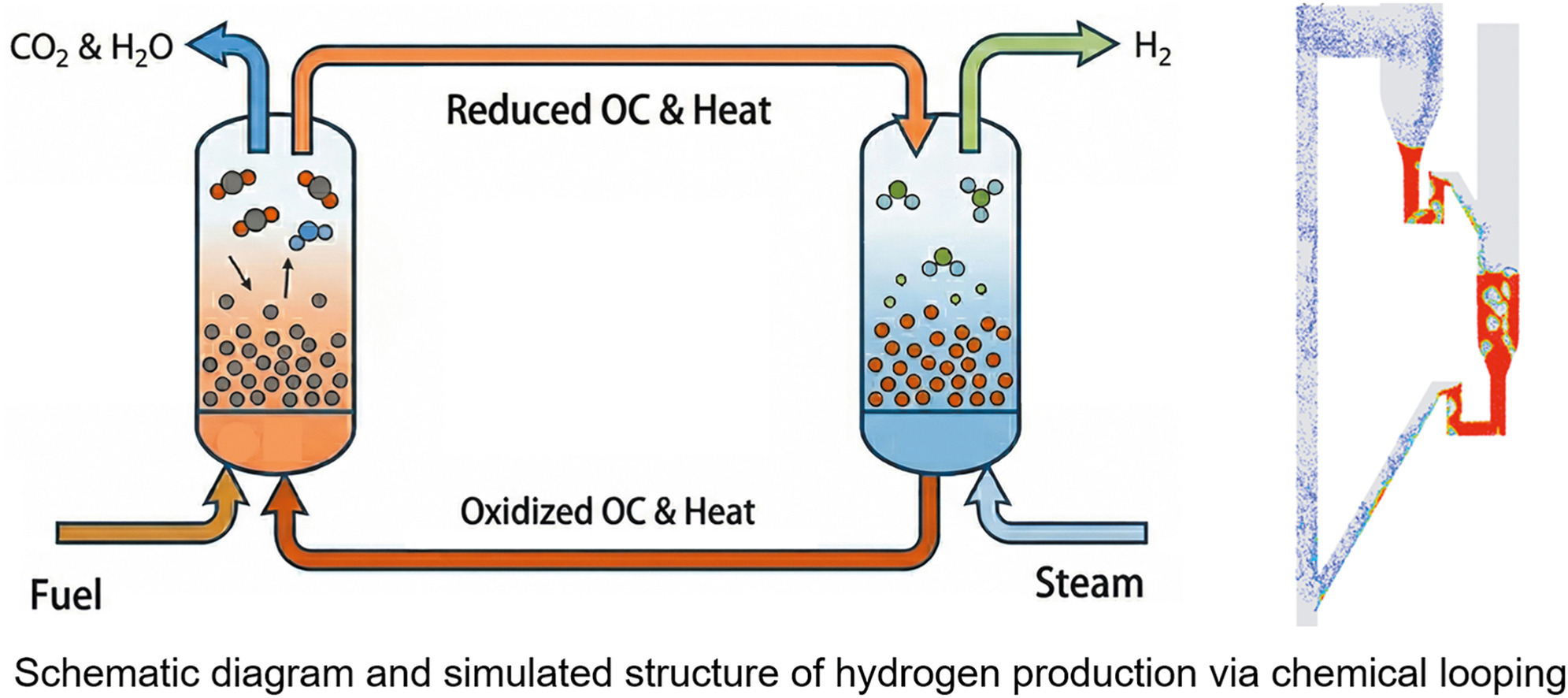
Hydrogen stands as a pivotal energy carrier with significant potential to facilitate the global transition towards a low-carbon energy future. The main challenge in current stage is the production of hydrogen with less emission and high efficiency. To resolve this problem, chemical looping hydrogen production (CLHP) is proposed and investigated. The key factors influencing the efficiency of CLHP are the gas-solid flow, heat transfer and mass transfer processes. A dual-reactor system is established in this work and numerical model based on CPFD is utilised for investigating the reaction characteristics. Hydrogen production decreases with increasing gas velocity in the hydrogen production reactor. Variations in the solid circulation rate alter the mass and heat distribution within the system, consequently affecting the hydrogen production rate. A riser gas velocity of 7 m/s and a circulation rate of 0.15 kg/s are the recommended values for the current constructor. Overall, reactor temperature remains the predominant influencing factor. This study provides insights for reactor optimization and scale-up design.
Graphical abstract
Keywords
Chemical looping hydrogen production; Numerical simulation; CPFD; Reaction behavior
文章导读