
期刊文章
过刊浏览
- Volumes 108-119 (2025)
-
Volumes 96-107 (2025)
-
Volume 107
Pages 1-376 (December 2025)
-
Volume 106
Pages 1-336 (November 2025)
-
Volume 105
Pages 1-356 (October 2025)
-
Volume 104
Pages 1-332 (September 2025)
-
Volume 103
Pages 1-314 (August 2025)
-
Volume 102
Pages 1-276 (July 2025)
-
Volume 101
Pages 1-166 (June 2025)
-
Volume 100
Pages 1-256 (May 2025)
-
Volume 99
Pages 1-242 (April 2025)
-
Volume 98
Pages 1-288 (March 2025)
-
Volume 97
Pages 1-256 (February 2025)
-
Volume 96
Pages 1-340 (January 2025)
-
Volume 107
-
Volumes 84-95 (2024)
-
Volume 95
Pages 1-392 (December 2024)
-
Volume 94
Pages 1-400 (November 2024)
-
Volume 93
Pages 1-376 (October 2024)
-
Volume 92
Pages 1-316 (September 2024)
-
Volume 91
Pages 1-378 (August 2024)
-
Volume 90
Pages 1-580 (July 2024)
-
Volume 89
Pages 1-278 (June 2024)
-
Volume 88
Pages 1-350 (May 2024)
-
Volume 87
Pages 1-338 (April 2024)
-
Volume 86
Pages 1-312 (March 2024)
-
Volume 85
Pages 1-334 (February 2024)
-
Volume 84
Pages 1-308 (January 2024)
-
Volume 95
-
Volumes 72-83 (2023)
-
Volume 83
Pages 1-258 (December 2023)
-
Volume 82
Pages 1-204 (November 2023)
-
Volume 81
Pages 1-188 (October 2023)
-
Volume 80
Pages 1-202 (September 2023)
-
Volume 79
Pages 1-172 (August 2023)
-
Volume 78
Pages 1-146 (July 2023)
-
Volume 77
Pages 1-152 (June 2023)
-
Volume 76
Pages 1-176 (May 2023)
-
Volume 75
Pages 1-228 (April 2023)
-
Volume 74
Pages 1-200 (March 2023)
-
Volume 73
Pages 1-138 (February 2023)
-
Volume 72
Pages 1-144 (January 2023)
-
Volume 83
-
Volumes 60-71 (2022)
-
Volume 71
Pages 1-108 (December 2022)
-
Volume 70
Pages 1-106 (November 2022)
-
Volume 69
Pages 1-122 (October 2022)
-
Volume 68
Pages 1-124 (September 2022)
-
Volume 67
Pages 1-102 (August 2022)
-
Volume 66
Pages 1-112 (July 2022)
-
Volume 65
Pages 1-138 (June 2022)
-
Volume 64
Pages 1-186 (May 2022)
-
Volume 63
Pages 1-124 (April 2022)
-
Volume 62
Pages 1-104 (March 2022)
-
Volume 61
Pages 1-120 (February 2022)
-
Volume 60
Pages 1-124 (January 2022)
-
Volume 71
- Volumes 54-59 (2021)
- Volumes 48-53 (2020)
- Volumes 42-47 (2019)
- Volumes 36-41 (2018)
- Volumes 30-35 (2017)
- Volumes 24-29 (2016)
- Volumes 18-23 (2015)
- Volumes 12-17 (2014)
- Volume 11 (2013)
- Volume 10 (2012)
- Volume 9 (2011)
- Volume 8 (2010)
- Volume 7 (2009)
- Volume 6 (2008)
- Volume 5 (2007)
- Volume 4 (2006)
- Volume 3 (2005)
- Volume 2 (2004)
- Volume 1 (2003)
Volume 115
Chien, T. B., Phu, L. P., Bao, N. C., Thien, N. N., Nghi, T. T. P., Khuong, T. N. P., & Thang, N. H. (2026). Sustainable glass-phase engineering via photovoltaic waste glass for enhanced energy storage in BNT ceramics. Particuology, 115, 174-191. https://doi.org/10.1016/j.partic.2026.05.014
Sustainable glass-phase engineering via photovoltaic waste glass for enhanced energy storage in BNT ceramics
Truong Bach Chien, Le Phong Phu, Nguyen Chi Bao, Nguyen Ngoc Thien, Tran Thi Phuong Nghi, Thach Nguyen Phuc Khuong, Nguyen Hoc Thang *
Faculty of Chemical Engineering, Ho Chi Minh City University of Industry and Trade, 140 Le Trong Tan street, Tay Thanh ward, Ho Chi Minh City, 700000, Viet Nam
10.1016/j.partic.2026.05.014
Volume 115,
August 2026,
Pages 174-191
Received 4 April 2026, Revised 13 May 2026, Accepted 21 May 2026, Available online 26 May 2026, Version of Record 3 June 2026.
E-mail:
thangnh@huit.edu.vn
Highlights
• Photovoltaic waste glass enables sustainable BNT ceramic engineering.
• Dual role of glass phase controls conduction and microstructure.
• Grain boundary modification enhances dielectric breakdown strength.
• High energy density of 1.76 J/cm3 achieved at 220 kV/cm.
• Improved efficiency via reduced remanent polarization.
Abstract
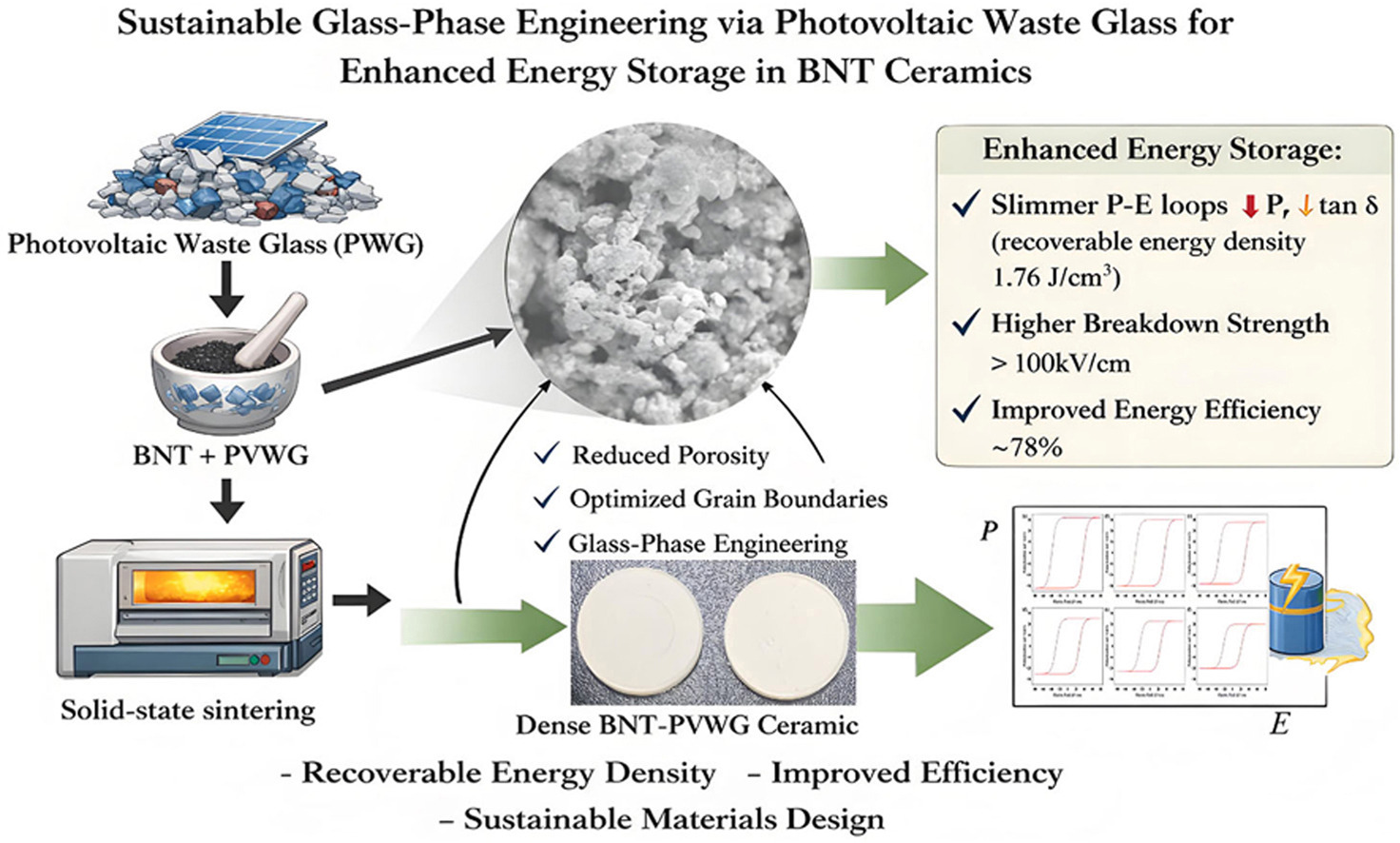
Developing sustainable dielectric ceramics with high energy storage performance under a moderate electric field is still a great challenge for the next generation pulse power capacitors. Herein, recycled photovoltaic waste glass (PVWG) was added into Bi0.5Na0.5TiO3 (BNT)-based lead-free ceramics via a conventional solid-state route and sintered at 1120 °C for 2 h. The PVWG additive facilitated liquid-phase sintering, reduced porosity, promoted grain-boundary homogeneity and improved the dielectric breakdown strength. Therefore, the optimized BNT-08 ceramic exhibits a high relative density of 97.04 ± 0.15 %, a reduced remanent polarization (Pr) of 9.4 ± 0.3 μC cm−2, an increased breakdown strength (Eb ∼220 ± 5 kV cm−1) and a significantly slimmer P-E hysteresis loop. Hence, a recoverable energy density (Wrec) of 1.76 ± 0.07 J cm−3 and an energy storage efficiency of 78 ± 2 % were obtained under a moderate electric field at 220 kV cm−1. The enhanced energy storage performance was ascribed to the synergistic effects of structural stabilization, defect-regulated charge transport, and PVWG-induced microstructural refinement. This simple, low cost and environmentally friendly method demonstrates PVWG as a promising multifunctional additive for electroceramic applications in line with the circular strategy.
Graphical abstract
Keywords
Bi0.5Na0.5TiO3 (BNT); Lead-free ferroelectric ceramic; Piezoelectric; Energy storage; Photovoltaic waste glass (PVWG); Glass-phase engineering
文章导读