
期刊文章
过刊浏览
- Volumes 108-119 (2025)
-
Volumes 96-107 (2025)
-
Volume 107
Pages 1-376 (December 2025)
-
Volume 106
Pages 1-336 (November 2025)
-
Volume 105
Pages 1-356 (October 2025)
-
Volume 104
Pages 1-332 (September 2025)
-
Volume 103
Pages 1-314 (August 2025)
-
Volume 102
Pages 1-276 (July 2025)
-
Volume 101
Pages 1-166 (June 2025)
-
Volume 100
Pages 1-256 (May 2025)
-
Volume 99
Pages 1-242 (April 2025)
-
Volume 98
Pages 1-288 (March 2025)
-
Volume 97
Pages 1-256 (February 2025)
-
Volume 96
Pages 1-340 (January 2025)
-
Volume 107
-
Volumes 84-95 (2024)
-
Volume 95
Pages 1-392 (December 2024)
-
Volume 94
Pages 1-400 (November 2024)
-
Volume 93
Pages 1-376 (October 2024)
-
Volume 92
Pages 1-316 (September 2024)
-
Volume 91
Pages 1-378 (August 2024)
-
Volume 90
Pages 1-580 (July 2024)
-
Volume 89
Pages 1-278 (June 2024)
-
Volume 88
Pages 1-350 (May 2024)
-
Volume 87
Pages 1-338 (April 2024)
-
Volume 86
Pages 1-312 (March 2024)
-
Volume 85
Pages 1-334 (February 2024)
-
Volume 84
Pages 1-308 (January 2024)
-
Volume 95
-
Volumes 72-83 (2023)
-
Volume 83
Pages 1-258 (December 2023)
-
Volume 82
Pages 1-204 (November 2023)
-
Volume 81
Pages 1-188 (October 2023)
-
Volume 80
Pages 1-202 (September 2023)
-
Volume 79
Pages 1-172 (August 2023)
-
Volume 78
Pages 1-146 (July 2023)
-
Volume 77
Pages 1-152 (June 2023)
-
Volume 76
Pages 1-176 (May 2023)
-
Volume 75
Pages 1-228 (April 2023)
-
Volume 74
Pages 1-200 (March 2023)
-
Volume 73
Pages 1-138 (February 2023)
-
Volume 72
Pages 1-144 (January 2023)
-
Volume 83
-
Volumes 60-71 (2022)
-
Volume 71
Pages 1-108 (December 2022)
-
Volume 70
Pages 1-106 (November 2022)
-
Volume 69
Pages 1-122 (October 2022)
-
Volume 68
Pages 1-124 (September 2022)
-
Volume 67
Pages 1-102 (August 2022)
-
Volume 66
Pages 1-112 (July 2022)
-
Volume 65
Pages 1-138 (June 2022)
-
Volume 64
Pages 1-186 (May 2022)
-
Volume 63
Pages 1-124 (April 2022)
-
Volume 62
Pages 1-104 (March 2022)
-
Volume 61
Pages 1-120 (February 2022)
-
Volume 60
Pages 1-124 (January 2022)
-
Volume 71
- Volumes 54-59 (2021)
- Volumes 48-53 (2020)
- Volumes 42-47 (2019)
- Volumes 36-41 (2018)
- Volumes 30-35 (2017)
- Volumes 24-29 (2016)
- Volumes 18-23 (2015)
- Volumes 12-17 (2014)
- Volume 11 (2013)
- Volume 10 (2012)
- Volume 9 (2011)
- Volume 8 (2010)
- Volume 7 (2009)
- Volume 6 (2008)
- Volume 5 (2007)
- Volume 4 (2006)
- Volume 3 (2005)
- Volume 2 (2004)
- Volume 1 (2003)
Volume 115
Zhang, L., Zhang, C., Wang, Z., Zhao, X., Shen, J., & Bai, D. (2026). High-temperature coal gangue-based composites for sustainable thermal energy storage: Characterization and performance assessment. Particuology, 115, 192-201. https://doi.org/10.1016/j.partic.2026.05.015
High-temperature coal gangue-based composites for sustainable thermal energy storage: Characterization and performance assessment
Lei Zhang a, Chenxi Zhang a b *, Zezhong Wang a, Xingbo Zhao a, Jing Shen c, Dingrong Bai a *
a Ordos Laboratory, Ordos, Inner Mongolia, 017010, China
b Beijing Key Laboratory of Green Chemical Reaction Engineering and Technology, Department of Chemical Engineering, Tsinghua University, Beijing, 100084, China
c YanKuang Energy Group Company Limited, Zoucheng, 273500, China
10.1016/j.partic.2026.05.015
Volume 115,
August 2026,
Pages 192-201
Received 4 April 2026, Revised 14 May 2026, Accepted 21 May 2026, Available online 29 May 2026, Version of Record 4 June 2026.
E-mail:
cxzhang@tsinghua.edu.cn; drbai@syuct.edu.cn
Highlights
• Coal gangue can be converted into a sensible heat storage material.
• TES can be made cost-effective using coal-gangue-based materials.
• In-depth characterization relates the TES performance to the material properties.
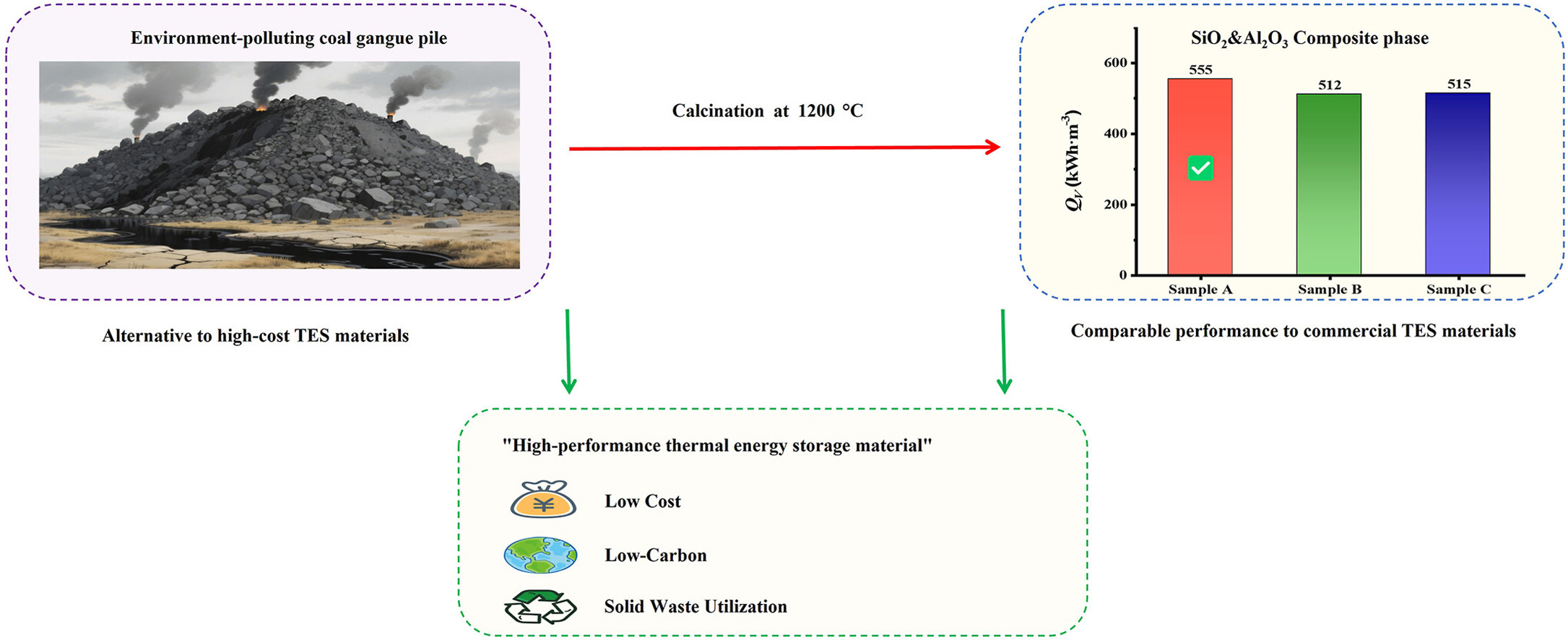
• Coal gangue TES material reaches 555 kWh/m3 of energy storage density at 1200 °C.
Abstract
Thermal energy storage (TES) is a key enabler for the large-scale utilization of intermittent renewable energy sources like solar and wind power, and it also offers an efficient pathway for industrial electrification and decarbonization. However, the widespread adoption of TES is hindered by the high cost of conventional TES materials, such as alumina, magnesium oxide, and other ceramics. This study investigates the feasibility of converting coal gangue, an abundant industrial waste with considerable environmental impact, into a low-cost, mechanically stable, and thermally efficient material for medium-to high-temperature sensible heat storage applications. Three representative coal gangue samples from the Ordos region in Inner Mongolia, China, were calcined at temperatures ranging from 1000 to 1300 °C to optimize their phase compositions, mechanical strengths, and thermophysical properties. Among the samples, Sample A from Jungar exhibited the best overall performance, achieving a volumetric heat storage density of approximately 555 kWh m−3 at 1200 °C, which is comparable to typical sensible heat storage materials, while maintaining good mechanical integrity and satisfactory cyclic stability. With near-zero raw-material cost, a simple single-step preparation process, and potential policy incentives for solid-waste utilization, the coal-gangue-based composites developed here offer clear economic and environmental advantages and introduce a promising, low-cost material system for sustainable TES applications at medium-to high-temperature levels.
Graphical abstract
Keywords
Sensible heat storage materials; Coal gangue; Volumetric heat storage density; Solid waste beneficiation
文章导读