
期刊文章
过刊浏览
- Volumes 108-119 (2025)
-
Volumes 96-107 (2025)
-
Volume 107
Pages 1-376 (December 2025)
-
Volume 106
Pages 1-336 (November 2025)
-
Volume 105
Pages 1-356 (October 2025)
-
Volume 104
Pages 1-332 (September 2025)
-
Volume 103
Pages 1-314 (August 2025)
-
Volume 102
Pages 1-276 (July 2025)
-
Volume 101
Pages 1-166 (June 2025)
-
Volume 100
Pages 1-256 (May 2025)
-
Volume 99
Pages 1-242 (April 2025)
-
Volume 98
Pages 1-288 (March 2025)
-
Volume 97
Pages 1-256 (February 2025)
-
Volume 96
Pages 1-340 (January 2025)
-
Volume 107
-
Volumes 84-95 (2024)
-
Volume 95
Pages 1-392 (December 2024)
-
Volume 94
Pages 1-400 (November 2024)
-
Volume 93
Pages 1-376 (October 2024)
-
Volume 92
Pages 1-316 (September 2024)
-
Volume 91
Pages 1-378 (August 2024)
-
Volume 90
Pages 1-580 (July 2024)
-
Volume 89
Pages 1-278 (June 2024)
-
Volume 88
Pages 1-350 (May 2024)
-
Volume 87
Pages 1-338 (April 2024)
-
Volume 86
Pages 1-312 (March 2024)
-
Volume 85
Pages 1-334 (February 2024)
-
Volume 84
Pages 1-308 (January 2024)
-
Volume 95
-
Volumes 72-83 (2023)
-
Volume 83
Pages 1-258 (December 2023)
-
Volume 82
Pages 1-204 (November 2023)
-
Volume 81
Pages 1-188 (October 2023)
-
Volume 80
Pages 1-202 (September 2023)
-
Volume 79
Pages 1-172 (August 2023)
-
Volume 78
Pages 1-146 (July 2023)
-
Volume 77
Pages 1-152 (June 2023)
-
Volume 76
Pages 1-176 (May 2023)
-
Volume 75
Pages 1-228 (April 2023)
-
Volume 74
Pages 1-200 (March 2023)
-
Volume 73
Pages 1-138 (February 2023)
-
Volume 72
Pages 1-144 (January 2023)
-
Volume 83
-
Volumes 60-71 (2022)
-
Volume 71
Pages 1-108 (December 2022)
-
Volume 70
Pages 1-106 (November 2022)
-
Volume 69
Pages 1-122 (October 2022)
-
Volume 68
Pages 1-124 (September 2022)
-
Volume 67
Pages 1-102 (August 2022)
-
Volume 66
Pages 1-112 (July 2022)
-
Volume 65
Pages 1-138 (June 2022)
-
Volume 64
Pages 1-186 (May 2022)
-
Volume 63
Pages 1-124 (April 2022)
-
Volume 62
Pages 1-104 (March 2022)
-
Volume 61
Pages 1-120 (February 2022)
-
Volume 60
Pages 1-124 (January 2022)
-
Volume 71
- Volumes 54-59 (2021)
- Volumes 48-53 (2020)
- Volumes 42-47 (2019)
- Volumes 36-41 (2018)
- Volumes 30-35 (2017)
- Volumes 24-29 (2016)
- Volumes 18-23 (2015)
- Volumes 12-17 (2014)
- Volume 11 (2013)
- Volume 10 (2012)
- Volume 9 (2011)
- Volume 8 (2010)
- Volume 7 (2009)
- Volume 6 (2008)
- Volume 5 (2007)
- Volume 4 (2006)
- Volume 3 (2005)
- Volume 2 (2004)
- Volume 1 (2003)
Volume 115
Weidemann, M., & Schmidt, E. (2026). Dust release from various small-scale belt conveyor setups discharging into a wind tunnel – experimental investigation using different limestone qualities. Particuology, 115, 202-213. https://doi.org/10.1016/j.partic.2026.05.016
Dust release from various small-scale belt conveyor setups discharging into a wind tunnel – experimental investigation using different limestone qualities (Open Access)
Marcus Weidemann *, Eberhard Schmidt
Institute of Particle Technology, University of Wuppertal, 42119, Wuppertal, Germany
10.1016/j.partic.2026.05.016
Volume 115,
August 2026,
Pages 202-213
Received 28 July 2025, Revised 20 April 2026, Accepted 19 May 2026, Available online 28 May 2026, Version of Record 5 June 2026.
E-mail:
weidemann@uni-wuppertal.de
Highlights
• Different limestone fractions discharged into a wind tunnel from a conveyor belt.
• Coarse material emits dust mainly upon impact on the bulk pile.
• The microscopic mechanism can be described by a literature model, consisting of fine dust-laden coarse particles.
• Fine material emits dust mainly by collision of loose agglomerates while falling.
• The microscopic mechanism can be described by a literature model, which consists of agglomerates breaking upon impact.
Abstract
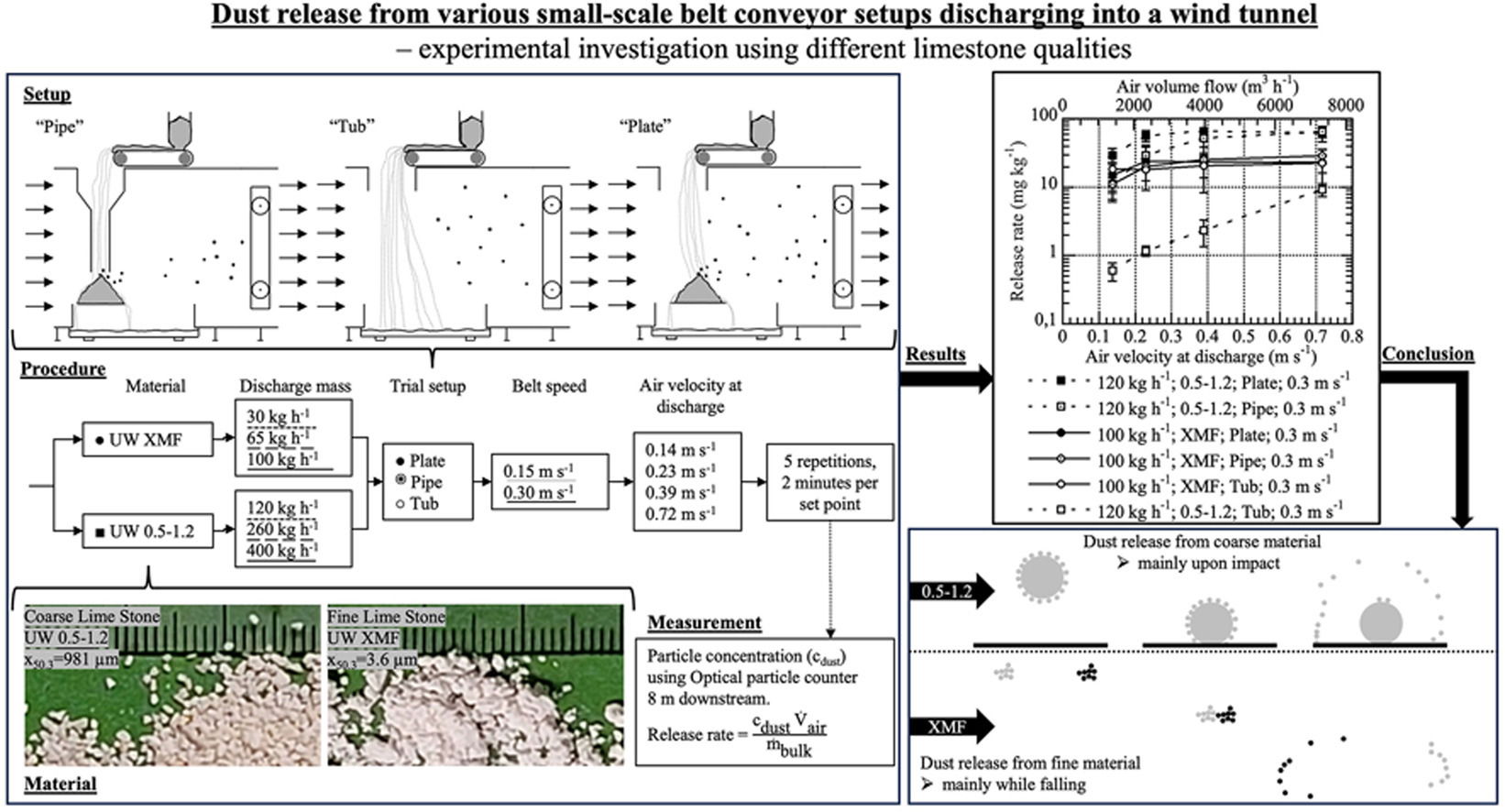
To investigate the release of dust, coarse (x50.3 = 980 μm) and fine (x50.3 = 3.6 μm) limestone was discharged into a wind tunnel using a model conveyor belt. Different test setups were used to measure the dust release in different phases of the discharge. The discharge mass flow, belt speed and wind tunnel air velocity were varied. Systematic differences were found between the two size fractions. The dust release of the fine material mainly takes place during the fall, while the dust release of the coarse material is dominated by the impact on the bulk pile. For the coarse material, a model for the individual release of dust-laden coarse material particles from the literature can be used as an explanatory approach. A different explanatory approach is required to describe the release of dust from the fine material.
Graphical abstract
Keywords
Dust; Dust release; Bulk material handling; Belt conveyor; Discharge
文章导读