
期刊文章
过刊浏览
- Volumes 108-119 (2025)
-
Volumes 96-107 (2025)
-
Volume 107
Pages 1-376 (December 2025)
-
Volume 106
Pages 1-336 (November 2025)
-
Volume 105
Pages 1-356 (October 2025)
-
Volume 104
Pages 1-332 (September 2025)
-
Volume 103
Pages 1-314 (August 2025)
-
Volume 102
Pages 1-276 (July 2025)
-
Volume 101
Pages 1-166 (June 2025)
-
Volume 100
Pages 1-256 (May 2025)
-
Volume 99
Pages 1-242 (April 2025)
-
Volume 98
Pages 1-288 (March 2025)
-
Volume 97
Pages 1-256 (February 2025)
-
Volume 96
Pages 1-340 (January 2025)
-
Volume 107
-
Volumes 84-95 (2024)
-
Volume 95
Pages 1-392 (December 2024)
-
Volume 94
Pages 1-400 (November 2024)
-
Volume 93
Pages 1-376 (October 2024)
-
Volume 92
Pages 1-316 (September 2024)
-
Volume 91
Pages 1-378 (August 2024)
-
Volume 90
Pages 1-580 (July 2024)
-
Volume 89
Pages 1-278 (June 2024)
-
Volume 88
Pages 1-350 (May 2024)
-
Volume 87
Pages 1-338 (April 2024)
-
Volume 86
Pages 1-312 (March 2024)
-
Volume 85
Pages 1-334 (February 2024)
-
Volume 84
Pages 1-308 (January 2024)
-
Volume 95
-
Volumes 72-83 (2023)
-
Volume 83
Pages 1-258 (December 2023)
-
Volume 82
Pages 1-204 (November 2023)
-
Volume 81
Pages 1-188 (October 2023)
-
Volume 80
Pages 1-202 (September 2023)
-
Volume 79
Pages 1-172 (August 2023)
-
Volume 78
Pages 1-146 (July 2023)
-
Volume 77
Pages 1-152 (June 2023)
-
Volume 76
Pages 1-176 (May 2023)
-
Volume 75
Pages 1-228 (April 2023)
-
Volume 74
Pages 1-200 (March 2023)
-
Volume 73
Pages 1-138 (February 2023)
-
Volume 72
Pages 1-144 (January 2023)
-
Volume 83
-
Volumes 60-71 (2022)
-
Volume 71
Pages 1-108 (December 2022)
-
Volume 70
Pages 1-106 (November 2022)
-
Volume 69
Pages 1-122 (October 2022)
-
Volume 68
Pages 1-124 (September 2022)
-
Volume 67
Pages 1-102 (August 2022)
-
Volume 66
Pages 1-112 (July 2022)
-
Volume 65
Pages 1-138 (June 2022)
-
Volume 64
Pages 1-186 (May 2022)
-
Volume 63
Pages 1-124 (April 2022)
-
Volume 62
Pages 1-104 (March 2022)
-
Volume 61
Pages 1-120 (February 2022)
-
Volume 60
Pages 1-124 (January 2022)
-
Volume 71
- Volumes 54-59 (2021)
- Volumes 48-53 (2020)
- Volumes 42-47 (2019)
- Volumes 36-41 (2018)
- Volumes 30-35 (2017)
- Volumes 24-29 (2016)
- Volumes 18-23 (2015)
- Volumes 12-17 (2014)
- Volume 11 (2013)
- Volume 10 (2012)
- Volume 9 (2011)
- Volume 8 (2010)
- Volume 7 (2009)
- Volume 6 (2008)
- Volume 5 (2007)
- Volume 4 (2006)
- Volume 3 (2005)
- Volume 2 (2004)
- Volume 1 (2003)
Volume 115
Li, M., Zhang, F., Zirwes, T., Stein, O. T., Tavakkol, S., & Stapf, D. (2026). Numerical simulation of plastic pyrolysis in fluidized bed reactors under continuous and batch-wise feeding. Particuology, 115, 214-227. https://doi.org/10.1016/j.partic.2026.05.017
Numerical simulation of plastic pyrolysis in fluidized bed reactors under continuous and batch-wise feeding (Open Access)
Muhao Li a, Feichi Zhang a *, Thorsten Zirwes b, Oliver T. Stein c, Salar Tavakkol a *, Dieter Stapf a
a Institute for Technical Chemistry (ITC), Karlsruhe Institute of Technology (KIT), Kaiserstr.12, 76131, Karlsruhe, Germany
b Institute for Reactive Flows, University of Stuttgart, Pfaffenwaldring 31, 70569, Stuttgart, Germany
c Engler-Bunte-Institute (EBI), Division for Combustion Technology, Karlsruhe Institute of Technology (KIT), Engler-Bunte-Ring 7, 76131, Karlsruhe, Germany
10.1016/j.partic.2026.05.017
Volume 115,
August 2026,
Pages 214-227
Received 29 November 2025, Revised 7 May 2026, Accepted 25 May 2026, Available online 1 June 2026, Version of Record 6 June 2026.
E-mail:
feichi.zhang@kit.edu; salar.tavakkol@kit.edu
Highlights
• Eulerian–Lagrangian CFD solver developed for plastic pyrolysis in fluidized bed reactors.
• Lumped kinetics and particle-scale heat transfer integrated for product yield prediction.
• Baseline modeling framework for plastic pyrolysis in fluidized bed reactors.
• Stronger thermal inhomogeneity during the first 10 s for batch-wise feeding.
• Similar final product selectivity for both batch-wise and continuous feeding.
Abstract
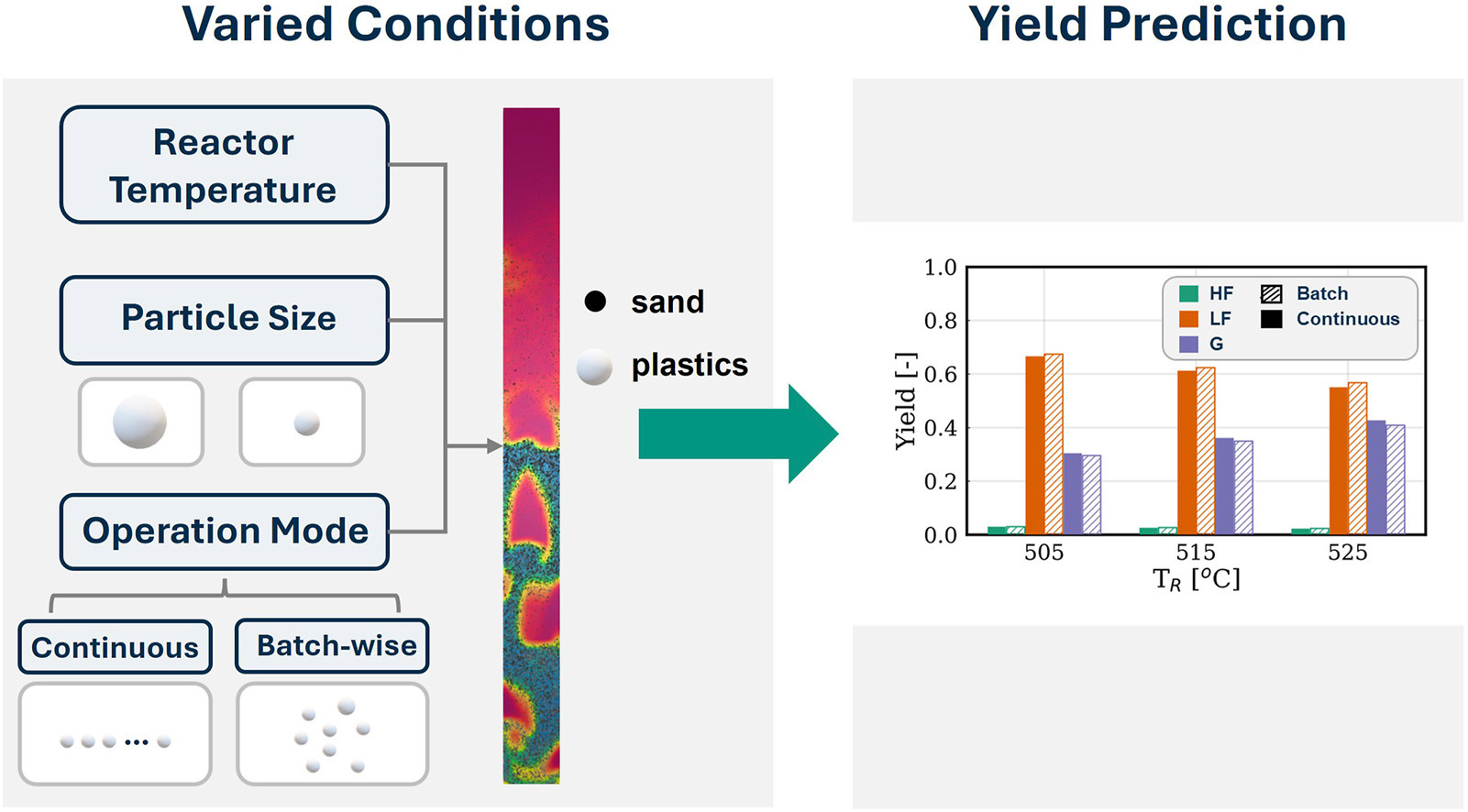
Numerical simulations were conducted to study the pyrolysis of polypropylene (PP) in a fluidized bed reactor (FBR). For that purpose, a Eulerian–Lagrangian solver was developed, incorporating the gas–solid hydrodynamics in FBR, particle-level heat transfer, and a five-lump pyrolysis reaction kinetic model. This framework captures the mutual interplay among these physicochemical processes and enables predicting the yields of permanent gas (G), light fraction (LF), and heavy fraction (HF). Analysis of the characteristic timescales confirms that the pyrolysis reaction is significantly slower than convective heat transfer. At 505 °C, LF was the dominant product (67.4 wt%), followed by G (29.6 wt%) and HF (3 wt%), and the product distribution significantly shifted toward G formation with increasing reactor temperature. In contrast, variations in particle size (1.5–2.5 mm) and operation mode (batch-wise vs. continuous) affected the transient thermal behavior but had minor effects on product yields, as heat transfer is not rate-determining under the investigated conditions.
Graphical abstract
Keywords
Eulerian–Lagrangian; Plastic pyrolysis; Fluidized bed reactor; Chemical recycling
文章导读