
期刊文章
过刊浏览
- Volumes 108-119 (2025)
-
Volumes 96-107 (2025)
-
Volume 107
Pages 1-376 (December 2025)
-
Volume 106
Pages 1-336 (November 2025)
-
Volume 105
Pages 1-356 (October 2025)
-
Volume 104
Pages 1-332 (September 2025)
-
Volume 103
Pages 1-314 (August 2025)
-
Volume 102
Pages 1-276 (July 2025)
-
Volume 101
Pages 1-166 (June 2025)
-
Volume 100
Pages 1-256 (May 2025)
-
Volume 99
Pages 1-242 (April 2025)
-
Volume 98
Pages 1-288 (March 2025)
-
Volume 97
Pages 1-256 (February 2025)
-
Volume 96
Pages 1-340 (January 2025)
-
Volume 107
-
Volumes 84-95 (2024)
-
Volume 95
Pages 1-392 (December 2024)
-
Volume 94
Pages 1-400 (November 2024)
-
Volume 93
Pages 1-376 (October 2024)
-
Volume 92
Pages 1-316 (September 2024)
-
Volume 91
Pages 1-378 (August 2024)
-
Volume 90
Pages 1-580 (July 2024)
-
Volume 89
Pages 1-278 (June 2024)
-
Volume 88
Pages 1-350 (May 2024)
-
Volume 87
Pages 1-338 (April 2024)
-
Volume 86
Pages 1-312 (March 2024)
-
Volume 85
Pages 1-334 (February 2024)
-
Volume 84
Pages 1-308 (January 2024)
-
Volume 95
-
Volumes 72-83 (2023)
-
Volume 83
Pages 1-258 (December 2023)
-
Volume 82
Pages 1-204 (November 2023)
-
Volume 81
Pages 1-188 (October 2023)
-
Volume 80
Pages 1-202 (September 2023)
-
Volume 79
Pages 1-172 (August 2023)
-
Volume 78
Pages 1-146 (July 2023)
-
Volume 77
Pages 1-152 (June 2023)
-
Volume 76
Pages 1-176 (May 2023)
-
Volume 75
Pages 1-228 (April 2023)
-
Volume 74
Pages 1-200 (March 2023)
-
Volume 73
Pages 1-138 (February 2023)
-
Volume 72
Pages 1-144 (January 2023)
-
Volume 83
-
Volumes 60-71 (2022)
-
Volume 71
Pages 1-108 (December 2022)
-
Volume 70
Pages 1-106 (November 2022)
-
Volume 69
Pages 1-122 (October 2022)
-
Volume 68
Pages 1-124 (September 2022)
-
Volume 67
Pages 1-102 (August 2022)
-
Volume 66
Pages 1-112 (July 2022)
-
Volume 65
Pages 1-138 (June 2022)
-
Volume 64
Pages 1-186 (May 2022)
-
Volume 63
Pages 1-124 (April 2022)
-
Volume 62
Pages 1-104 (March 2022)
-
Volume 61
Pages 1-120 (February 2022)
-
Volume 60
Pages 1-124 (January 2022)
-
Volume 71
- Volumes 54-59 (2021)
- Volumes 48-53 (2020)
- Volumes 42-47 (2019)
- Volumes 36-41 (2018)
- Volumes 30-35 (2017)
- Volumes 24-29 (2016)
- Volumes 18-23 (2015)
- Volumes 12-17 (2014)
- Volume 11 (2013)
- Volume 10 (2012)
- Volume 9 (2011)
- Volume 8 (2010)
- Volume 7 (2009)
- Volume 6 (2008)
- Volume 5 (2007)
- Volume 4 (2006)
- Volume 3 (2005)
- Volume 2 (2004)
- Volume 1 (2003)
Volume 115
Luo, W., & Fan, F. (2026). Effect of rotational motion on inertial migration of a neutrally buoyant rigid sphere in circular Poiseuille flow. Particuology, 115, 228-237. https://doi.org/10.1016/j.partic.2026.05.013
Effect of rotational motion on inertial migration of a neutrally buoyant rigid sphere in circular Poiseuille flow
Weile Luo a, Fengxian Fan a b *
a School of Energy and Power Engineering, University of Shanghai for Science and Technology, Shanghai, 200093, China
b Shanghai Key Laboratory of Multiphase Flow and Heat Transfer in Power Engineering, University of Shanghai for Science and Technology, Shanghai, 200093, China
10.1016/j.partic.2026.05.013
Volume 115,
August 2026,
Pages 228-237
Received 12 February 2026, Revised 24 April 2026, Accepted 12 May 2026, Available online 1 June 2026, Version of Record 9 June 2026.
E-mail:
fanfengxian@usst.edu.cn
Highlights
• Fully resolved CFD–DEM simulations reveal rotation effects on inertial migration.
• Suppressing rotation consistently shifts equilibrium position toward pipe centerline.
• Migration dynamics alteration due to rotation suppression depends on initial position.
• Non-rotating spheres remain in monotonic regime, unlike freely rotating spheres.
• Suppressing rotation increases entry length required for full inertial migration.
Abstract
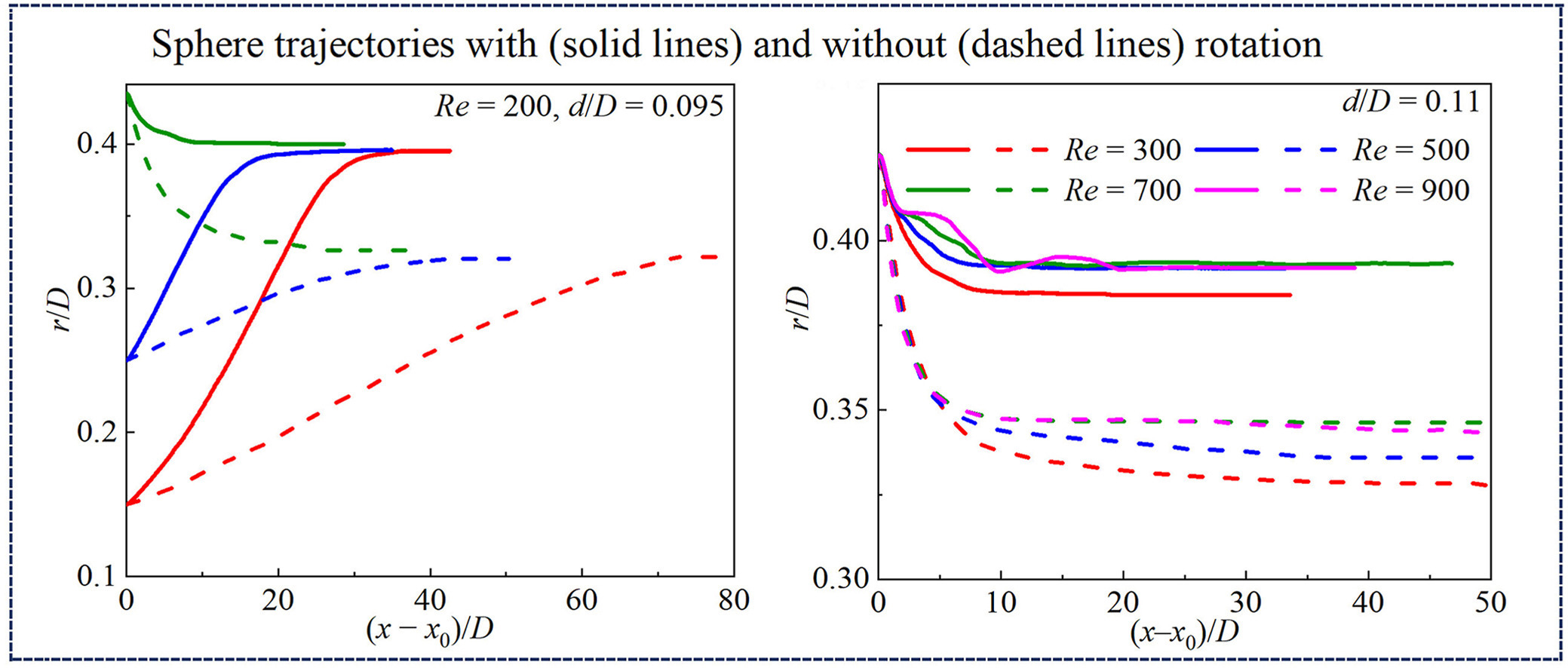
Inertial migration of a neutrally buoyant rigid sphere in circular Poiseuille flow is strongly affected by particle rotation, yet its role remains poorly understood. This study employs three-dimensional fully-resolved CFD–DEM simulations to investigate inertial migration with and without particle rotation. The model is validated against experimental equilibrium radial positions. Simulation results reveal that suppressing rotation consistently shifts the equilibrium radial position toward the pipe centerline, but rotation's effect on the migration dynamics depends on the sphere's initial radial position. When rotation is suppressed, radial migration accelerates for the sphere released near the pipe wall, whereas radial migration slows for the sphere released closer to the centerline. While the freely rotating spheres experience a transition between different migration regimes as the sphere-to-pipe diameter ratio or the fluid Reynolds number increases, non-rotating spheres remain in the monotonic regime since they stabilize closer to the pipe centerline where both shear-gradient and wall-induced lift forces vanish. Moreover, suppressing rotation increases the entry length required for the sphere to achieve full migration. This study elucidates how particle rotation affects inertial migration and offers new insights into rotation-modulated lateral migration in microfluidics.
Graphical abstract
Keywords
Particle-laden flow; CFD–DEM; Inertial migration; Microfluidics
文章导读