
期刊文章
过刊浏览
- Volumes 108-119 (2025)
-
Volumes 96-107 (2025)
-
Volume 107
Pages 1-376 (December 2025)
-
Volume 106
Pages 1-336 (November 2025)
-
Volume 105
Pages 1-356 (October 2025)
-
Volume 104
Pages 1-332 (September 2025)
-
Volume 103
Pages 1-314 (August 2025)
-
Volume 102
Pages 1-276 (July 2025)
-
Volume 101
Pages 1-166 (June 2025)
-
Volume 100
Pages 1-256 (May 2025)
-
Volume 99
Pages 1-242 (April 2025)
-
Volume 98
Pages 1-288 (March 2025)
-
Volume 97
Pages 1-256 (February 2025)
-
Volume 96
Pages 1-340 (January 2025)
-
Volume 107
-
Volumes 84-95 (2024)
-
Volume 95
Pages 1-392 (December 2024)
-
Volume 94
Pages 1-400 (November 2024)
-
Volume 93
Pages 1-376 (October 2024)
-
Volume 92
Pages 1-316 (September 2024)
-
Volume 91
Pages 1-378 (August 2024)
-
Volume 90
Pages 1-580 (July 2024)
-
Volume 89
Pages 1-278 (June 2024)
-
Volume 88
Pages 1-350 (May 2024)
-
Volume 87
Pages 1-338 (April 2024)
-
Volume 86
Pages 1-312 (March 2024)
-
Volume 85
Pages 1-334 (February 2024)
-
Volume 84
Pages 1-308 (January 2024)
-
Volume 95
-
Volumes 72-83 (2023)
-
Volume 83
Pages 1-258 (December 2023)
-
Volume 82
Pages 1-204 (November 2023)
-
Volume 81
Pages 1-188 (October 2023)
-
Volume 80
Pages 1-202 (September 2023)
-
Volume 79
Pages 1-172 (August 2023)
-
Volume 78
Pages 1-146 (July 2023)
-
Volume 77
Pages 1-152 (June 2023)
-
Volume 76
Pages 1-176 (May 2023)
-
Volume 75
Pages 1-228 (April 2023)
-
Volume 74
Pages 1-200 (March 2023)
-
Volume 73
Pages 1-138 (February 2023)
-
Volume 72
Pages 1-144 (January 2023)
-
Volume 83
-
Volumes 60-71 (2022)
-
Volume 71
Pages 1-108 (December 2022)
-
Volume 70
Pages 1-106 (November 2022)
-
Volume 69
Pages 1-122 (October 2022)
-
Volume 68
Pages 1-124 (September 2022)
-
Volume 67
Pages 1-102 (August 2022)
-
Volume 66
Pages 1-112 (July 2022)
-
Volume 65
Pages 1-138 (June 2022)
-
Volume 64
Pages 1-186 (May 2022)
-
Volume 63
Pages 1-124 (April 2022)
-
Volume 62
Pages 1-104 (March 2022)
-
Volume 61
Pages 1-120 (February 2022)
-
Volume 60
Pages 1-124 (January 2022)
-
Volume 71
- Volumes 54-59 (2021)
- Volumes 48-53 (2020)
- Volumes 42-47 (2019)
- Volumes 36-41 (2018)
- Volumes 30-35 (2017)
- Volumes 24-29 (2016)
- Volumes 18-23 (2015)
- Volumes 12-17 (2014)
- Volume 11 (2013)
- Volume 10 (2012)
- Volume 9 (2011)
- Volume 8 (2010)
- Volume 7 (2009)
- Volume 6 (2008)
- Volume 5 (2007)
- Volume 4 (2006)
- Volume 3 (2005)
- Volume 2 (2004)
- Volume 1 (2003)
Volume 115
Shi, L., Hu, Z., Li, H., Lin, B., Tan, Y., & Deng, Y. (2026). Influence of RAP content on the mesostructure and mechanical response of recycled asphalt mixtures. Particuology, 115, 238-255. https://doi.org/10.1016/j.partic.2026.05.019
Influence of RAP content on the mesostructure and mechanical response of recycled asphalt mixtures
Liwan Shi a, Zhiyong Hu b *, Hao Li c, Bohuang Lin d, Youwei Tan c, Yi Deng a
a School of Civil Engineering and Transportation, Foshan University, 528225, Foshan, China
b Wuhan Qingchuan University, 430204, Wuhan, China
c Foshan Transportation Technology Tiannuo (Guangdong) Materials Co., Ltd, 528000, Foshan, China
d National Engineering Laboratory of Highway Maintenance Technology, School of Traffic and Transportation Engineering, Changsha University of Science & Technology, 410114, Changsha, China
10.1016/j.partic.2026.05.019
Volume 115,
August 2026,
Pages 238-255
Received 13 February 2026, Revised 18 May 2026, Accepted 23 May 2026, Available online 4 June 2026, Version of Record 10 June 2026.
E-mail:
390496593@qq.com
Highlights
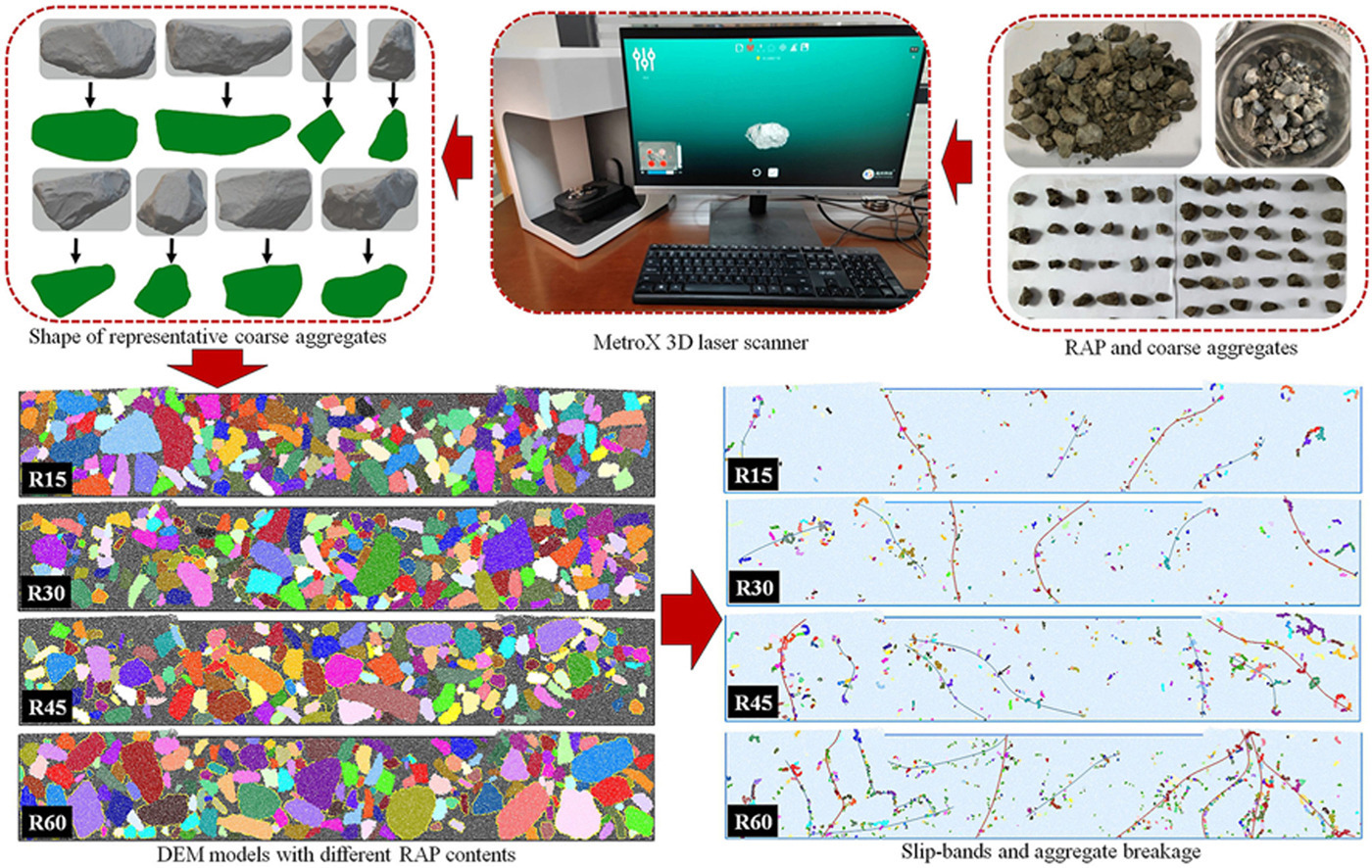
• DEM models with crushable coarse aggregates were developed to accurately distinguish new aggregates and RAP.
• Stress characteristics in different regions and among various meso-structure components were analyzed.
• The concept and characteristics of slip-band structures in recycled asphalt mixtures were defined.
• The evolution laws of slip-bands and aggregate breakage with different RAP contents were revealed.
Abstract
The road performance of recycled asphalt pavement (RAP) is crucial for low-carbon road construction. However, existing studies lack refined simulation of the mesostructure involving RAP, new aggregates, aged asphalt, and new asphalt, leaving the effects of different RAP contents on stress distribution and damage mechanisms unclear. This study develops discrete element models to analyze the influence of RAP content on mesoscopic stress evolution, crack propagation, and aggregate breakage. The results show that when RAP content exceeds 45%, aged asphalt and RAP exhibit notably non-uniform distributions. The maximum normal stress occurs at the loading center, while the maximum shear stress is located at the bottom sides of the loading center. As RAP content rises from 15 % to 60 %, the number of effective microcracks increases by 2.04 times. The length and area of slip-bands grows rapidly, and the crack damage index D follows an exponential upward trend. Considering rutting resistance, crack resistance, and resource utilization efficiency comprehensively, the recommended suitable RAP content range is 30 % – 45 %, with the following threshold values: number of slip-bands≤8, average length of slip-bands≤48 mm, and D ≤ 7.5 %. The findings provide a theoretical basis for understanding the meso-mechanical behavior of recycled asphalt mixtures.
Graphical abstract
Keywords
Recycled asphalt mixture; Discrete element method; Stress distribution; Microcrack; Aggregate breakage
文章导读