
期刊文章
过刊浏览
- Volumes 108-119 (2025)
-
Volumes 96-107 (2025)
-
Volume 107
Pages 1-376 (December 2025)
-
Volume 106
Pages 1-336 (November 2025)
-
Volume 105
Pages 1-356 (October 2025)
-
Volume 104
Pages 1-332 (September 2025)
-
Volume 103
Pages 1-314 (August 2025)
-
Volume 102
Pages 1-276 (July 2025)
-
Volume 101
Pages 1-166 (June 2025)
-
Volume 100
Pages 1-256 (May 2025)
-
Volume 99
Pages 1-242 (April 2025)
-
Volume 98
Pages 1-288 (March 2025)
-
Volume 97
Pages 1-256 (February 2025)
-
Volume 96
Pages 1-340 (January 2025)
-
Volume 107
-
Volumes 84-95 (2024)
-
Volume 95
Pages 1-392 (December 2024)
-
Volume 94
Pages 1-400 (November 2024)
-
Volume 93
Pages 1-376 (October 2024)
-
Volume 92
Pages 1-316 (September 2024)
-
Volume 91
Pages 1-378 (August 2024)
-
Volume 90
Pages 1-580 (July 2024)
-
Volume 89
Pages 1-278 (June 2024)
-
Volume 88
Pages 1-350 (May 2024)
-
Volume 87
Pages 1-338 (April 2024)
-
Volume 86
Pages 1-312 (March 2024)
-
Volume 85
Pages 1-334 (February 2024)
-
Volume 84
Pages 1-308 (January 2024)
-
Volume 95
-
Volumes 72-83 (2023)
-
Volume 83
Pages 1-258 (December 2023)
-
Volume 82
Pages 1-204 (November 2023)
-
Volume 81
Pages 1-188 (October 2023)
-
Volume 80
Pages 1-202 (September 2023)
-
Volume 79
Pages 1-172 (August 2023)
-
Volume 78
Pages 1-146 (July 2023)
-
Volume 77
Pages 1-152 (June 2023)
-
Volume 76
Pages 1-176 (May 2023)
-
Volume 75
Pages 1-228 (April 2023)
-
Volume 74
Pages 1-200 (March 2023)
-
Volume 73
Pages 1-138 (February 2023)
-
Volume 72
Pages 1-144 (January 2023)
-
Volume 83
-
Volumes 60-71 (2022)
-
Volume 71
Pages 1-108 (December 2022)
-
Volume 70
Pages 1-106 (November 2022)
-
Volume 69
Pages 1-122 (October 2022)
-
Volume 68
Pages 1-124 (September 2022)
-
Volume 67
Pages 1-102 (August 2022)
-
Volume 66
Pages 1-112 (July 2022)
-
Volume 65
Pages 1-138 (June 2022)
-
Volume 64
Pages 1-186 (May 2022)
-
Volume 63
Pages 1-124 (April 2022)
-
Volume 62
Pages 1-104 (March 2022)
-
Volume 61
Pages 1-120 (February 2022)
-
Volume 60
Pages 1-124 (January 2022)
-
Volume 71
- Volumes 54-59 (2021)
- Volumes 48-53 (2020)
- Volumes 42-47 (2019)
- Volumes 36-41 (2018)
- Volumes 30-35 (2017)
- Volumes 24-29 (2016)
- Volumes 18-23 (2015)
- Volumes 12-17 (2014)
- Volume 11 (2013)
- Volume 10 (2012)
- Volume 9 (2011)
- Volume 8 (2010)
- Volume 7 (2009)
- Volume 6 (2008)
- Volume 5 (2007)
- Volume 4 (2006)
- Volume 3 (2005)
- Volume 2 (2004)
- Volume 1 (2003)
Volume 115
Cai, R., Rukh, M., Jones, A., Brody, L., Pierce, A., Shahrak, M. N., . . . Li, F. (2026). Isothermal sorption-enhanced biomass gasification for hydrogen-rich syngas production using SrMnO3 redox-activated CO2 sorbents in a fluidized bed. Particuology, 115, 256-266. https://doi.org/10.1016/j.partic.2026.05.018
Isothermal sorption-enhanced biomass gasification for hydrogen-rich syngas production using SrMnO3 redox-activated CO2 sorbents in a fluidized bed (Open Access)
Runxia Cai a 1 2, Mahe Rukh a 1, Andrew Jones b, Leo Brody a, Alexandra Pierce a, Mahdi Niknam Shahrak a, Stephen Kelly b, Sunkyu Park b *, Fanxing Li a *
a Department of Chemical and Biomolecular Engineering, North Carolina State University, Raleigh, NC 27695-7905, USA
b Department of Forest Biomaterials, North Carolina State University, Raleigh, NC 27695-7905, USA
10.1016/j.partic.2026.05.018
Volume 115,
August 2026,
Pages 256-266
Received 8 April 2026, Revised 22 May 2026, Accepted 24 May 2026, Available online 29 May 2026, Version of Record 10 June 2026.
E-mail:
spark@ncsu.edu; fli5@ncsu.edu
Highlights
• Redox-active sorbent enables isothermal sorption enhanced steam gasification (SESG).
• Isothermal SESG leads to six-fold increase in H2 yield.
• SrMnO3-δ shows excellent cyclic stability and ash tolerance.
• SESG improves cold gas efficiency with better syngas quality.
Abstract
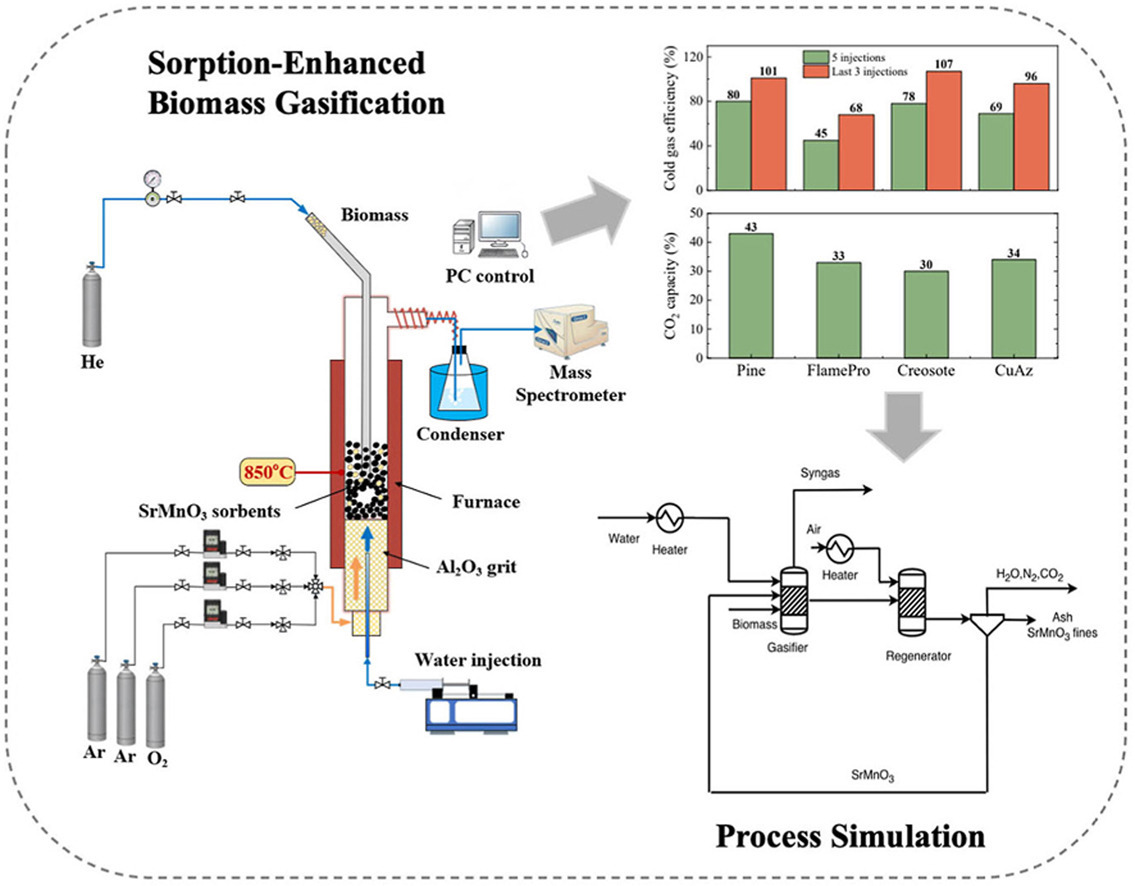
Sorption-enhanced steam gasification (SESG) represents a promising route for hydrogen-rich syngas production. However, the rapid deactivation of conventional CaO-based sorbents, and the efficiency loss associated with the high temperature sorbent regeneration step, remain as critical challenges. In this study, a redox-activated SrMnO3 sorbent was used for isothermal SESG of biomass in a fluidized-bed to investigate fuel flexibility, torrefaction effects, and long-term stability. Four biomass feedstocks as well as their torrefied counterparts were evaluated. All untreated feedstocks produced hydrogen-rich syngas with H2 concentration >60% and H2/CO ratios >4 under isothermal operation at 850 °C. Torrefaction decreased H2 purity and syngas yield due to reduced volatile matter content. Long-term experiments in both a fluidized-bed reactor and TGA demonstrated excellent cyclic stability of SrMnO3 and strong ash resistance. The structural and compositional properties of the sorbents were characterized in detail, confirming the chemical and structural stability of the SrMnO3 sorbent during prolonged cyclic operation. Process simulation further showed that SESG of biomass significantly enhanced cold gas efficiency while maintaining a comparable heat demand compared to state-of-the-art indirect biomass gasification. Overall, SrMnO3 exhibits strong potential as a robust sorbent for efficient and flexible biomass-to-hydrogen conversion.
Graphical abstract
Keywords
Gasification; Hydrogen; Sorbent; Carbon dioxide; Fluidized bed
文章导读