
期刊文章
过刊浏览
- Volumes 108-119 (2025)
-
Volumes 96-107 (2025)
-
Volume 107
Pages 1-376 (December 2025)
-
Volume 106
Pages 1-336 (November 2025)
-
Volume 105
Pages 1-356 (October 2025)
-
Volume 104
Pages 1-332 (September 2025)
-
Volume 103
Pages 1-314 (August 2025)
-
Volume 102
Pages 1-276 (July 2025)
-
Volume 101
Pages 1-166 (June 2025)
-
Volume 100
Pages 1-256 (May 2025)
-
Volume 99
Pages 1-242 (April 2025)
-
Volume 98
Pages 1-288 (March 2025)
-
Volume 97
Pages 1-256 (February 2025)
-
Volume 96
Pages 1-340 (January 2025)
-
Volume 107
-
Volumes 84-95 (2024)
-
Volume 95
Pages 1-392 (December 2024)
-
Volume 94
Pages 1-400 (November 2024)
-
Volume 93
Pages 1-376 (October 2024)
-
Volume 92
Pages 1-316 (September 2024)
-
Volume 91
Pages 1-378 (August 2024)
-
Volume 90
Pages 1-580 (July 2024)
-
Volume 89
Pages 1-278 (June 2024)
-
Volume 88
Pages 1-350 (May 2024)
-
Volume 87
Pages 1-338 (April 2024)
-
Volume 86
Pages 1-312 (March 2024)
-
Volume 85
Pages 1-334 (February 2024)
-
Volume 84
Pages 1-308 (January 2024)
-
Volume 95
-
Volumes 72-83 (2023)
-
Volume 83
Pages 1-258 (December 2023)
-
Volume 82
Pages 1-204 (November 2023)
-
Volume 81
Pages 1-188 (October 2023)
-
Volume 80
Pages 1-202 (September 2023)
-
Volume 79
Pages 1-172 (August 2023)
-
Volume 78
Pages 1-146 (July 2023)
-
Volume 77
Pages 1-152 (June 2023)
-
Volume 76
Pages 1-176 (May 2023)
-
Volume 75
Pages 1-228 (April 2023)
-
Volume 74
Pages 1-200 (March 2023)
-
Volume 73
Pages 1-138 (February 2023)
-
Volume 72
Pages 1-144 (January 2023)
-
Volume 83
-
Volumes 60-71 (2022)
-
Volume 71
Pages 1-108 (December 2022)
-
Volume 70
Pages 1-106 (November 2022)
-
Volume 69
Pages 1-122 (October 2022)
-
Volume 68
Pages 1-124 (September 2022)
-
Volume 67
Pages 1-102 (August 2022)
-
Volume 66
Pages 1-112 (July 2022)
-
Volume 65
Pages 1-138 (June 2022)
-
Volume 64
Pages 1-186 (May 2022)
-
Volume 63
Pages 1-124 (April 2022)
-
Volume 62
Pages 1-104 (March 2022)
-
Volume 61
Pages 1-120 (February 2022)
-
Volume 60
Pages 1-124 (January 2022)
-
Volume 71
- Volumes 54-59 (2021)
- Volumes 48-53 (2020)
- Volumes 42-47 (2019)
- Volumes 36-41 (2018)
- Volumes 30-35 (2017)
- Volumes 24-29 (2016)
- Volumes 18-23 (2015)
- Volumes 12-17 (2014)
- Volume 11 (2013)
- Volume 10 (2012)
- Volume 9 (2011)
- Volume 8 (2010)
- Volume 7 (2009)
- Volume 6 (2008)
- Volume 5 (2007)
- Volume 4 (2006)
- Volume 3 (2005)
- Volume 2 (2004)
- Volume 1 (2003)
Volume 115
Yin, H., Xuan, Y., & Liu, J. (2026). Studies on desorption features of a shrinking hydrogel particle. Particuology, 115, 267-276. https://doi.org/10.1016/j.partic.2026.05.020
Studies on desorption features of a shrinking hydrogel particle
Huining Yin, Yimin Xuan *, Jingrui Liu
School of Energy and Power Engineering, Nanjing University of Aeronautics and Astronautics, Nanjing, 210016, China
10.1016/j.partic.2026.05.020
Volume 115,
August 2026,
Pages 267-276
Received 3 March 2026, Revised 5 May 2026, Accepted 28 May 2026, Available online 6 June 2026, Version of Record 11 June 2026.
E-mail:
ymxuan@nuaa.edu.cn
Highlights
• A model with shrinkage deformation is developed for desorption prediction.
• The model uniquely couples multiphase flow, heat/mass transfer, and phase change.
• The model accurately predicts hydrogel desorption kinetics and shrinkage.
Abstract
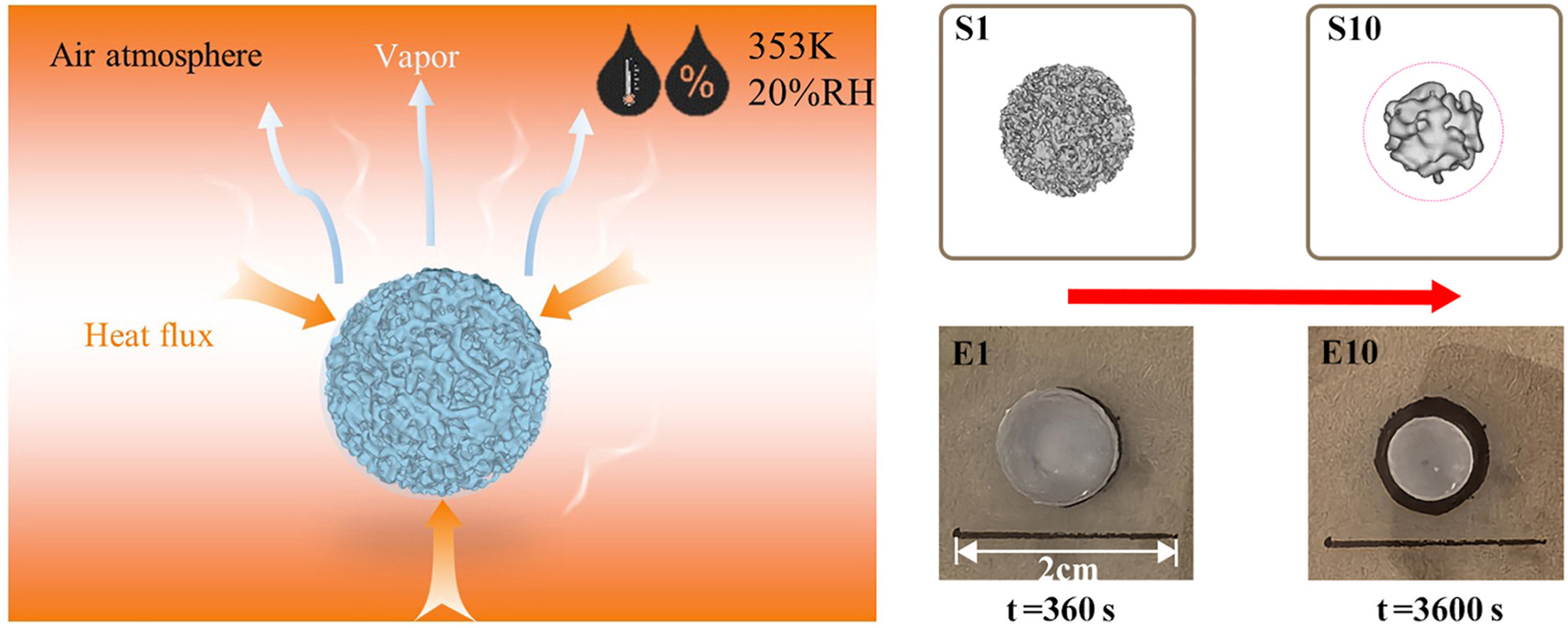
Hydrogel desorption shows promise for thermal management and passive cooling engineering applications, but challenges persist in understanding particle desorption and shrinkage. A Lattice Boltzmann-based phase-field model was developed by combining experiments and mesoscopic simulations to simulate conjugate heat transfer, desorption kinetics, and shrinkage of single hydrogel particles, achieving <5% deviation from experiments. Results show that raising temperature from 343 to 353 K increases 1-h desorption mass by ∼12% of initial mass (vs. 1.3% for 313–323 K), driven by rising saturation vapor pressure and falling evaporation enthalpy. Shrinkage is more sensitive at high temperature and low humidity, with surface area reductions of ∼17% (343–353 K) and ∼13% (20–30% RH), compared to ∼5% under mild conditions. Reducing particle initial mass from 5.75 g to 0.16 g shortens the time to release 50% of the initial water from 516 min to 117 min, indicating greater efficiency for smaller particles. This work bridges the macro-pore scale gap and offers a numerical tool with design insights for passive cooling.
Graphical abstract
Keywords
Desorption; Hydrogel particle; Lattice Boltzmann method; Shrinkage deformation; Heat and mass transfer
文章导读