
期刊文章
过刊浏览
- Volumes 108-119 (2025)
-
Volumes 96-107 (2025)
-
Volume 107
Pages 1-376 (December 2025)
-
Volume 106
Pages 1-336 (November 2025)
-
Volume 105
Pages 1-356 (October 2025)
-
Volume 104
Pages 1-332 (September 2025)
-
Volume 103
Pages 1-314 (August 2025)
-
Volume 102
Pages 1-276 (July 2025)
-
Volume 101
Pages 1-166 (June 2025)
-
Volume 100
Pages 1-256 (May 2025)
-
Volume 99
Pages 1-242 (April 2025)
-
Volume 98
Pages 1-288 (March 2025)
-
Volume 97
Pages 1-256 (February 2025)
-
Volume 96
Pages 1-340 (January 2025)
-
Volume 107
-
Volumes 84-95 (2024)
-
Volume 95
Pages 1-392 (December 2024)
-
Volume 94
Pages 1-400 (November 2024)
-
Volume 93
Pages 1-376 (October 2024)
-
Volume 92
Pages 1-316 (September 2024)
-
Volume 91
Pages 1-378 (August 2024)
-
Volume 90
Pages 1-580 (July 2024)
-
Volume 89
Pages 1-278 (June 2024)
-
Volume 88
Pages 1-350 (May 2024)
-
Volume 87
Pages 1-338 (April 2024)
-
Volume 86
Pages 1-312 (March 2024)
-
Volume 85
Pages 1-334 (February 2024)
-
Volume 84
Pages 1-308 (January 2024)
-
Volume 95
-
Volumes 72-83 (2023)
-
Volume 83
Pages 1-258 (December 2023)
-
Volume 82
Pages 1-204 (November 2023)
-
Volume 81
Pages 1-188 (October 2023)
-
Volume 80
Pages 1-202 (September 2023)
-
Volume 79
Pages 1-172 (August 2023)
-
Volume 78
Pages 1-146 (July 2023)
-
Volume 77
Pages 1-152 (June 2023)
-
Volume 76
Pages 1-176 (May 2023)
-
Volume 75
Pages 1-228 (April 2023)
-
Volume 74
Pages 1-200 (March 2023)
-
Volume 73
Pages 1-138 (February 2023)
-
Volume 72
Pages 1-144 (January 2023)
-
Volume 83
-
Volumes 60-71 (2022)
-
Volume 71
Pages 1-108 (December 2022)
-
Volume 70
Pages 1-106 (November 2022)
-
Volume 69
Pages 1-122 (October 2022)
-
Volume 68
Pages 1-124 (September 2022)
-
Volume 67
Pages 1-102 (August 2022)
-
Volume 66
Pages 1-112 (July 2022)
-
Volume 65
Pages 1-138 (June 2022)
-
Volume 64
Pages 1-186 (May 2022)
-
Volume 63
Pages 1-124 (April 2022)
-
Volume 62
Pages 1-104 (March 2022)
-
Volume 61
Pages 1-120 (February 2022)
-
Volume 60
Pages 1-124 (January 2022)
-
Volume 71
- Volumes 54-59 (2021)
- Volumes 48-53 (2020)
- Volumes 42-47 (2019)
- Volumes 36-41 (2018)
- Volumes 30-35 (2017)
- Volumes 24-29 (2016)
- Volumes 18-23 (2015)
- Volumes 12-17 (2014)
- Volume 11 (2013)
- Volume 10 (2012)
- Volume 9 (2011)
- Volume 8 (2010)
- Volume 7 (2009)
- Volume 6 (2008)
- Volume 5 (2007)
- Volume 4 (2006)
- Volume 3 (2005)
- Volume 2 (2004)
- Volume 1 (2003)
Volume 115
Wang, Q., Wang, Y., Zhao, J., Liu, H., Gao, H., Zhou, Y., & Hu, Y. (2026). Transport mechanism of proppants in complex fracture networks based on multiphase particle-in-cell method. Particuology, 115, 277-291. https://doi.org/10.1016/j.partic.2026.05.021
Transport mechanism of proppants in complex fracture networks based on multiphase particle-in-cell method
Qiang Wang a 1, Yufeng Wang a 1 *, Jinzhou Zhao a, Hai Liu b, Hao Gao c d, Yuchao Zhou a, Yongquan Hu a
a State Key Laboratory of Oil and Gas Reservoir Geology and Exploitation, Southwest Petroleum University, Chengdu, China
b No. 11 Oil Production Plant, Changqing Oilfield Company, Qinyang, China
c Oil and Gas Technology Research Institute, PetroChina Changqing Oilfield Company, Xi'an, China
d National Engineering Laboratory for Exploration and Development of Low Permeability Oil & Gas Fields, Xi'an, China
10.1016/j.partic.2026.05.021
Volume 115,
August 2026,
Pages 277-291
Received 2 March 2026, Revised 19 May 2026, Accepted 29 May 2026, Available online 6 June 2026, Version of Record 12 June 2026.
E-mail:
202515000006@stu.swpu.edu.cn
Highlights
• MP-PIC model couples realistic shale geometries for complex fracture networks.
• Early-stage vortexes and high injection rates aggravate placement heterogeneity.
• Dual proppant transport mechanisms emerge across Main and Secondary fractures.
• Proppant volume decays distally; large intersection angles hinder migration.
• Reducing proppant density/size and elevating viscosity enhance sweep efficiency.
Abstract
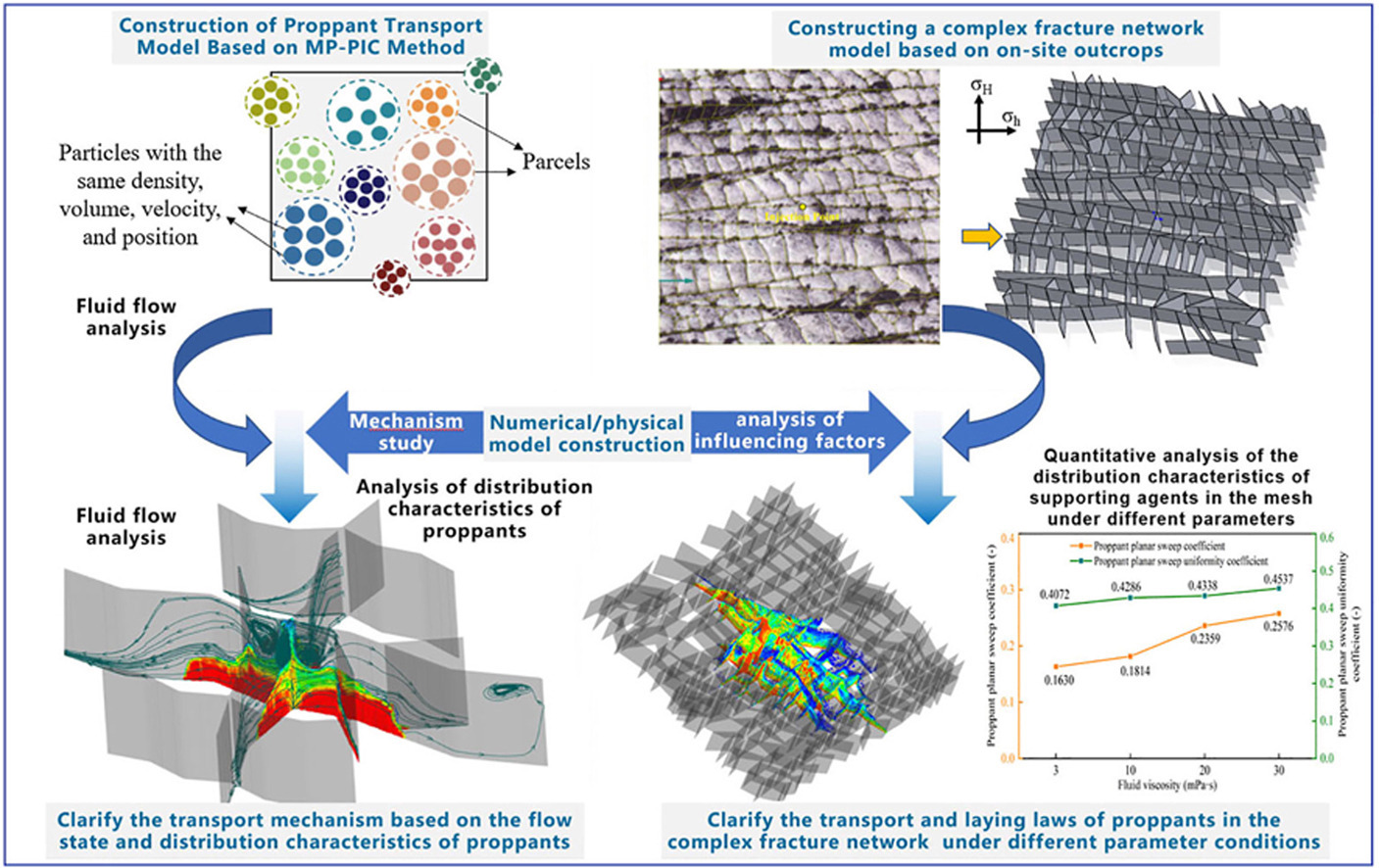
To improve understanding of proppant transport mechanisms in complex fracture networks, a field-scale model based on the Multiphase Particle-in-Cell (MP-PIC) method was developed using fracture geometries derived from real shale outcrops and validated against experimental data. Results indicate that: (1) intense vortex formation during early-to-mid injection stages or at high flow rates exacerbates the longitudinal heterogeneity of proppant distribution. (2) In the near-wellbore zone, the synergistic effects of fracture width variations, high flow velocities, and natural weak planes drive proppants to migrate preferentially along paths aligned with the maximum and minimum principal stress directions, forming a dual-channel transport pattern. (3) The volume of proppant entering secondary fractures decreases with distance from the injection point, and the proppant dune height within dominant channels exhibits stepwise attenuation. Larger intersection angles between secondary and main fractures hinder proppant migration. (4) Smaller proppant size and lower density improve the planar sweep and distribution uniformity coefficients, while increased fracturing fluid viscosity extends the proppant sweep range and further improves uniformity; high injection rates promote long-distance proppant transport and broader coverage but may reduce uniformity, leading to sparse proppant distribution and necking at fracture mouths. These findings provide quantitative guidance for optimizing hydraulic fracturing designs.
Graphical abstract
Keywords
Multiphase particle-in-cell method; Liquid-solid two-phase flow; Eulerian-Lagrangian method; Complex fracture network; Proppant transport
文章导读