
期刊文章
过刊浏览
- Volumes 108-119 (2025)
-
Volumes 96-107 (2025)
-
Volume 107
Pages 1-376 (December 2025)
-
Volume 106
Pages 1-336 (November 2025)
-
Volume 105
Pages 1-356 (October 2025)
-
Volume 104
Pages 1-332 (September 2025)
-
Volume 103
Pages 1-314 (August 2025)
-
Volume 102
Pages 1-276 (July 2025)
-
Volume 101
Pages 1-166 (June 2025)
-
Volume 100
Pages 1-256 (May 2025)
-
Volume 99
Pages 1-242 (April 2025)
-
Volume 98
Pages 1-288 (March 2025)
-
Volume 97
Pages 1-256 (February 2025)
-
Volume 96
Pages 1-340 (January 2025)
-
Volume 107
-
Volumes 84-95 (2024)
-
Volume 95
Pages 1-392 (December 2024)
-
Volume 94
Pages 1-400 (November 2024)
-
Volume 93
Pages 1-376 (October 2024)
-
Volume 92
Pages 1-316 (September 2024)
-
Volume 91
Pages 1-378 (August 2024)
-
Volume 90
Pages 1-580 (July 2024)
-
Volume 89
Pages 1-278 (June 2024)
-
Volume 88
Pages 1-350 (May 2024)
-
Volume 87
Pages 1-338 (April 2024)
-
Volume 86
Pages 1-312 (March 2024)
-
Volume 85
Pages 1-334 (February 2024)
-
Volume 84
Pages 1-308 (January 2024)
-
Volume 95
-
Volumes 72-83 (2023)
-
Volume 83
Pages 1-258 (December 2023)
-
Volume 82
Pages 1-204 (November 2023)
-
Volume 81
Pages 1-188 (October 2023)
-
Volume 80
Pages 1-202 (September 2023)
-
Volume 79
Pages 1-172 (August 2023)
-
Volume 78
Pages 1-146 (July 2023)
-
Volume 77
Pages 1-152 (June 2023)
-
Volume 76
Pages 1-176 (May 2023)
-
Volume 75
Pages 1-228 (April 2023)
-
Volume 74
Pages 1-200 (March 2023)
-
Volume 73
Pages 1-138 (February 2023)
-
Volume 72
Pages 1-144 (January 2023)
-
Volume 83
-
Volumes 60-71 (2022)
-
Volume 71
Pages 1-108 (December 2022)
-
Volume 70
Pages 1-106 (November 2022)
-
Volume 69
Pages 1-122 (October 2022)
-
Volume 68
Pages 1-124 (September 2022)
-
Volume 67
Pages 1-102 (August 2022)
-
Volume 66
Pages 1-112 (July 2022)
-
Volume 65
Pages 1-138 (June 2022)
-
Volume 64
Pages 1-186 (May 2022)
-
Volume 63
Pages 1-124 (April 2022)
-
Volume 62
Pages 1-104 (March 2022)
-
Volume 61
Pages 1-120 (February 2022)
-
Volume 60
Pages 1-124 (January 2022)
-
Volume 71
- Volumes 54-59 (2021)
- Volumes 48-53 (2020)
- Volumes 42-47 (2019)
- Volumes 36-41 (2018)
- Volumes 30-35 (2017)
- Volumes 24-29 (2016)
- Volumes 18-23 (2015)
- Volumes 12-17 (2014)
- Volume 11 (2013)
- Volume 10 (2012)
- Volume 9 (2011)
- Volume 8 (2010)
- Volume 7 (2009)
- Volume 6 (2008)
- Volume 5 (2007)
- Volume 4 (2006)
- Volume 3 (2005)
- Volume 2 (2004)
- Volume 1 (2003)
Volume 115
Zhao, M., Chen, F., Zhang, Y., Li, C., Qiu, T., & Ge, W. (2026). Improvement of hard-sphere/pseudo-particle modeling (HS-PPM) for high Knudsen number gas-solid flows. Particuology, 115, 292-308. https://doi.org/10.1016/j.partic.2026.06.002
Improvement of hard-sphere/pseudo-particle modeling (HS-PPM) for high Knudsen number gas-solid flows
Mingcan Zhao a, Feiguo Chen a, Yu Zhang a, Chengxiang Li a c, Tianhao Qiu b, Wei Ge a c *
a State Key Laboratory of Mesoscience and Process Engineering, Institute of Process Engineering, Chinese Academy of Sciences, Beijing, 100190, China
b School of Energy Science and Engineering, Harbin Institute of Technology (HIT), Harbin, 150001, China
c School of Chemical Engineering, University of Chinese Academy of Sciences, Beijing, 100049, China
10.1016/j.partic.2026.06.002
Volume 115,
August 2026,
Pages 292-308
Received 12 February 2026, Revised 16 May 2026, Accepted 1 June 2026, Available online 8 June 2026, Version of Record 16 June 2026.
E-mail:
wge@ipe.ac.cn
Highlights
• HS-PPM is implemented with eliminated inlet-outlet coupling and triangular elements method for wall description.
• Simulation accuracy and efficiency are balanced for high Knudsen number situations.
• Temperature and flow fields of IRVE in rarefied gas are well predicted based on dimensionless numbers.
• The flow system of porous particle at atomic level can be simulated by the implemented HS-PPM.
Abstract
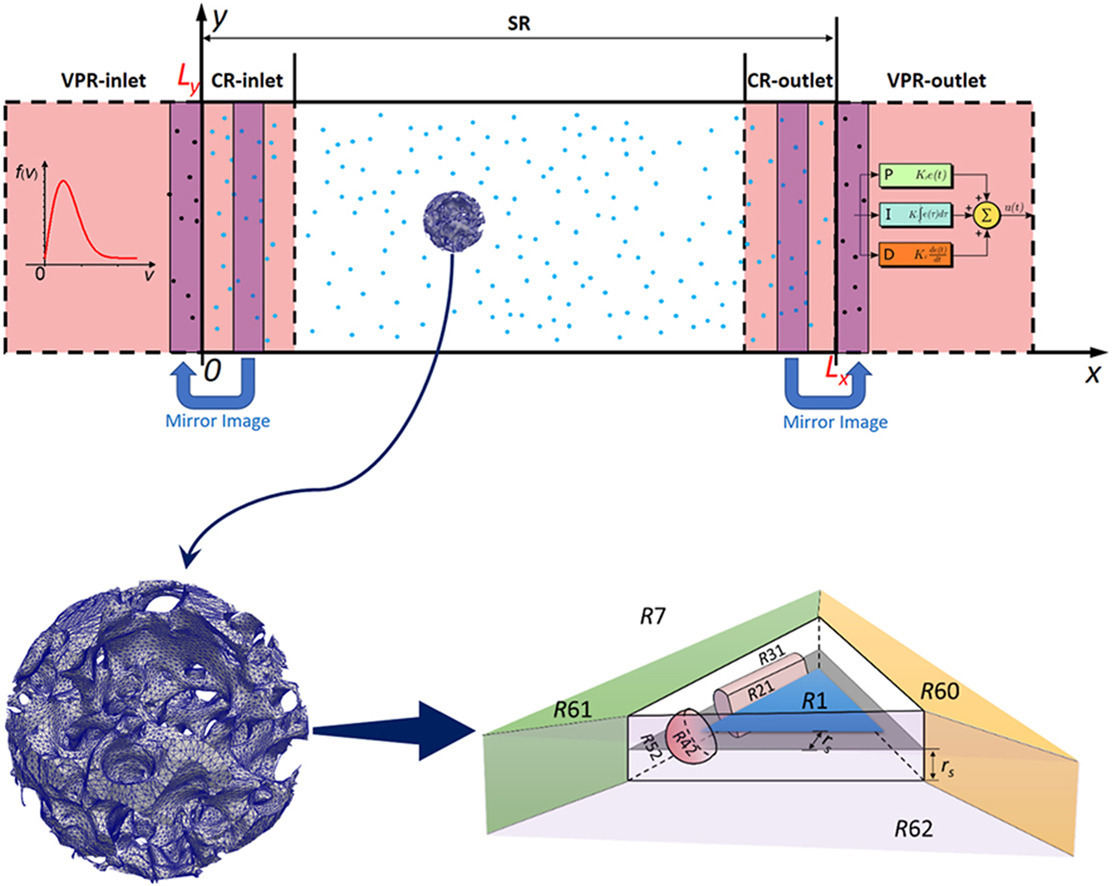
Hard-sphere/pseudo-particle modeling (HS-PPM) provides a parallel and more versatile implementation of molecular dynamics simulation based on hard-sphere model at large scales with remarkable performance. For more practical applications, however, more sophisticated and realistic boundary conditions have to be incorporated. In this work, the artifact of inlet-outlet coupling due to periodic boundary is basically eliminated by adding collisions at both ends and proportional-integral-differential (PID) control of density at the outlet based on implicit boundary conditions, maintaining reasonable flow field there for both high (up to 13.0) and low (down to 0.0) Mach numbers. Moreover, geometrically complex boundaries are approximated by a large number of polygonal (in particular, triangular) elements, instead of exact analytical descriptions, to balance the accuracy and efficiency. Given the challenges of nanoscale experimentation, the drag coefficients from simulation conducted at matching dimensionless numbers were compared with macroscopic results. With these improvements, the flow around a conical particle and the Inflatable Re-entry Vehicle Experiment (IRVE) was successfully simulated and demonstrated consistent to experiment and numerical results from direct simulation Monte Carlo (DSMC) towards the continuum flow limit (with the Knudsen number ranging from 0.1 to 1.7). Furthermore, the drag coefficient of nano-particles in fluid flow, which is challenging for experimental measurement, was obtained from simulation results, and the potential of HS-PPM in simulating particles and systems with complex structures is exemplified by the gas flow and diffusion in porous micro/nano-particles.
Graphical abstract
Keywords
HS-PPM; Implicit boundary conditions; Triangular elements; Flow around porous particles; Rarefied gas; Supersonic flow
文章导读