
期刊文章
过刊浏览
- Volumes 108-119 (2025)
-
Volumes 96-107 (2025)
-
Volume 107
Pages 1-376 (December 2025)
-
Volume 106
Pages 1-336 (November 2025)
-
Volume 105
Pages 1-356 (October 2025)
-
Volume 104
Pages 1-332 (September 2025)
-
Volume 103
Pages 1-314 (August 2025)
-
Volume 102
Pages 1-276 (July 2025)
-
Volume 101
Pages 1-166 (June 2025)
-
Volume 100
Pages 1-256 (May 2025)
-
Volume 99
Pages 1-242 (April 2025)
-
Volume 98
Pages 1-288 (March 2025)
-
Volume 97
Pages 1-256 (February 2025)
-
Volume 96
Pages 1-340 (January 2025)
-
Volume 107
-
Volumes 84-95 (2024)
-
Volume 95
Pages 1-392 (December 2024)
-
Volume 94
Pages 1-400 (November 2024)
-
Volume 93
Pages 1-376 (October 2024)
-
Volume 92
Pages 1-316 (September 2024)
-
Volume 91
Pages 1-378 (August 2024)
-
Volume 90
Pages 1-580 (July 2024)
-
Volume 89
Pages 1-278 (June 2024)
-
Volume 88
Pages 1-350 (May 2024)
-
Volume 87
Pages 1-338 (April 2024)
-
Volume 86
Pages 1-312 (March 2024)
-
Volume 85
Pages 1-334 (February 2024)
-
Volume 84
Pages 1-308 (January 2024)
-
Volume 95
-
Volumes 72-83 (2023)
-
Volume 83
Pages 1-258 (December 2023)
-
Volume 82
Pages 1-204 (November 2023)
-
Volume 81
Pages 1-188 (October 2023)
-
Volume 80
Pages 1-202 (September 2023)
-
Volume 79
Pages 1-172 (August 2023)
-
Volume 78
Pages 1-146 (July 2023)
-
Volume 77
Pages 1-152 (June 2023)
-
Volume 76
Pages 1-176 (May 2023)
-
Volume 75
Pages 1-228 (April 2023)
-
Volume 74
Pages 1-200 (March 2023)
-
Volume 73
Pages 1-138 (February 2023)
-
Volume 72
Pages 1-144 (January 2023)
-
Volume 83
-
Volumes 60-71 (2022)
-
Volume 71
Pages 1-108 (December 2022)
-
Volume 70
Pages 1-106 (November 2022)
-
Volume 69
Pages 1-122 (October 2022)
-
Volume 68
Pages 1-124 (September 2022)
-
Volume 67
Pages 1-102 (August 2022)
-
Volume 66
Pages 1-112 (July 2022)
-
Volume 65
Pages 1-138 (June 2022)
-
Volume 64
Pages 1-186 (May 2022)
-
Volume 63
Pages 1-124 (April 2022)
-
Volume 62
Pages 1-104 (March 2022)
-
Volume 61
Pages 1-120 (February 2022)
-
Volume 60
Pages 1-124 (January 2022)
-
Volume 71
- Volumes 54-59 (2021)
- Volumes 48-53 (2020)
- Volumes 42-47 (2019)
- Volumes 36-41 (2018)
- Volumes 30-35 (2017)
- Volumes 24-29 (2016)
- Volumes 18-23 (2015)
- Volumes 12-17 (2014)
- Volume 11 (2013)
- Volume 10 (2012)
- Volume 9 (2011)
- Volume 8 (2010)
- Volume 7 (2009)
- Volume 6 (2008)
- Volume 5 (2007)
- Volume 4 (2006)
- Volume 3 (2005)
- Volume 2 (2004)
- Volume 1 (2003)
Volume 115
Hoang, T. T., Nguyen, T. T., Huynh, T. Q., & Doan, T. (2026). Insights into sinkhole development in granular soils: Experimental and numerical investigations. Particuology, 115, 321-335. https://doi.org/10.1016/j.partic.2026.06.006
Insights into sinkhole development in granular soils: Experimental and numerical investigations
Tung T. Hoang a, Thanh T. Nguyen a *, Thien Q. Huynh a, Thao Doan a b
a School of Civil and Environmental Engineering, University of Technology Sydney, Ultimo, Australia
b Wollongong Council, Wollongong, Australia
10.1016/j.partic.2026.06.006
Volume 115,
August 2026,
Pages 321-335
Received 21 March 2026, Revised 19 May 2026, Accepted 4 June 2026, Available online 12 June 2026, Version of Record 19 June 2026.
E-mail:
thanh.nguyen-4@uts.edu.au
Highlights
• Innovative experiment coupling model test and Particle Image Velocimetry (PIV).
• DEM simulation of sinkhole development with validation against experiment.
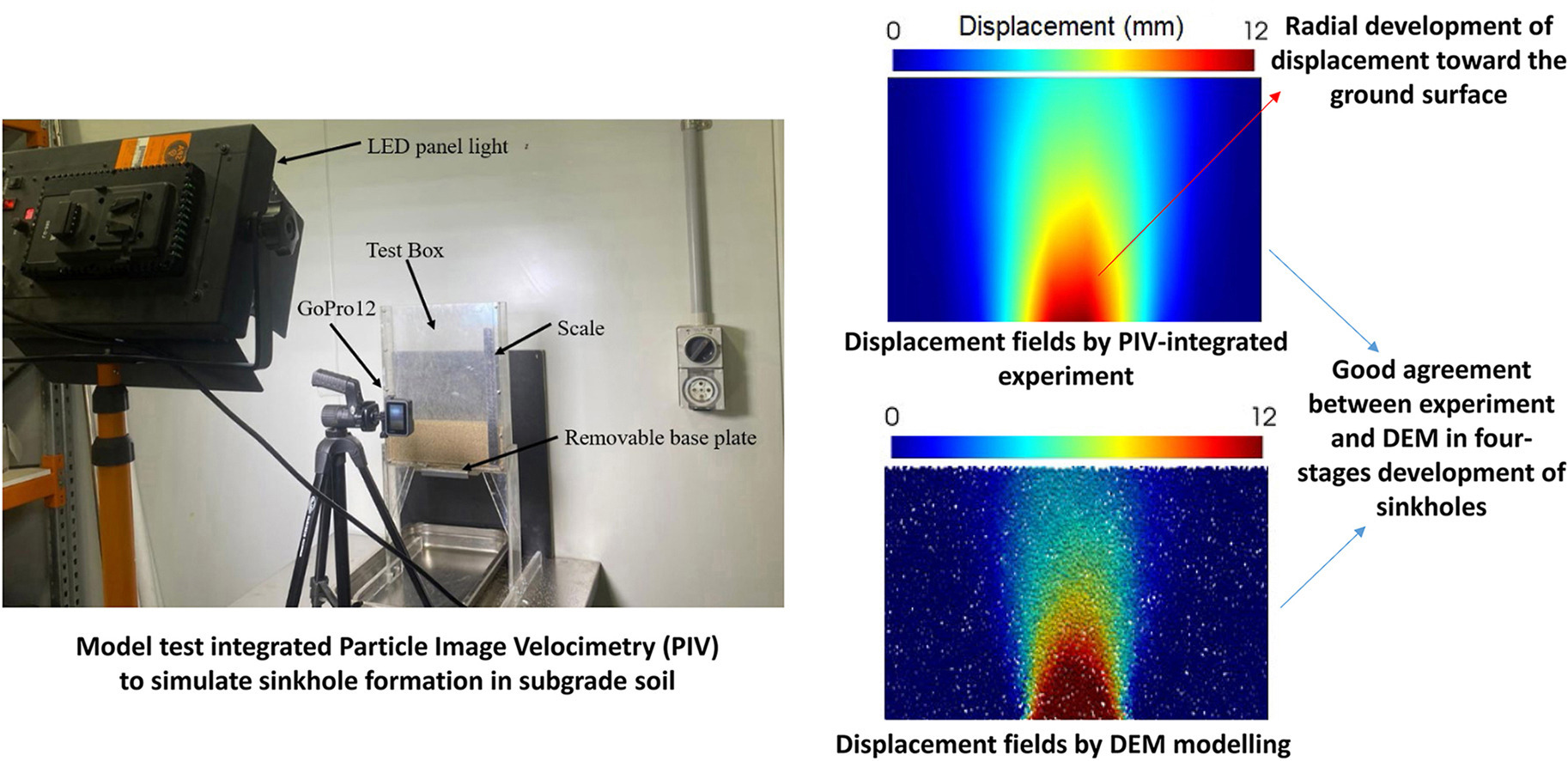
• Excellent agreement between experiment and DEM in four-stage development of sinkholes.
• Exploring the influence of triggering depth and compaction state on sinkhole formation.
• Interparticle evolution through transition phases of sinkhole formation.
Abstract
Sinkholes, a common geotechnical failure, have been reported more frequently in recent years due to complex climate change and urbanisation. This study investigates mechanisms of sinkhole development, considering the influence of triggering depth and compaction degree through experiments integrated with Particle Image Velocimetry (PIV) technique and Discrete Element Method (DEM). Laboratory tests simulating the formation of sinkhole in subgrade soil are carried out under varying triggering depths and void ratios, where the soil displacement is recorded over time. DEM simulations are performed and validated against the experimental results analysed by PIV technique. The results show good agreement between DEM and experimental investigations, especially in capturing time-dependent stages and displacement fields of sinkhole development. Furthermore, the numerical investigation indicates that increasing the triggering depth results in later development of sinkhole with greater vertical displacement around the triggering point to promote its propagation towards the ground surface. Interestingly, dense soil exhibits highly localised mobilisation confined within well-defined displacement boundaries, whereas loose soil displays a wider displacement zone characterised by a funnel-shaped pattern. The interparticle contact behaviour further releases the insightful mechanism of sinkhole progression, giving considerable value to our understanding and prediction of this catastrophic failure.
Graphical abstract
Keywords
Sinkholes; Particle Image Velocimetry (PIV); DEM; Displacement fields; Triggering depth; Compaction state
文章导读