
期刊文章
过刊浏览
- Volumes 108-119 (2025)
-
Volumes 96-107 (2025)
-
Volume 107
Pages 1-376 (December 2025)
-
Volume 106
Pages 1-336 (November 2025)
-
Volume 105
Pages 1-356 (October 2025)
-
Volume 104
Pages 1-332 (September 2025)
-
Volume 103
Pages 1-314 (August 2025)
-
Volume 102
Pages 1-276 (July 2025)
-
Volume 101
Pages 1-166 (June 2025)
-
Volume 100
Pages 1-256 (May 2025)
-
Volume 99
Pages 1-242 (April 2025)
-
Volume 98
Pages 1-288 (March 2025)
-
Volume 97
Pages 1-256 (February 2025)
-
Volume 96
Pages 1-340 (January 2025)
-
Volume 107
-
Volumes 84-95 (2024)
-
Volume 95
Pages 1-392 (December 2024)
-
Volume 94
Pages 1-400 (November 2024)
-
Volume 93
Pages 1-376 (October 2024)
-
Volume 92
Pages 1-316 (September 2024)
-
Volume 91
Pages 1-378 (August 2024)
-
Volume 90
Pages 1-580 (July 2024)
-
Volume 89
Pages 1-278 (June 2024)
-
Volume 88
Pages 1-350 (May 2024)
-
Volume 87
Pages 1-338 (April 2024)
-
Volume 86
Pages 1-312 (March 2024)
-
Volume 85
Pages 1-334 (February 2024)
-
Volume 84
Pages 1-308 (January 2024)
-
Volume 95
-
Volumes 72-83 (2023)
-
Volume 83
Pages 1-258 (December 2023)
-
Volume 82
Pages 1-204 (November 2023)
-
Volume 81
Pages 1-188 (October 2023)
-
Volume 80
Pages 1-202 (September 2023)
-
Volume 79
Pages 1-172 (August 2023)
-
Volume 78
Pages 1-146 (July 2023)
-
Volume 77
Pages 1-152 (June 2023)
-
Volume 76
Pages 1-176 (May 2023)
-
Volume 75
Pages 1-228 (April 2023)
-
Volume 74
Pages 1-200 (March 2023)
-
Volume 73
Pages 1-138 (February 2023)
-
Volume 72
Pages 1-144 (January 2023)
-
Volume 83
-
Volumes 60-71 (2022)
-
Volume 71
Pages 1-108 (December 2022)
-
Volume 70
Pages 1-106 (November 2022)
-
Volume 69
Pages 1-122 (October 2022)
-
Volume 68
Pages 1-124 (September 2022)
-
Volume 67
Pages 1-102 (August 2022)
-
Volume 66
Pages 1-112 (July 2022)
-
Volume 65
Pages 1-138 (June 2022)
-
Volume 64
Pages 1-186 (May 2022)
-
Volume 63
Pages 1-124 (April 2022)
-
Volume 62
Pages 1-104 (March 2022)
-
Volume 61
Pages 1-120 (February 2022)
-
Volume 60
Pages 1-124 (January 2022)
-
Volume 71
- Volumes 54-59 (2021)
- Volumes 48-53 (2020)
- Volumes 42-47 (2019)
- Volumes 36-41 (2018)
- Volumes 30-35 (2017)
- Volumes 24-29 (2016)
- Volumes 18-23 (2015)
- Volumes 12-17 (2014)
- Volume 11 (2013)
- Volume 10 (2012)
- Volume 9 (2011)
- Volume 8 (2010)
- Volume 7 (2009)
- Volume 6 (2008)
- Volume 5 (2007)
- Volume 4 (2006)
- Volume 3 (2005)
- Volume 2 (2004)
- Volume 1 (2003)
Volume 115
Weston, D., Liu, L., & Windows-Yule, C. (2026). Prediction of immersion mill performance and energy use via machine learning. Particuology, 115, 336-355. https://doi.org/10.1016/j.partic.2026.05.023
Prediction of immersion mill performance and energy use via machine learning (Open Access)
Daniel Weston a b *, Li Liu b, Christopher Windows-Yule a
a School of Chemical Engineering, University of Birmingham, Birmingham, B15 2TT, UK
b Johnson Matthey Technology Centre, P.O. Box 1, Belasis Avenue, Billingham, TS23 1LB, UK
10.1016/j.partic.2026.05.023
Volume 115,
August 2026,
Pages 336-355
Received 30 January 2026, Revised 6 May 2026, Accepted 29 May 2026, Available online 10 June 2026, Version of Record 19 June 2026.
E-mail:
dtw545@student.bham.ac.uk
Highlights
• Symbolic regression predicted immersion mill performance with a sparse dataset.
• The generated equations provided interpretable rules for process optimisation.
• This approach minimised energy use whilst achieving a target particle size.
Abstract
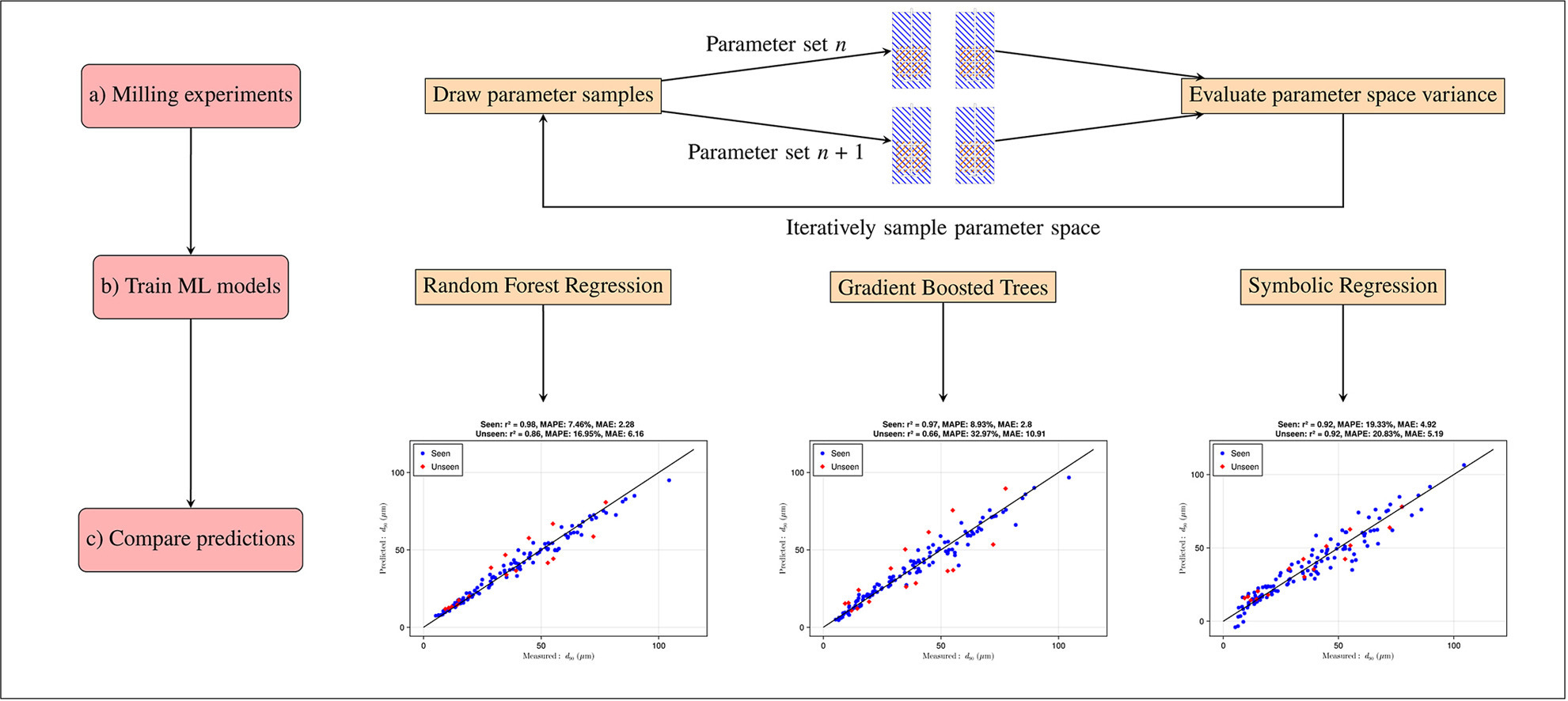
This study performs a comparative assessment of three Machine Learning (ML) models to determine their robustness in data-sparse industrial environments for predicting and optimising the performance and energy consumption of an immersion mill. By employing active learning strategies that target high-variance regions in process space, a limited experimental dataset (15 batches) was found sufficient to accurately predict mill performance, provided the correct model architecture is chosen. Three models were used: Random Forest Regression (RFR), Gradient Boosted Trees (GBT) and Symbolic Regression (SR). Based on performance when used on completely unseen data, as well as interpretability and usability, the SR models were found to be the most effective for this application. The simple algebraic form of the SR models allowed for direct use in exploring ‘what-if’ scenarios, and equally allowed either model to serve as a constraint for the other to minimise energy use to achieve a target particle size. An unexpected finding during this work was that the relationship between final particle size and impeller speed and grinding media content is weaker than for classic vertical stirred mill designs owing to transport and/or mixing mechanisms novel to this particular mill design. The result of this study is a set of predictive models that can be used in optimising the immersion milling process, and effectively responding to changes in feed Particle Size Distribution (PSD) whilst minimising energy use.
Graphical abstract
Keywords
Machine learning; Wet milling; Prediction; Optimisation
文章导读