
期刊文章
过刊浏览
- Volumes 108-119 (2025)
-
Volumes 96-107 (2025)
-
Volume 107
Pages 1-376 (December 2025)
-
Volume 106
Pages 1-336 (November 2025)
-
Volume 105
Pages 1-356 (October 2025)
-
Volume 104
Pages 1-332 (September 2025)
-
Volume 103
Pages 1-314 (August 2025)
-
Volume 102
Pages 1-276 (July 2025)
-
Volume 101
Pages 1-166 (June 2025)
-
Volume 100
Pages 1-256 (May 2025)
-
Volume 99
Pages 1-242 (April 2025)
-
Volume 98
Pages 1-288 (March 2025)
-
Volume 97
Pages 1-256 (February 2025)
-
Volume 96
Pages 1-340 (January 2025)
-
Volume 107
-
Volumes 84-95 (2024)
-
Volume 95
Pages 1-392 (December 2024)
-
Volume 94
Pages 1-400 (November 2024)
-
Volume 93
Pages 1-376 (October 2024)
-
Volume 92
Pages 1-316 (September 2024)
-
Volume 91
Pages 1-378 (August 2024)
-
Volume 90
Pages 1-580 (July 2024)
-
Volume 89
Pages 1-278 (June 2024)
-
Volume 88
Pages 1-350 (May 2024)
-
Volume 87
Pages 1-338 (April 2024)
-
Volume 86
Pages 1-312 (March 2024)
-
Volume 85
Pages 1-334 (February 2024)
-
Volume 84
Pages 1-308 (January 2024)
-
Volume 95
-
Volumes 72-83 (2023)
-
Volume 83
Pages 1-258 (December 2023)
-
Volume 82
Pages 1-204 (November 2023)
-
Volume 81
Pages 1-188 (October 2023)
-
Volume 80
Pages 1-202 (September 2023)
-
Volume 79
Pages 1-172 (August 2023)
-
Volume 78
Pages 1-146 (July 2023)
-
Volume 77
Pages 1-152 (June 2023)
-
Volume 76
Pages 1-176 (May 2023)
-
Volume 75
Pages 1-228 (April 2023)
-
Volume 74
Pages 1-200 (March 2023)
-
Volume 73
Pages 1-138 (February 2023)
-
Volume 72
Pages 1-144 (January 2023)
-
Volume 83
-
Volumes 60-71 (2022)
-
Volume 71
Pages 1-108 (December 2022)
-
Volume 70
Pages 1-106 (November 2022)
-
Volume 69
Pages 1-122 (October 2022)
-
Volume 68
Pages 1-124 (September 2022)
-
Volume 67
Pages 1-102 (August 2022)
-
Volume 66
Pages 1-112 (July 2022)
-
Volume 65
Pages 1-138 (June 2022)
-
Volume 64
Pages 1-186 (May 2022)
-
Volume 63
Pages 1-124 (April 2022)
-
Volume 62
Pages 1-104 (March 2022)
-
Volume 61
Pages 1-120 (February 2022)
-
Volume 60
Pages 1-124 (January 2022)
-
Volume 71
- Volumes 54-59 (2021)
- Volumes 48-53 (2020)
- Volumes 42-47 (2019)
- Volumes 36-41 (2018)
- Volumes 30-35 (2017)
- Volumes 24-29 (2016)
- Volumes 18-23 (2015)
- Volumes 12-17 (2014)
- Volume 11 (2013)
- Volume 10 (2012)
- Volume 9 (2011)
- Volume 8 (2010)
- Volume 7 (2009)
- Volume 6 (2008)
- Volume 5 (2007)
- Volume 4 (2006)
- Volume 3 (2005)
- Volume 2 (2004)
- Volume 1 (2003)
Volume 115
Tu, W., Tian, P., Fan, L.-L., & Zhao, L. (2026). Settling dynamics of micro-sized char and coal powders: An experimental study. Particuology, 115, 356-365. https://doi.org/10.1016/j.partic.2026.05.022
Settling dynamics of micro-sized char and coal powders: An experimental study
Wenyu Tu a 1, Peilin Tian a 1, Liang-Liang Fan b *, Liang Zhao a *
a State Key Laboratory of Multiphase Flow in Power Engineering, Xi'an Jiaotong University, Xi'an, 710049, China
b School of Instrument Science and Technology, Xi'an Jiaotong University, Xi'an, 710049, China
10.1016/j.partic.2026.05.022
Volume 115,
August 2026,
Pages 356-365
Received 3 February 2026, Revised 17 May 2026, Accepted 29 May 2026, Available online 6 June 2026, Version of Record 19 June 2026.
E-mail:
fanllxj@xjtu.edu.cn; lzhao@mail.xjtu.edu.cn
Highlights
• Drag coefficients for char particles are derived for the first time.
• Stokes and Schiller drag formulations are revised for coal and char particles.
• Rough char surfaces from pyrolysis yield higher drag coefficients.
• The model modified by this work refines char pneumatic conveying simulations.
Abstract
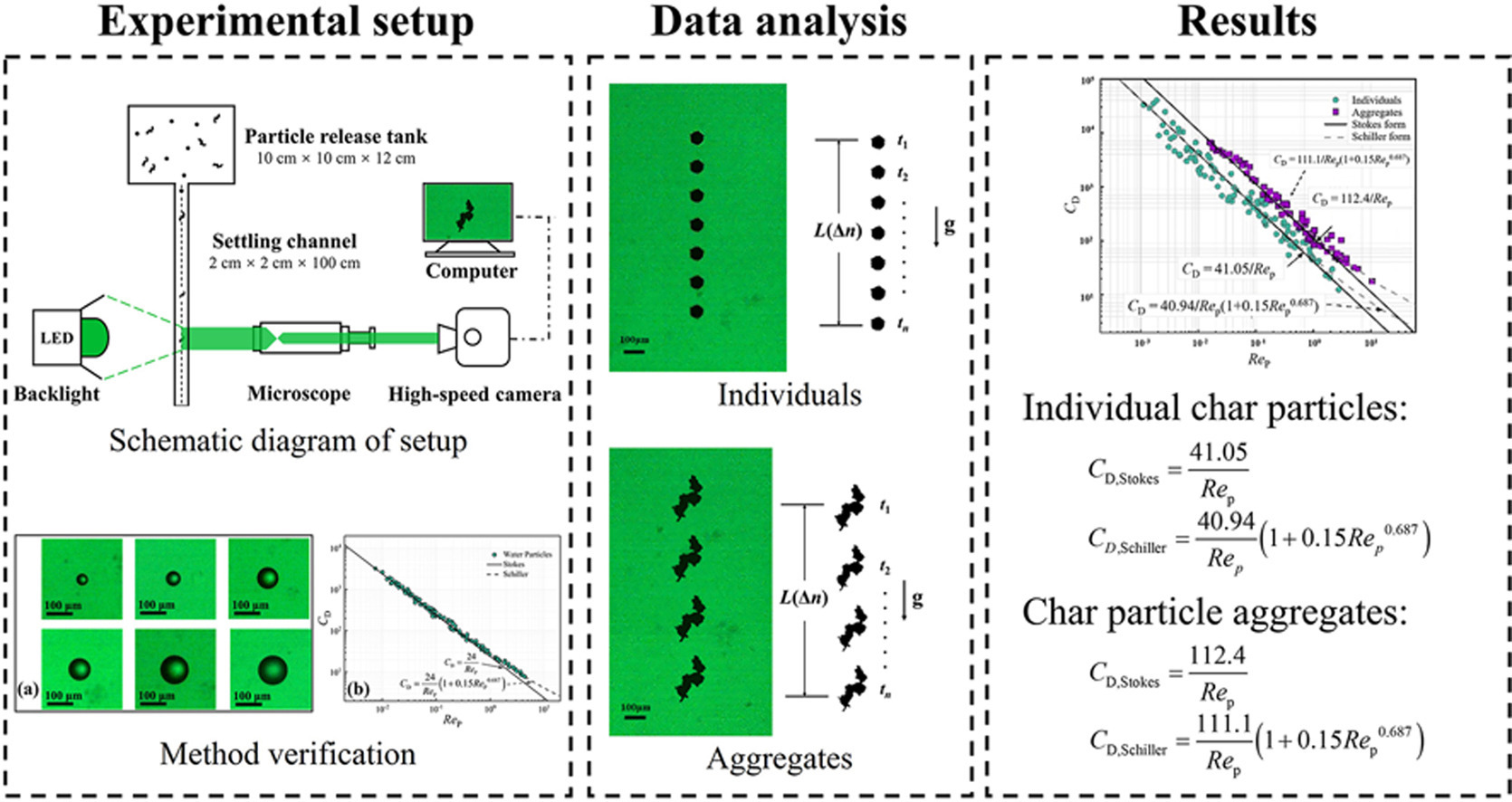
Char particles from coal pyrolysis exhibit unique settling dynamics, such as terminal velocity and drag coefficient. Accurate quantification of drag characteristics is essential for pneumatic conveying. Current simulations adopting spherical drag models suffer large deviations for irregular char particles. To fill this gap, we built a visual platform to investigate free settling of coal and char particles (<200 μm). Terminal velocities were measured for individual particles and aggregates. Based on statistical analysis, we revised Stokes and Schiller drag formulations. In the Stokes form, the fitted coefficients for individual coal particles and coal aggregates are 26.04 ± 3.5 and 52.15 ± 4.8, respectively; for individual char particles and char aggregates, they are 41.05 ± 3.2 and 112.4 ± 4.3, respectively. In the Schiller form, the fitted coefficients for individual coal particles and coal aggregates are 26.19 ± 3.4 and 53.88 ± 4.2, respectively; for individual char particles and char aggregates, they are 40.94 ± 3.2 and 111.1 ± 4.2, respectively. These correlations can be directly employed in drag model for numerical simulation of char pneumatic conveying. Validation shows significantly improved accuracy. This work presents the first experimentally derived drag coefficient correlations for char particles, addressing the lack of quantitative data and offering a more precise tool for char transport design.
Graphical abstract
Keywords
Settling dynamics; Char powder; Coal powder; Drag coefficient; Settling velocity
文章导读