
期刊文章
过刊浏览
- Volumes 108-119 (2025)
-
Volumes 96-107 (2025)
-
Volume 107
Pages 1-376 (December 2025)
-
Volume 106
Pages 1-336 (November 2025)
-
Volume 105
Pages 1-356 (October 2025)
-
Volume 104
Pages 1-332 (September 2025)
-
Volume 103
Pages 1-314 (August 2025)
-
Volume 102
Pages 1-276 (July 2025)
-
Volume 101
Pages 1-166 (June 2025)
-
Volume 100
Pages 1-256 (May 2025)
-
Volume 99
Pages 1-242 (April 2025)
-
Volume 98
Pages 1-288 (March 2025)
-
Volume 97
Pages 1-256 (February 2025)
-
Volume 96
Pages 1-340 (January 2025)
-
Volume 107
-
Volumes 84-95 (2024)
-
Volume 95
Pages 1-392 (December 2024)
-
Volume 94
Pages 1-400 (November 2024)
-
Volume 93
Pages 1-376 (October 2024)
-
Volume 92
Pages 1-316 (September 2024)
-
Volume 91
Pages 1-378 (August 2024)
-
Volume 90
Pages 1-580 (July 2024)
-
Volume 89
Pages 1-278 (June 2024)
-
Volume 88
Pages 1-350 (May 2024)
-
Volume 87
Pages 1-338 (April 2024)
-
Volume 86
Pages 1-312 (March 2024)
-
Volume 85
Pages 1-334 (February 2024)
-
Volume 84
Pages 1-308 (January 2024)
-
Volume 95
-
Volumes 72-83 (2023)
-
Volume 83
Pages 1-258 (December 2023)
-
Volume 82
Pages 1-204 (November 2023)
-
Volume 81
Pages 1-188 (October 2023)
-
Volume 80
Pages 1-202 (September 2023)
-
Volume 79
Pages 1-172 (August 2023)
-
Volume 78
Pages 1-146 (July 2023)
-
Volume 77
Pages 1-152 (June 2023)
-
Volume 76
Pages 1-176 (May 2023)
-
Volume 75
Pages 1-228 (April 2023)
-
Volume 74
Pages 1-200 (March 2023)
-
Volume 73
Pages 1-138 (February 2023)
-
Volume 72
Pages 1-144 (January 2023)
-
Volume 83
-
Volumes 60-71 (2022)
-
Volume 71
Pages 1-108 (December 2022)
-
Volume 70
Pages 1-106 (November 2022)
-
Volume 69
Pages 1-122 (October 2022)
-
Volume 68
Pages 1-124 (September 2022)
-
Volume 67
Pages 1-102 (August 2022)
-
Volume 66
Pages 1-112 (July 2022)
-
Volume 65
Pages 1-138 (June 2022)
-
Volume 64
Pages 1-186 (May 2022)
-
Volume 63
Pages 1-124 (April 2022)
-
Volume 62
Pages 1-104 (March 2022)
-
Volume 61
Pages 1-120 (February 2022)
-
Volume 60
Pages 1-124 (January 2022)
-
Volume 71
- Volumes 54-59 (2021)
- Volumes 48-53 (2020)
- Volumes 42-47 (2019)
- Volumes 36-41 (2018)
- Volumes 30-35 (2017)
- Volumes 24-29 (2016)
- Volumes 18-23 (2015)
- Volumes 12-17 (2014)
- Volume 11 (2013)
- Volume 10 (2012)
- Volume 9 (2011)
- Volume 8 (2010)
- Volume 7 (2009)
- Volume 6 (2008)
- Volume 5 (2007)
- Volume 4 (2006)
- Volume 3 (2005)
- Volume 2 (2004)
- Volume 1 (2003)
Volume 115
Pielsticker, S., Gfall, K., Rohlfs, W., & Kneer, R. (2026). Kinetic modeling of methyl methacrylate gas-phase decomposition and its impact on polymethyl methacrylate pyrolysis yields. Particuology, 115, 366-377. https://doi.org/10.1016/j.partic.2026.05.011
Kinetic modeling of methyl methacrylate gas-phase decomposition and its impact on polymethyl methacrylate pyrolysis yields (Open Access)
Stefan Pielsticker *, Konstantinos Gfall, Wilko Rohlfs, Reinhold Kneer
Institute of Heat and Mass Transfer (WSA), RWTH Aachen University, Augustinerbach 6, 52056, Aachen, Germany
10.1016/j.partic.2026.05.011
Volume 115,
August 2026,
Pages 366-377
Received 12 January 2026, Revised 13 May 2026, Accepted 17 May 2026, Available online 28 May 2026, Version of Record 19 June 2026.
E-mail:
pielsticker@wsa.rwth-aachen.de
Highlights
• Separate MMA kinetic modeling is undertaken to improve PMMA pyrolysis models.
• Low-energy decarboxylation dominates cracking reactions at low temperatures.
• Competitive reaction model (CRM) accurately predicts MMA product selectivity.
• Direct solid-to-gas pathways are key to predict low-temperature PMMA yields.
• Peak monomer recovery near 723 K shows excellent agreement with literature.
Abstract
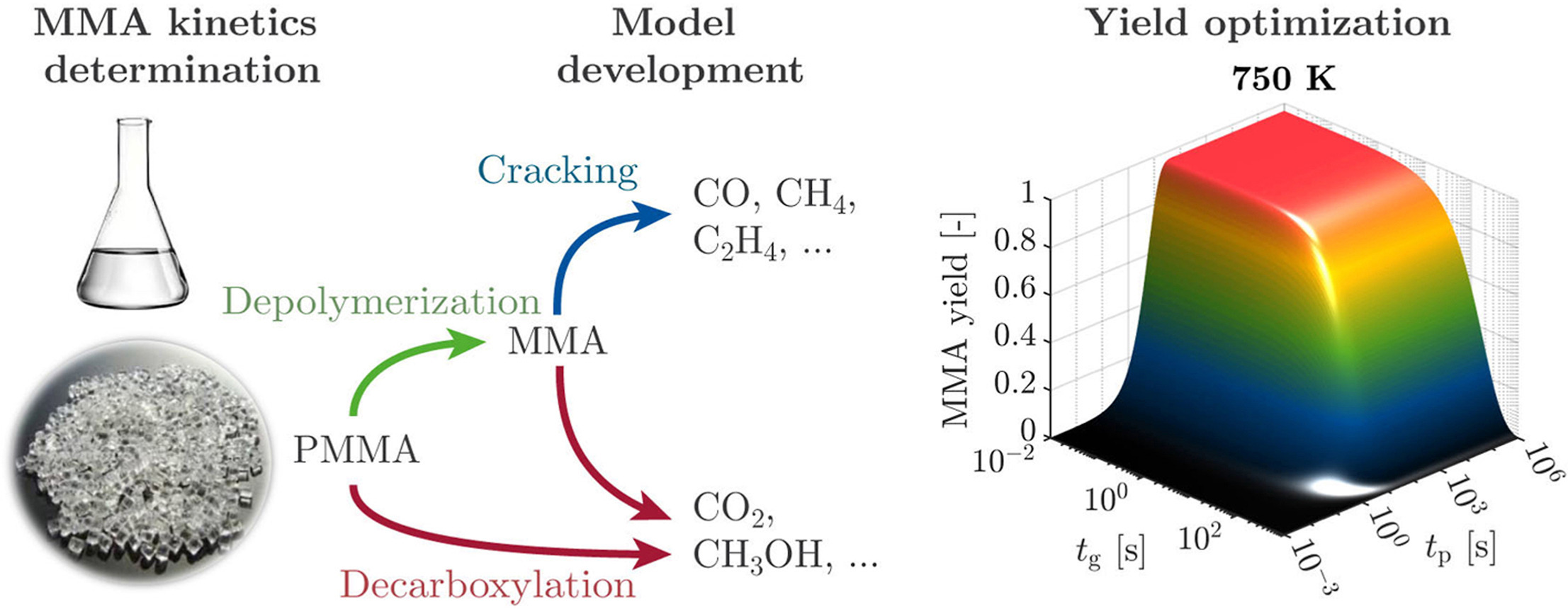
Chemical recycling of polymethyl methacrylate (PMMA) to its monomer, methyl methacrylate (MMA), requires balancing primary depolymerization with the suppression of secondary gas-phase reactions. This study investigates non-oxidative MMA decomposition in a fluidized bed reactor across a temperature range of 623 to 1073 K using online FTIR spectroscopy. Experimental results reveal a significant shift in product selectivity: low temperatures favor a low-energy decarboxylation pathway (yielding CO2 and methanol), while high temperatures promote radical cracking (yielding CO and light hydrocarbons). To describe this, a two-competing-reactions model (CRM) is used, outperforming the traditional single first-order approaches. The CRM identifies two distinct activation energies: Ea,1 = 76.5 kJ mol−1 for decarboxylation and Ea,2 = 269.9 kJ mol−1 for cracking. The research further demonstrates that the classical sequential decomposition model (PMMA → MMA → light gases) overpredicts monomer yields at low temperatures. By integrating a direct solid-to-gas pathway to account for side-chain break-off and incorporating multi-volume reactor hydrodynamics, the model's predictive accuracy significantly improved. This integrated framework identifies an optimal recovery window near 723 K, achieving MMA yields over 95 %.
Graphical abstract
Keywords
MMA and PMMA pyrolysis; Fluidized bed reactor; FTIR gas analysis; Kinetic modelling; Primary and secondary reactions
文章导读