
期刊文章
过刊浏览
- Volumes 108-119 (2025)
-
Volumes 96-107 (2025)
-
Volume 107
Pages 1-376 (December 2025)
-
Volume 106
Pages 1-336 (November 2025)
-
Volume 105
Pages 1-356 (October 2025)
-
Volume 104
Pages 1-332 (September 2025)
-
Volume 103
Pages 1-314 (August 2025)
-
Volume 102
Pages 1-276 (July 2025)
-
Volume 101
Pages 1-166 (June 2025)
-
Volume 100
Pages 1-256 (May 2025)
-
Volume 99
Pages 1-242 (April 2025)
-
Volume 98
Pages 1-288 (March 2025)
-
Volume 97
Pages 1-256 (February 2025)
-
Volume 96
Pages 1-340 (January 2025)
-
Volume 107
-
Volumes 84-95 (2024)
-
Volume 95
Pages 1-392 (December 2024)
-
Volume 94
Pages 1-400 (November 2024)
-
Volume 93
Pages 1-376 (October 2024)
-
Volume 92
Pages 1-316 (September 2024)
-
Volume 91
Pages 1-378 (August 2024)
-
Volume 90
Pages 1-580 (July 2024)
-
Volume 89
Pages 1-278 (June 2024)
-
Volume 88
Pages 1-350 (May 2024)
-
Volume 87
Pages 1-338 (April 2024)
-
Volume 86
Pages 1-312 (March 2024)
-
Volume 85
Pages 1-334 (February 2024)
-
Volume 84
Pages 1-308 (January 2024)
-
Volume 95
-
Volumes 72-83 (2023)
-
Volume 83
Pages 1-258 (December 2023)
-
Volume 82
Pages 1-204 (November 2023)
-
Volume 81
Pages 1-188 (October 2023)
-
Volume 80
Pages 1-202 (September 2023)
-
Volume 79
Pages 1-172 (August 2023)
-
Volume 78
Pages 1-146 (July 2023)
-
Volume 77
Pages 1-152 (June 2023)
-
Volume 76
Pages 1-176 (May 2023)
-
Volume 75
Pages 1-228 (April 2023)
-
Volume 74
Pages 1-200 (March 2023)
-
Volume 73
Pages 1-138 (February 2023)
-
Volume 72
Pages 1-144 (January 2023)
-
Volume 83
-
Volumes 60-71 (2022)
-
Volume 71
Pages 1-108 (December 2022)
-
Volume 70
Pages 1-106 (November 2022)
-
Volume 69
Pages 1-122 (October 2022)
-
Volume 68
Pages 1-124 (September 2022)
-
Volume 67
Pages 1-102 (August 2022)
-
Volume 66
Pages 1-112 (July 2022)
-
Volume 65
Pages 1-138 (June 2022)
-
Volume 64
Pages 1-186 (May 2022)
-
Volume 63
Pages 1-124 (April 2022)
-
Volume 62
Pages 1-104 (March 2022)
-
Volume 61
Pages 1-120 (February 2022)
-
Volume 60
Pages 1-124 (January 2022)
-
Volume 71
- Volumes 54-59 (2021)
- Volumes 48-53 (2020)
- Volumes 42-47 (2019)
- Volumes 36-41 (2018)
- Volumes 30-35 (2017)
- Volumes 24-29 (2016)
- Volumes 18-23 (2015)
- Volumes 12-17 (2014)
- Volume 11 (2013)
- Volume 10 (2012)
- Volume 9 (2011)
- Volume 8 (2010)
- Volume 7 (2009)
- Volume 6 (2008)
- Volume 5 (2007)
- Volume 4 (2006)
- Volume 3 (2005)
- Volume 2 (2004)
- Volume 1 (2003)
Volume 115
Li, H., Dai, K., Xie, J., Chen, X., Li, D., Xie, X., & Zhao, C. (2026). A study on the discharge and mixing process of wet coal in silos. Particuology, 115, 378-389. https://doi.org/10.1016/j.partic.2026.06.007
A study on the discharge and mixing process of wet coal in silos
Haoyuan Li, Kaixin Dai, Jun Xie *, Xiaole Chen, Dong Li, Xiaojian Xie, Chuanwen Zhao
School of Energy Science and Engineering, Nanjing Normal University, Nanjing, 210023, China
10.1016/j.partic.2026.06.007
Volume 115,
August 2026,
Pages 378-389
Received 31 March 2026, Revised 28 May 2026, Accepted 7 June 2026, Available online 13 June 2026, Version of Record 19 June 2026.
E-mail:
junxie@njnu.edu.cn
Highlights
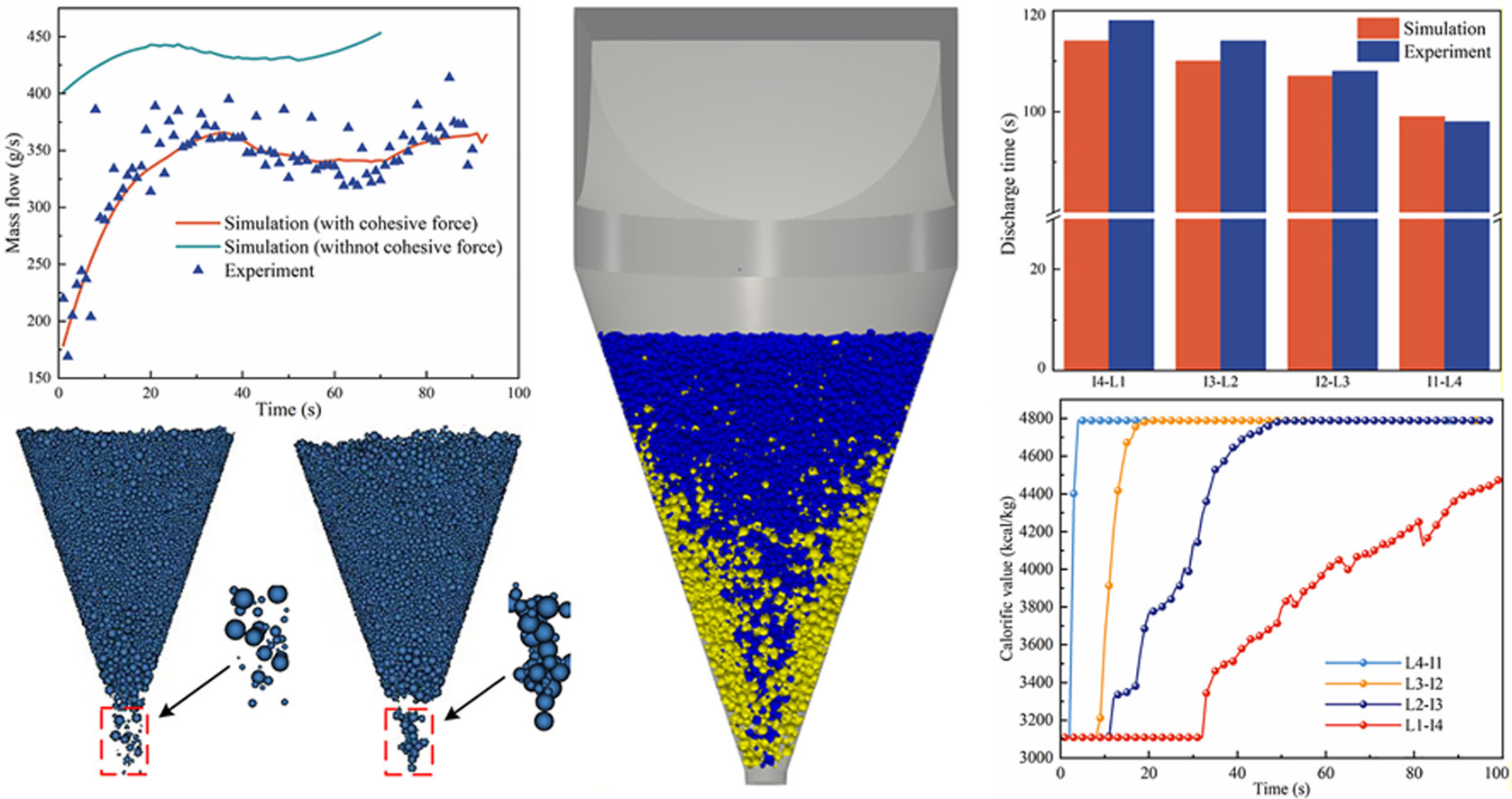
• Develops a CG-DEM model coupled with moisture-induced cohesive force.
• Reveals the decisive influence of stacking sequence on the evolution of outlet coal quality.
• Quantifies that cohesive force dominates, affecting ∼80% of particles throughout discharge.
• Demonstrates that flow is characterized by a lower-layer-dominated funnel flow pattern.
• Provides a high-fidelity, low-cost tool for predicting industrial wet coal discharge.
Abstract
This paper develops a computational framework coupling a moisture-induced cohesive force model with the Coarse-Grained Discrete Element Method (CG-DEM) to efficiently and accurately simulate the mixed discharge process of wet coal in a laboratory-scale three-dimensional silo. The moisture-induced cohesive force model quantifies the effect of moisture on coal flowability by correlating moisture content with macroscopic mechanical parameters of the particles (cohesion, internal friction angle). Simulation results indicate that particle flow exhibits a significant central-channeling "funnel flow" characteristic, and the flow structure is dominated by the flowability of the lower coal layer. The moisture-induced cohesive force is a key factor controlling particle motion. The study further reveals the decisive influence of stacking sequence on the evolution of outlet coal quality: when the lower layer consists of high-moisture, poor-flowability Indonesian coal, the outlet calorific value shows a slow rising trend; conversely, when the lower layer consists of good-flowability Longwanggou coal, the outlet calorific value decreases rapidly. This research provides a reliable, low-cost numerical tool for understanding and predicting the discharge and mixing behavior of wet coal in industrial silos, offering guidance for optimizing coal blending and stabilizing the quality of feed coal.
Graphical abstract
Keywords
Silo; Wet coal; Mixed discharge; CG-DEM; Cohesive force
文章导读