
期刊文章
过刊浏览
- Volumes 108-119 (2025)
-
Volumes 96-107 (2025)
-
Volume 107
Pages 1-376 (December 2025)
-
Volume 106
Pages 1-336 (November 2025)
-
Volume 105
Pages 1-356 (October 2025)
-
Volume 104
Pages 1-332 (September 2025)
-
Volume 103
Pages 1-314 (August 2025)
-
Volume 102
Pages 1-276 (July 2025)
-
Volume 101
Pages 1-166 (June 2025)
-
Volume 100
Pages 1-256 (May 2025)
-
Volume 99
Pages 1-242 (April 2025)
-
Volume 98
Pages 1-288 (March 2025)
-
Volume 97
Pages 1-256 (February 2025)
-
Volume 96
Pages 1-340 (January 2025)
-
Volume 107
-
Volumes 84-95 (2024)
-
Volume 95
Pages 1-392 (December 2024)
-
Volume 94
Pages 1-400 (November 2024)
-
Volume 93
Pages 1-376 (October 2024)
-
Volume 92
Pages 1-316 (September 2024)
-
Volume 91
Pages 1-378 (August 2024)
-
Volume 90
Pages 1-580 (July 2024)
-
Volume 89
Pages 1-278 (June 2024)
-
Volume 88
Pages 1-350 (May 2024)
-
Volume 87
Pages 1-338 (April 2024)
-
Volume 86
Pages 1-312 (March 2024)
-
Volume 85
Pages 1-334 (February 2024)
-
Volume 84
Pages 1-308 (January 2024)
-
Volume 95
-
Volumes 72-83 (2023)
-
Volume 83
Pages 1-258 (December 2023)
-
Volume 82
Pages 1-204 (November 2023)
-
Volume 81
Pages 1-188 (October 2023)
-
Volume 80
Pages 1-202 (September 2023)
-
Volume 79
Pages 1-172 (August 2023)
-
Volume 78
Pages 1-146 (July 2023)
-
Volume 77
Pages 1-152 (June 2023)
-
Volume 76
Pages 1-176 (May 2023)
-
Volume 75
Pages 1-228 (April 2023)
-
Volume 74
Pages 1-200 (March 2023)
-
Volume 73
Pages 1-138 (February 2023)
-
Volume 72
Pages 1-144 (January 2023)
-
Volume 83
-
Volumes 60-71 (2022)
-
Volume 71
Pages 1-108 (December 2022)
-
Volume 70
Pages 1-106 (November 2022)
-
Volume 69
Pages 1-122 (October 2022)
-
Volume 68
Pages 1-124 (September 2022)
-
Volume 67
Pages 1-102 (August 2022)
-
Volume 66
Pages 1-112 (July 2022)
-
Volume 65
Pages 1-138 (June 2022)
-
Volume 64
Pages 1-186 (May 2022)
-
Volume 63
Pages 1-124 (April 2022)
-
Volume 62
Pages 1-104 (March 2022)
-
Volume 61
Pages 1-120 (February 2022)
-
Volume 60
Pages 1-124 (January 2022)
-
Volume 71
- Volumes 54-59 (2021)
- Volumes 48-53 (2020)
- Volumes 42-47 (2019)
- Volumes 36-41 (2018)
- Volumes 30-35 (2017)
- Volumes 24-29 (2016)
- Volumes 18-23 (2015)
- Volumes 12-17 (2014)
- Volume 11 (2013)
- Volume 10 (2012)
- Volume 9 (2011)
- Volume 8 (2010)
- Volume 7 (2009)
- Volume 6 (2008)
- Volume 5 (2007)
- Volume 4 (2006)
- Volume 3 (2005)
- Volume 2 (2004)
- Volume 1 (2003)
Volume 115
Ghofrani, P., Luu, T. D., Tey, S. H., Stein, O. T., & Kempf, A. (2026). Carrier-phase DNS of iron particle cloud combustion in a highly turbulent shear layer. Particuology, 115, 390-400. https://doi.org/10.1016/j.partic.2026.06.005
Carrier-phase DNS of iron particle cloud combustion in a highly turbulent shear layer (Open Access)
P. Ghofrani a *, T.D. Luu b, S.H. Tey a, O.T. Stein b, A. Kempf a
a Chair of Fluid Dynamics, Institute for Energy and Materials Processes, University of Duisburg–Essen, Germany
b Engler-Bunte-Institut, Simulation of Reacting Thermo-Fluid Systems, Karlsruhe Institute of Technology, Germany
10.1016/j.partic.2026.06.005
Volume 115,
August 2026,
Pages 390-400
Received 12 January 2026, Revised 15 May 2026, Accepted 1 June 2026, Available online 12 June 2026, Version of Record 22 June 2026.
E-mail:
parsa.ghofrani@uni-due.de
Highlights
• Deterministic cross-validation of CP-DNS of reactive turbulent shear layer is carried out for the first time.
• Effects of high turbulence is investigated using the most resolved CP-DNS simulation of iron particle combustion to date.
• Weak coupling observed between gas-phase turbulence and individual particle combustion.
• Turbulence primarily affects combustion through gas-phase oxygen transport rather than direct particle-gas interactions.
Abstract
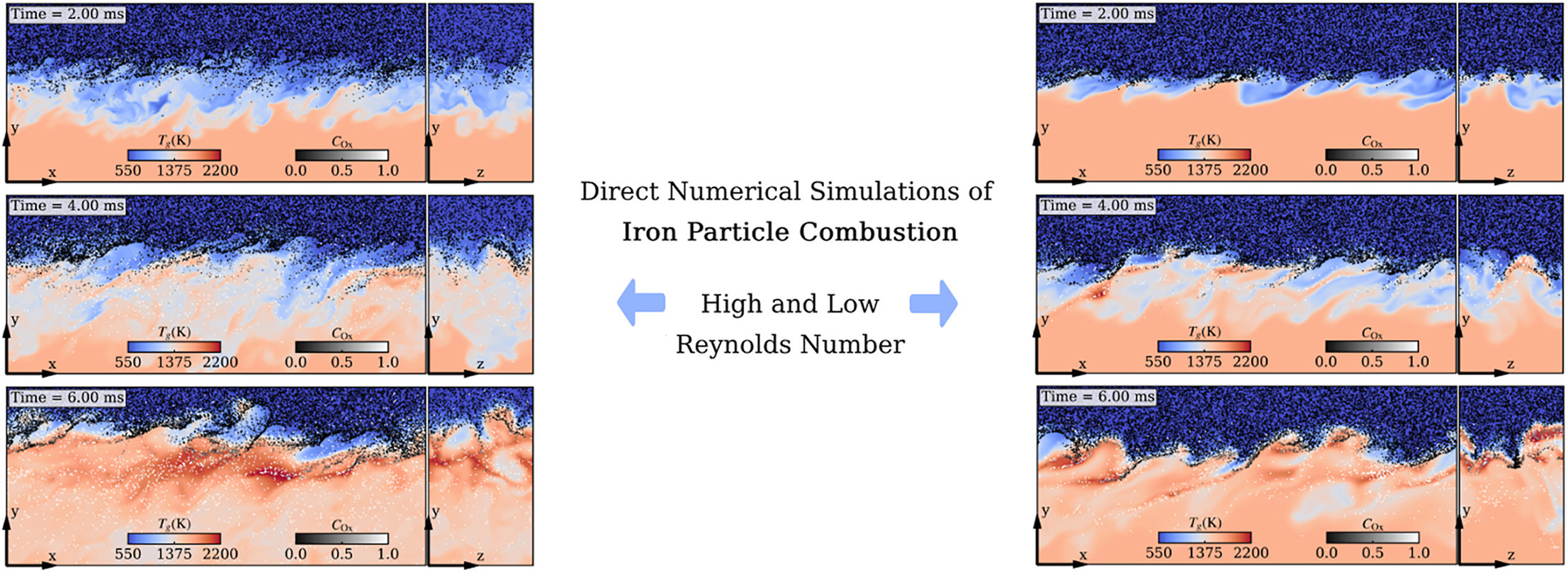
Carrier-phase direct numerical simulations (CP-DNS) of a three-dimensional turbulent shear- and mixing-layer are presented. DNS enables detailed investigation of complex multiphase turbulent reacting systems that are difficult to study experimentally; however, the reliability and reproducibility of such simulations remain uncertain and are potentially sensitive to the underlying numerical treatment. Given this, the simulations are cross-validated against DNS data by Luu et al. (Flow Turbul. Combust. 2024), first in a statistical sense and then, for the first time, by direct comparison of the instantaneous realizations of the two DNS. A further DNS is then presented for a higher Reynolds number at twice the grid resolution. This represents the most resolved carrier-phase DNS of such systems to date and enables higher turbulence conditions that better represent realistic burner operating conditions. The new simulations confirm the previously observed overall system behavior and further demonstrate the influence of Reynolds number on the combustion process. Higher turbulence intensity leads to a broader ignition zone, enhanced oxygen entrainment, and increased ignition and conversion rates, while the particle-scale oxidation behavior remains largely unchanged, indicating weak coupling between gas-phase turbulence and individual particle combustion.
Graphical abstract
Keywords
Iron combustion; Carrier-phase direct numerical simulation; Solid fuel combustion
文章导读