
期刊文章
过刊浏览
- Volumes 108-119 (2025)
-
Volumes 96-107 (2025)
-
Volume 107
Pages 1-376 (December 2025)
-
Volume 106
Pages 1-336 (November 2025)
-
Volume 105
Pages 1-356 (October 2025)
-
Volume 104
Pages 1-332 (September 2025)
-
Volume 103
Pages 1-314 (August 2025)
-
Volume 102
Pages 1-276 (July 2025)
-
Volume 101
Pages 1-166 (June 2025)
-
Volume 100
Pages 1-256 (May 2025)
-
Volume 99
Pages 1-242 (April 2025)
-
Volume 98
Pages 1-288 (March 2025)
-
Volume 97
Pages 1-256 (February 2025)
-
Volume 96
Pages 1-340 (January 2025)
-
Volume 107
-
Volumes 84-95 (2024)
-
Volume 95
Pages 1-392 (December 2024)
-
Volume 94
Pages 1-400 (November 2024)
-
Volume 93
Pages 1-376 (October 2024)
-
Volume 92
Pages 1-316 (September 2024)
-
Volume 91
Pages 1-378 (August 2024)
-
Volume 90
Pages 1-580 (July 2024)
-
Volume 89
Pages 1-278 (June 2024)
-
Volume 88
Pages 1-350 (May 2024)
-
Volume 87
Pages 1-338 (April 2024)
-
Volume 86
Pages 1-312 (March 2024)
-
Volume 85
Pages 1-334 (February 2024)
-
Volume 84
Pages 1-308 (January 2024)
-
Volume 95
-
Volumes 72-83 (2023)
-
Volume 83
Pages 1-258 (December 2023)
-
Volume 82
Pages 1-204 (November 2023)
-
Volume 81
Pages 1-188 (October 2023)
-
Volume 80
Pages 1-202 (September 2023)
-
Volume 79
Pages 1-172 (August 2023)
-
Volume 78
Pages 1-146 (July 2023)
-
Volume 77
Pages 1-152 (June 2023)
-
Volume 76
Pages 1-176 (May 2023)
-
Volume 75
Pages 1-228 (April 2023)
-
Volume 74
Pages 1-200 (March 2023)
-
Volume 73
Pages 1-138 (February 2023)
-
Volume 72
Pages 1-144 (January 2023)
-
Volume 83
-
Volumes 60-71 (2022)
-
Volume 71
Pages 1-108 (December 2022)
-
Volume 70
Pages 1-106 (November 2022)
-
Volume 69
Pages 1-122 (October 2022)
-
Volume 68
Pages 1-124 (September 2022)
-
Volume 67
Pages 1-102 (August 2022)
-
Volume 66
Pages 1-112 (July 2022)
-
Volume 65
Pages 1-138 (June 2022)
-
Volume 64
Pages 1-186 (May 2022)
-
Volume 63
Pages 1-124 (April 2022)
-
Volume 62
Pages 1-104 (March 2022)
-
Volume 61
Pages 1-120 (February 2022)
-
Volume 60
Pages 1-124 (January 2022)
-
Volume 71
- Volumes 54-59 (2021)
- Volumes 48-53 (2020)
- Volumes 42-47 (2019)
- Volumes 36-41 (2018)
- Volumes 30-35 (2017)
- Volumes 24-29 (2016)
- Volumes 18-23 (2015)
- Volumes 12-17 (2014)
- Volume 11 (2013)
- Volume 10 (2012)
- Volume 9 (2011)
- Volume 8 (2010)
- Volume 7 (2009)
- Volume 6 (2008)
- Volume 5 (2007)
- Volume 4 (2006)
- Volume 3 (2005)
- Volume 2 (2004)
- Volume 1 (2003)
Volume 115
Zhang, Q., Fu, G., Xu, S., Wang, D., Le, T., & Zhang, L. (2026). Ultrasound-assisted negative pressure crystallization of ammonium sulfate: Synergistic effects and intensification mechanisms. Particuology, 115, 401-414. https://doi.org/10.1016/j.partic.2026.06.003
Ultrasound-assisted negative pressure crystallization of ammonium sulfate: Synergistic effects and intensification mechanisms
Qian Zhang a b, Guang Fu c, Shuo Xu b, Dongbin Wang a b, Thiquynhxuan Le a b *, Libo Zhang a b *
a State Key Laboratory of Complex Non-ferrous Metal Resources Clean Utilization, Kunming University of Science and Technology, Kunming, 650093, China
b Faculty of Metallurgical and Energy Engineering, Kunming University of Science and Technology, Kunming, 650093, China
c Yunnan Chihong Zinc and Germanium Co., Ltd., Qujing, 655011, China
10.1016/j.partic.2026.06.003
Volume 115,
August 2026,
Pages 401-414
Received 7 April 2026, Revised 6 May 2026, Accepted 6 June 2026, Available online 9 June 2026, Version of Record 20 June 2026.
E-mail:
quynhxuanlt@kust.edu.cn; zhanglibopaper@126.com
Highlights
• Ultrasound-assisted negative pressure crystallization of ammonium sulfate solution.
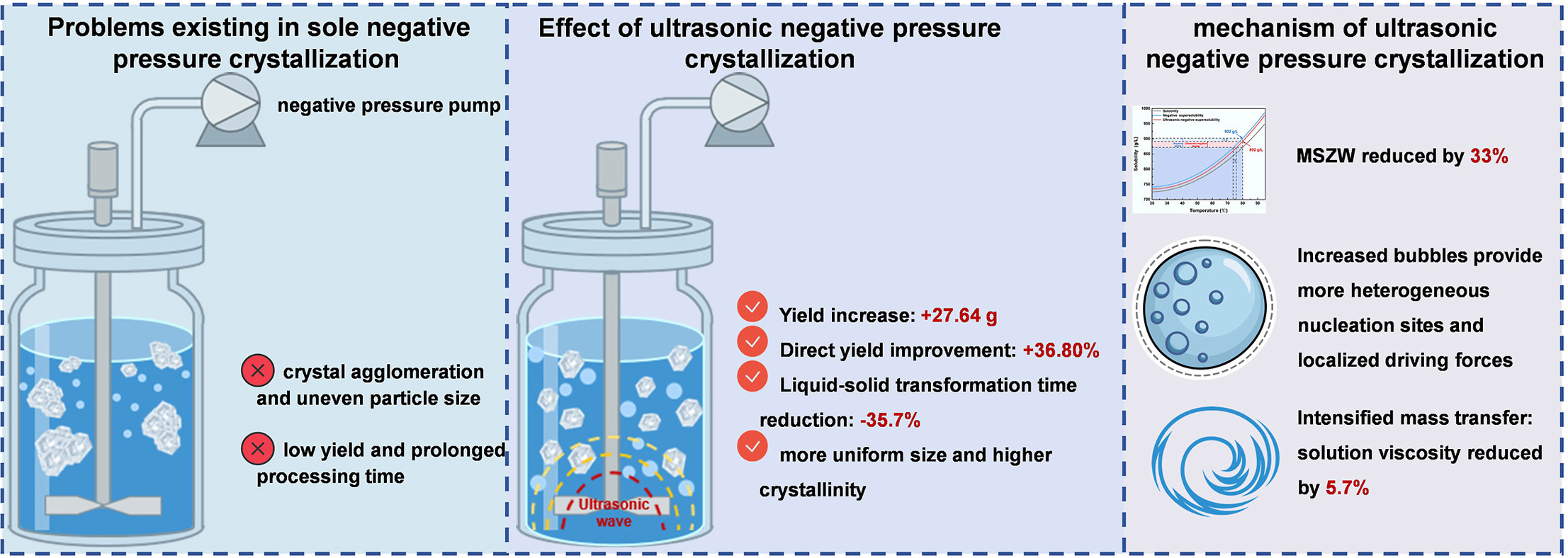
• Yield increased by 27.64 g and direct yield improved by 36.80% compared to negative pressure crystallization.
• MSZW narrowed by 33%, solid-liquid transition time shortened by 35.7%, and solution viscosity reduced by 5.7%.
• Crystals with more uniform size, regular morphology, and enhanced crystallinity are obtained.
Abstract
Although negative pressure crystallization of ammonium sulfate can mitigate low yield and long processing time in atmospheric pressure crystallization, it still faces challenges in enhancing crystallization efficiency and achieving a uniform crystal size distribution. To address these issues, this study proposed an ultrasound-assisted negative pressure crystallization technique. Under optimized conditions (pH = 7, 300 rpm, 80 °C, 45 min, 180 W, 0.03 MPa), the yield increased by 27.64 g and the direct yield improved by 36.80% compared with negative pressure crystallization. XRD and FTIR confirmed that this process maintained the crystal structure of ammonium sulfate while enhancing crystallinity. Mechanistic studies revealed that, compared with negative pressure crystallization, the synergistic effect of ultrasound narrowed the metastable zone width (MSZW) by approximately 33%, lowering the nucleation energy barrier. Ultrasound cavitation generated numerous bubbles, providing heterogeneous nucleation sites and localized supersaturation driving forces, which jointly accelerated nucleation and reduced the solid-liquid transition time by 35.7%. Furthermore, compared with the negative pressure crystallization system, the ultrasonic negative pressure crystallization reduced the solution viscosity by 5.7%, enhancing mass transfer and crystal growth. Ultimately, ultrasound-assisted negative pressure crystallization produced crystals with more uniform size and more regular morphology, offering important theoretical insights for improving ammonium sulfate crystallization processes.
Graphical abstract
Keywords
Ultrasound; Negative pressure crystallization; Synergistic intensification; Ammonium sulfate
文章导读