
Volume 116
Agglomeration characteristics of adhesive particles in curved pipes: An LBM-IBM-DEM study
Yibin Zhang, Yongzheng Jiang *, Youyang Liu, Zhengwu Wang
School of Mechanical and Electrical Engineering, Hunan University of Science and Technology, Xiangtan, 411201, China
10.1016/j.partic.2026.06.016
Volume 116,
September 2026,
Pages 249-263
Received 15 April 2026, Revised 18 May 2026, Accepted 9 June 2026, Available online 24 June 2026, Version of Record 11 July 2026.
E-mail:
jiangyz186@hnust.edu.cn
Highlights
• High surface energy induces stronger agglomeration and severe flow obstruction.
• Broader size distribution intensifies collisions, forming dense large clusters.
• High flow velocity suspends agglomerates and reduces deposition clogging risk.
• Exceeding critical particle numbers drops velocity and severely blocks the pipe.
Abstract
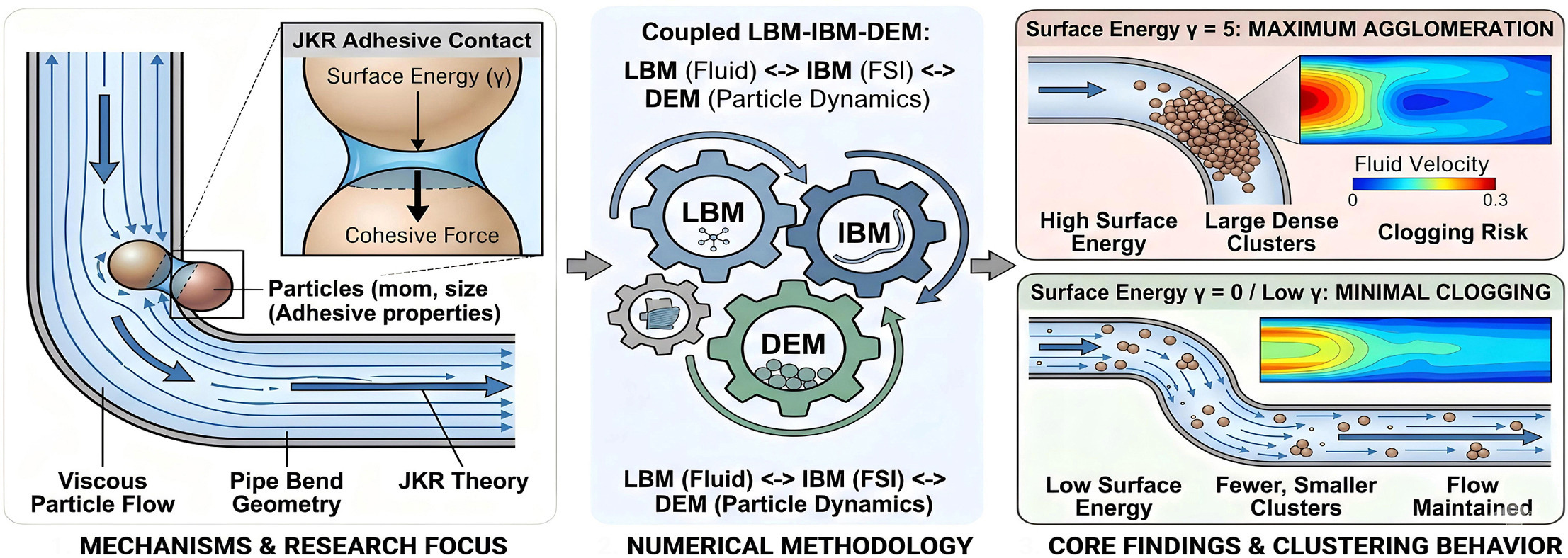
Solid-liquid two-phase flow pipeline transportation is widely utilized in mine backfilling and concrete pumping. Conventional numerical simulations commonly overlook inter-particle adhesion in high-viscosity materials, failing to precisely capture the dynamic evolution of particle contact-adhesion. To tackle this technical issue, the Johnson-Kendall-Roberts (JKR) adhesive contact theory is integrated into the coupled Lattice Boltzmann Method-Immersed Boundary Method-Discrete Element Method (LBM-IBM-DEM) framework, and the influences of surface energy, particle size random coefficient, inlet velocity and particle number on fluid-solid coupling and agglomeration behaviors are systematically explored. Results indicate that adhesive particles maintain high collision frequency in bend pipes and reduce the global flow velocity; medium and high adhesion present similar collision frequency while high adhesion generates stronger agglomeration and flow field hindrance; a wider size distribution intensifies particle collisions and agglomeration; particle agglomeration is governed by both collision frequency and flow velocity with distinct aggregation patterns; a large particle number fills the bend pipe cross-section and drastically elevates the blockage risk. This work unravels the adhesion-dominated macroscopic blockage mechanism, laying a theoretical foundation for anti-blockage design in pipeline transportation engineering.
Graphical abstract
Keywords
Numerical simulation; Particle agglomeration; Pipe bend blockage; JKR adhesive contact; Surface energy
文章导读