
期刊文章
过刊浏览
- Volumes 108-119 (2025)
-
Volumes 96-107 (2025)
-
Volume 107
Pages 1-376 (December 2025)
-
Volume 106
Pages 1-336 (November 2025)
-
Volume 105
Pages 1-356 (October 2025)
-
Volume 104
Pages 1-332 (September 2025)
-
Volume 103
Pages 1-314 (August 2025)
-
Volume 102
Pages 1-276 (July 2025)
-
Volume 101
Pages 1-166 (June 2025)
-
Volume 100
Pages 1-256 (May 2025)
-
Volume 99
Pages 1-242 (April 2025)
-
Volume 98
Pages 1-288 (March 2025)
-
Volume 97
Pages 1-256 (February 2025)
-
Volume 96
Pages 1-340 (January 2025)
-
Volume 107
-
Volumes 84-95 (2024)
-
Volume 95
Pages 1-392 (December 2024)
-
Volume 94
Pages 1-400 (November 2024)
-
Volume 93
Pages 1-376 (October 2024)
-
Volume 92
Pages 1-316 (September 2024)
-
Volume 91
Pages 1-378 (August 2024)
-
Volume 90
Pages 1-580 (July 2024)
-
Volume 89
Pages 1-278 (June 2024)
-
Volume 88
Pages 1-350 (May 2024)
-
Volume 87
Pages 1-338 (April 2024)
-
Volume 86
Pages 1-312 (March 2024)
-
Volume 85
Pages 1-334 (February 2024)
-
Volume 84
Pages 1-308 (January 2024)
-
Volume 95
-
Volumes 72-83 (2023)
-
Volume 83
Pages 1-258 (December 2023)
-
Volume 82
Pages 1-204 (November 2023)
-
Volume 81
Pages 1-188 (October 2023)
-
Volume 80
Pages 1-202 (September 2023)
-
Volume 79
Pages 1-172 (August 2023)
-
Volume 78
Pages 1-146 (July 2023)
-
Volume 77
Pages 1-152 (June 2023)
-
Volume 76
Pages 1-176 (May 2023)
-
Volume 75
Pages 1-228 (April 2023)
-
Volume 74
Pages 1-200 (March 2023)
-
Volume 73
Pages 1-138 (February 2023)
-
Volume 72
Pages 1-144 (January 2023)
-
Volume 83
-
Volumes 60-71 (2022)
-
Volume 71
Pages 1-108 (December 2022)
-
Volume 70
Pages 1-106 (November 2022)
-
Volume 69
Pages 1-122 (October 2022)
-
Volume 68
Pages 1-124 (September 2022)
-
Volume 67
Pages 1-102 (August 2022)
-
Volume 66
Pages 1-112 (July 2022)
-
Volume 65
Pages 1-138 (June 2022)
-
Volume 64
Pages 1-186 (May 2022)
-
Volume 63
Pages 1-124 (April 2022)
-
Volume 62
Pages 1-104 (March 2022)
-
Volume 61
Pages 1-120 (February 2022)
-
Volume 60
Pages 1-124 (January 2022)
-
Volume 71
- Volumes 54-59 (2021)
- Volumes 48-53 (2020)
- Volumes 42-47 (2019)
- Volumes 36-41 (2018)
- Volumes 30-35 (2017)
- Volumes 24-29 (2016)
- Volumes 18-23 (2015)
- Volumes 12-17 (2014)
- Volume 11 (2013)
- Volume 10 (2012)
- Volume 9 (2011)
- Volume 8 (2010)
- Volume 7 (2009)
- Volume 6 (2008)
- Volume 5 (2007)
- Volume 4 (2006)
- Volume 3 (2005)
- Volume 2 (2004)
- Volume 1 (2003)
Volume 117
Threading the needle between nano-milling efficiency and electrostatic stability (Open Access)
Willian F. Camargo a 1, Ana M. Segadães b *, Robinson C.D. Cruz a
a University of Caxias Do Sul, Postgraduate Program in Engineering and Materials Science, Caxias Do Sul, RS, Brazil
b University of Aveiro, Department of Materials and Ceramics Engineering (CICECO), Aveiro, Portugal
10.1016/j.partic.2026.07.002
Volume 117,
October 2026,
Pages 8-16
Received 23 December 2025, Revised 1 July 2026, Accepted 5 July 2026, Available online 15 July 2026, Version of Record 20 July 2026.
E-mail:
segadaes@ua.pt
Highlights
• Particle/bead electrostatic forces (attractive vs. repulsive) rule milling results.
• Milling improves when particles are attracted to (trapped on) the beads' surfaces.
• PH shifting during milling is directly related to ion adsorption at new surfaces.
• Ground powder amorphization is affected by the milling suspension pH.
• Tuning the ζ-potential of powder and beads may affect beads' wear and cleanability.
Abstract
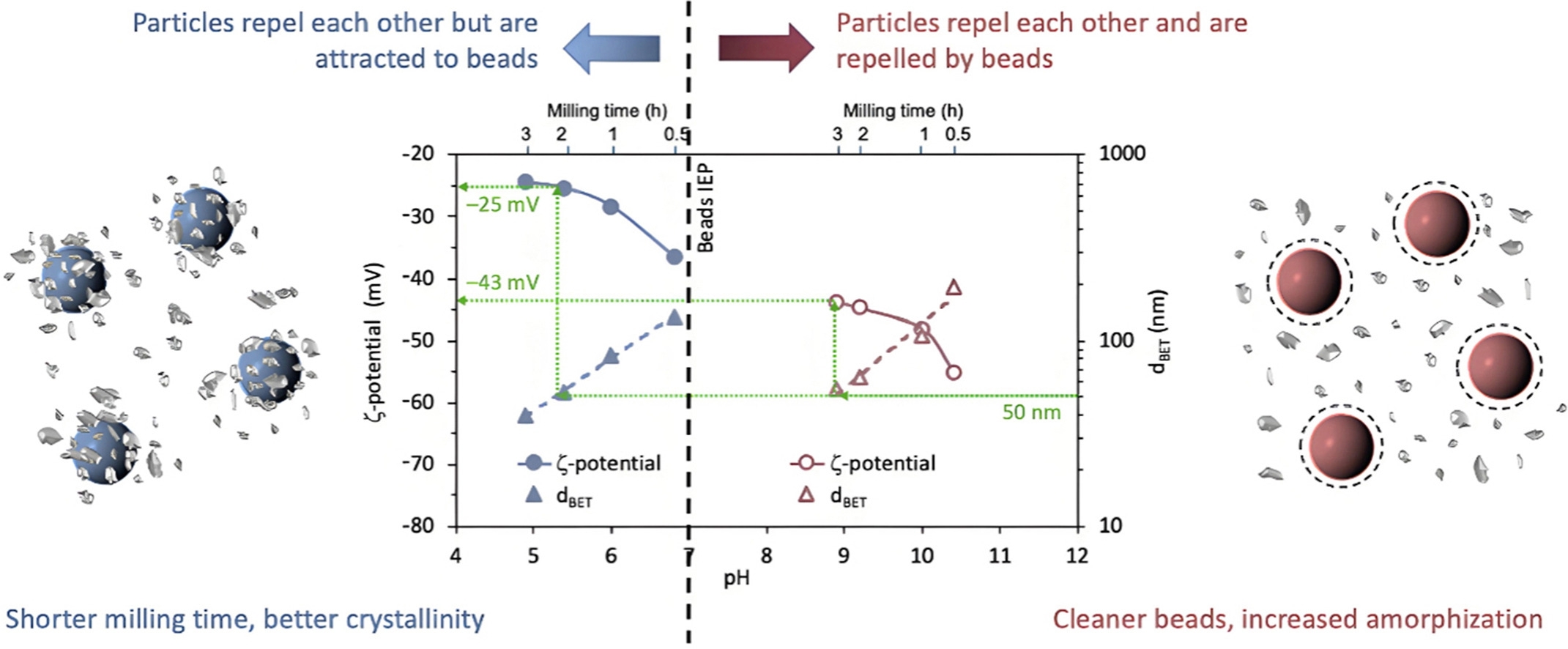
In this work, the high-energy milling of Quartz (20 wt% solids) using YSZ beads was assessed by specific energy consumption and particle size, specific surface area and ζ-potential. The use of 400 μm beads and a stirrer-tip speed of 16.8 m/s produces a 43 nm powder in 3-h milling runs. During milling, pH continuously decreases towards the Quartz's isoelectric point near pH 2, which was directly related to the OH− adsorption at the newly exposed positively charged surfaces. However, while particles' ζ-potential remains negative, that of the milling beads (isoelectric point ≈7) shifts to positive. Milling runs were designed to separate the effect of attractive and repulsive particle/bead electrostatic forces. When milling at “pH 5”, the ζ-potentials of particles and beads show opposing signs and lower particle sizes are obtained (39 nm, instead of 54 nm at “pH 9”). The new particles, which still repel each other, are attracted to the beads' surface where they are ground further. At “pH 5”, 50 nm particles can be produced in roughly two-thirds of the time needed at “pH 9”. Tuning the ζ-potential of powder to that of beads impacts milling efficiency and powder crystallinity, and may also affect beads' surface wear and cleanability.
Graphical abstract
Keywords
Quartz; High-energy bead milling; Electrostatic stability; ζ-potential; Particle size; Specific surface area
文章导读