
期刊文章
过刊浏览
- Volumes 108-119 (2025)
-
Volumes 96-107 (2025)
-
Volume 107
Pages 1-376 (December 2025)
-
Volume 106
Pages 1-336 (November 2025)
-
Volume 105
Pages 1-356 (October 2025)
-
Volume 104
Pages 1-332 (September 2025)
-
Volume 103
Pages 1-314 (August 2025)
-
Volume 102
Pages 1-276 (July 2025)
-
Volume 101
Pages 1-166 (June 2025)
-
Volume 100
Pages 1-256 (May 2025)
-
Volume 99
Pages 1-242 (April 2025)
-
Volume 98
Pages 1-288 (March 2025)
-
Volume 97
Pages 1-256 (February 2025)
-
Volume 96
Pages 1-340 (January 2025)
-
Volume 107
-
Volumes 84-95 (2024)
-
Volume 95
Pages 1-392 (December 2024)
-
Volume 94
Pages 1-400 (November 2024)
-
Volume 93
Pages 1-376 (October 2024)
-
Volume 92
Pages 1-316 (September 2024)
-
Volume 91
Pages 1-378 (August 2024)
-
Volume 90
Pages 1-580 (July 2024)
-
Volume 89
Pages 1-278 (June 2024)
-
Volume 88
Pages 1-350 (May 2024)
-
Volume 87
Pages 1-338 (April 2024)
-
Volume 86
Pages 1-312 (March 2024)
-
Volume 85
Pages 1-334 (February 2024)
-
Volume 84
Pages 1-308 (January 2024)
-
Volume 95
-
Volumes 72-83 (2023)
-
Volume 83
Pages 1-258 (December 2023)
-
Volume 82
Pages 1-204 (November 2023)
-
Volume 81
Pages 1-188 (October 2023)
-
Volume 80
Pages 1-202 (September 2023)
-
Volume 79
Pages 1-172 (August 2023)
-
Volume 78
Pages 1-146 (July 2023)
-
Volume 77
Pages 1-152 (June 2023)
-
Volume 76
Pages 1-176 (May 2023)
-
Volume 75
Pages 1-228 (April 2023)
-
Volume 74
Pages 1-200 (March 2023)
-
Volume 73
Pages 1-138 (February 2023)
-
Volume 72
Pages 1-144 (January 2023)
-
Volume 83
-
Volumes 60-71 (2022)
-
Volume 71
Pages 1-108 (December 2022)
-
Volume 70
Pages 1-106 (November 2022)
-
Volume 69
Pages 1-122 (October 2022)
-
Volume 68
Pages 1-124 (September 2022)
-
Volume 67
Pages 1-102 (August 2022)
-
Volume 66
Pages 1-112 (July 2022)
-
Volume 65
Pages 1-138 (June 2022)
-
Volume 64
Pages 1-186 (May 2022)
-
Volume 63
Pages 1-124 (April 2022)
-
Volume 62
Pages 1-104 (March 2022)
-
Volume 61
Pages 1-120 (February 2022)
-
Volume 60
Pages 1-124 (January 2022)
-
Volume 71
- Volumes 54-59 (2021)
- Volumes 48-53 (2020)
- Volumes 42-47 (2019)
- Volumes 36-41 (2018)
- Volumes 30-35 (2017)
- Volumes 24-29 (2016)
- Volumes 18-23 (2015)
- Volumes 12-17 (2014)
- Volume 11 (2013)
- Volume 10 (2012)
- Volume 9 (2011)
- Volume 8 (2010)
- Volume 7 (2009)
- Volume 6 (2008)
- Volume 5 (2007)
- Volume 4 (2006)
- Volume 3 (2005)
- Volume 2 (2004)
- Volume 1 (2003)
Volume 117
Efficient and clean extraction and separation of rubidium from low-grade rubidium ore via stepwise acid treatment and crystallization
Xiang Li a b 1, Konghai Xia a b 1, Hui Yang a b, Yubo Liu a b, Baozhong Ma a b *, Yongqiang Chen a b, Chengyan Wang a b
a State Key Laboratory of Advanced Metallurgy, University of Science and Technology Beijing, Beijing, 100083, China
b School of Metallurgical and Ecological Engineering, University of Science and Technology Beijing, Beijing, 100083, China
10.1016/j.partic.2026.07.005
Volume 117,
October 2026,
Pages 17-28
Received 4 May 2026, Revised 7 July 2026, Accepted 9 July 2026, Available online 17 July 2026, Version of Record 22 July 2026.
E-mail:
bzhma_ustb@yeah.net
Highlights
• A novel process was proposed for efficient extraction from low-grade rubidium ore.
• The pickling process enhanced extraction efficiency and reduced waste generation.
• A simple low-temperature sulfidation process enables transformation of Rb-containing phase.
• The leaching residue was able to prepare high-purity silicon products.
Abstract
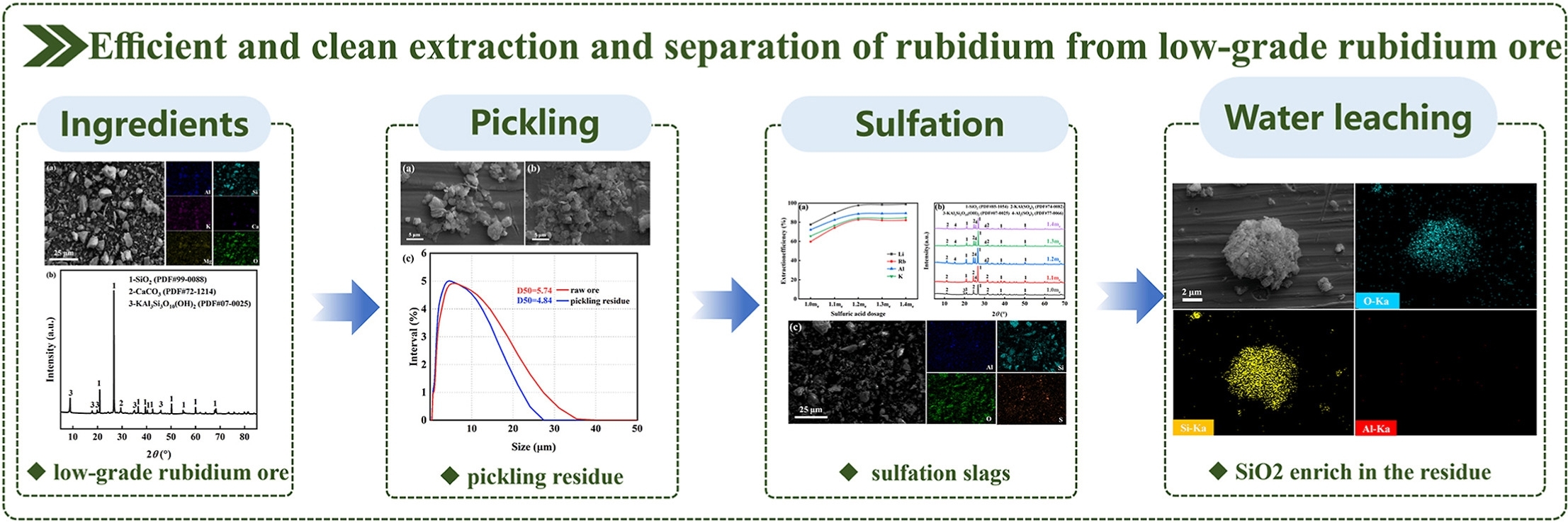
Rubidium is an important strategic metal. In this study, rubidium was efficiently extracted and separated from low-grade rubidium ore via stepwise acid leaching and crystallization. The main phase composition of low-grade rubidium ore was determined as muscovite, calcite, and quartz. This paper adopted hydrochloric acid pickling to remove calcium, and then extracted the valuable elements by sulfation-water leaching. The removal of calcium reached 99.3% under the optimum pickling conditions of 70 °C, 0.5 mol/L HCl, 1.5 h, and 2 mL/g Liquid-solid (L/S) ratio. The average particle size of low-grade rubidium after pickling was decreased from 5.74 μm to 4.84 μm. Compared with direct sulfation, the process combined with pickling and sulfation could increase the extraction of rubidium by around 10%. The production of CaSO4 waste residues was avoided. The systematic sulfation and water leaching experiments indicated that the extraction of rubidium reached 85.4% under the optimal conditions. However, 92.8% of aluminum and 87.1% of potassium were also extracted simultaneously. Subsequently, the preliminary separation of rubidium and potassium could be achieved by crystallization, which laid the foundation for the subsequent preparation of high-purity rubidium products. The content of SiO2 in leaching residue reached 94.4%.
Graphical abstract
Keywords
Rubidium; Low-grade rubidium ore; Stepwise acid treatment; Crystallization; Extraction
文章导读