
期刊文章
过刊浏览
- Volumes 108-119 (2025)
-
Volumes 96-107 (2025)
-
Volume 107
Pages 1-376 (December 2025)
-
Volume 106
Pages 1-336 (November 2025)
-
Volume 105
Pages 1-356 (October 2025)
-
Volume 104
Pages 1-332 (September 2025)
-
Volume 103
Pages 1-314 (August 2025)
-
Volume 102
Pages 1-276 (July 2025)
-
Volume 101
Pages 1-166 (June 2025)
-
Volume 100
Pages 1-256 (May 2025)
-
Volume 99
Pages 1-242 (April 2025)
-
Volume 98
Pages 1-288 (March 2025)
-
Volume 97
Pages 1-256 (February 2025)
-
Volume 96
Pages 1-340 (January 2025)
-
Volume 107
-
Volumes 84-95 (2024)
-
Volume 95
Pages 1-392 (December 2024)
-
Volume 94
Pages 1-400 (November 2024)
-
Volume 93
Pages 1-376 (October 2024)
-
Volume 92
Pages 1-316 (September 2024)
-
Volume 91
Pages 1-378 (August 2024)
-
Volume 90
Pages 1-580 (July 2024)
-
Volume 89
Pages 1-278 (June 2024)
-
Volume 88
Pages 1-350 (May 2024)
-
Volume 87
Pages 1-338 (April 2024)
-
Volume 86
Pages 1-312 (March 2024)
-
Volume 85
Pages 1-334 (February 2024)
-
Volume 84
Pages 1-308 (January 2024)
-
Volume 95
-
Volumes 72-83 (2023)
-
Volume 83
Pages 1-258 (December 2023)
-
Volume 82
Pages 1-204 (November 2023)
-
Volume 81
Pages 1-188 (October 2023)
-
Volume 80
Pages 1-202 (September 2023)
-
Volume 79
Pages 1-172 (August 2023)
-
Volume 78
Pages 1-146 (July 2023)
-
Volume 77
Pages 1-152 (June 2023)
-
Volume 76
Pages 1-176 (May 2023)
-
Volume 75
Pages 1-228 (April 2023)
-
Volume 74
Pages 1-200 (March 2023)
-
Volume 73
Pages 1-138 (February 2023)
-
Volume 72
Pages 1-144 (January 2023)
-
Volume 83
-
Volumes 60-71 (2022)
-
Volume 71
Pages 1-108 (December 2022)
-
Volume 70
Pages 1-106 (November 2022)
-
Volume 69
Pages 1-122 (October 2022)
-
Volume 68
Pages 1-124 (September 2022)
-
Volume 67
Pages 1-102 (August 2022)
-
Volume 66
Pages 1-112 (July 2022)
-
Volume 65
Pages 1-138 (June 2022)
-
Volume 64
Pages 1-186 (May 2022)
-
Volume 63
Pages 1-124 (April 2022)
-
Volume 62
Pages 1-104 (March 2022)
-
Volume 61
Pages 1-120 (February 2022)
-
Volume 60
Pages 1-124 (January 2022)
-
Volume 71
- Volumes 54-59 (2021)
- Volumes 48-53 (2020)
- Volumes 42-47 (2019)
- Volumes 36-41 (2018)
- Volumes 30-35 (2017)
- Volumes 24-29 (2016)
- Volumes 18-23 (2015)
- Volumes 12-17 (2014)
- Volume 11 (2013)
- Volume 10 (2012)
- Volume 9 (2011)
- Volume 8 (2010)
- Volume 7 (2009)
- Volume 6 (2008)
- Volume 5 (2007)
- Volume 4 (2006)
- Volume 3 (2005)
- Volume 2 (2004)
- Volume 1 (2003)
Volume 117
Coarse-grained CFD-DEM study of gas-particle flow in solid propellant microthruster
Kaiwei Chu a *, Yandong Zhao b, Yimin Wei a, Sajjad Hussain a, Zeyong Yan b, Zhiwei Shi b, Yao Liu a, Zhiming Chen a, Wenjing Yang c, Peijin Liu c *, Yuqing Feng d
a School of Qilu Transportation, Shandong University, Jinan, 250061, China
b Inner Mongolia Institute of Dynamical Machinery, Huhehaote, 010010, China
c School of Aeronautics, Northwestern Polytechnical University, Xi'an, 710072, China
d Mineral Resources Business Unit, CSIRO, Clayton, VIC, 3169, Australia
10.1016/j.partic.2026.07.004
Volume 117,
October 2026,
Pages 41-59
Received 30 April 2026, Revised 24 June 2026, Accepted 6 July 2026, Available online 15 July 2026, Version of Record 22 July 2026.
E-mail:
k.chu@sdu.edu.cn; liupj@nwpu.edu.cn
Highlights
• A CG CFD-DEM model is developed for gas-particle microthruster flows.
• Intense particle-particle and particle-wall interaction regions are predicted.
• Particles of different sizes have different behaviours and effects on gas flow.
• Particle mass fraction has an obvious effect on the centerline Mach number.
Abstract
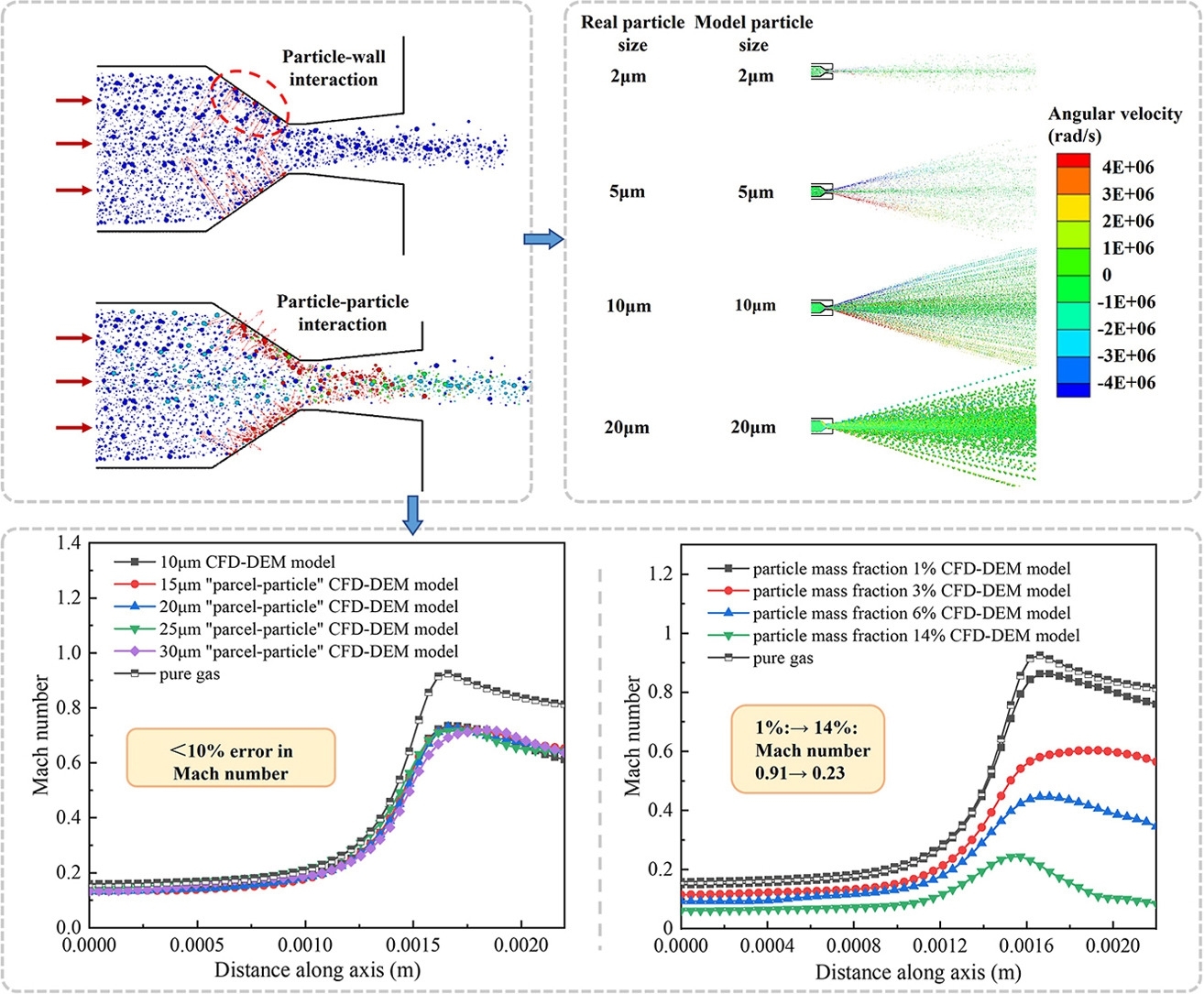
A coarse-grained computational fluid dynamics-discrete element method (CG CFD-DEM) model is developed to investigate gas-solid flow in solid propellant microthrusters, with consideration of particle-particle, particle-wall and particle-gas interactions. The coarse-grained model is first compared with the conventional CFD-DEM model, showing comparable predictions with significantly reduced computational cost and less than 10% error in the axial Mach number. The validated model is then used to examine the effects of particle size and particle loading on gas-particle flow behaviour. The results show that particle size and loading have a clear influence on particle velocities, gas-solid momentum exchange, pressure loss, and Mach number distribution. Smaller particles exhibit better gas-following ability and generate a larger overall drag force at the same particle mass flow rate because of the increased particle number. Reducing the particle size from 20 to 2 μm decreases the peak centerline Mach number by nearly 48%. Meanwhile, decreasing the particle mass fraction from 14% to 1% increases the centerline Mach number to nearly four times its original value. The present work demonstrates that the CG CFD-DEM approach provides a reliable and computationally efficient framework for simulating dense gas-particle flows in complex propulsion environments.
Graphical abstract
Keywords
Solid propellant microthruster; Gas-particle flow; Computational fluid dynamics; Discrete element method; Coarse-grained modelling
文章导读