
期刊文章
过刊浏览
- Volumes 108-119 (2025)
-
Volumes 96-107 (2025)
-
Volume 107
Pages 1-376 (December 2025)
-
Volume 106
Pages 1-336 (November 2025)
-
Volume 105
Pages 1-356 (October 2025)
-
Volume 104
Pages 1-332 (September 2025)
-
Volume 103
Pages 1-314 (August 2025)
-
Volume 102
Pages 1-276 (July 2025)
-
Volume 101
Pages 1-166 (June 2025)
-
Volume 100
Pages 1-256 (May 2025)
-
Volume 99
Pages 1-242 (April 2025)
-
Volume 98
Pages 1-288 (March 2025)
-
Volume 97
Pages 1-256 (February 2025)
-
Volume 96
Pages 1-340 (January 2025)
-
Volume 107
-
Volumes 84-95 (2024)
-
Volume 95
Pages 1-392 (December 2024)
-
Volume 94
Pages 1-400 (November 2024)
-
Volume 93
Pages 1-376 (October 2024)
-
Volume 92
Pages 1-316 (September 2024)
-
Volume 91
Pages 1-378 (August 2024)
-
Volume 90
Pages 1-580 (July 2024)
-
Volume 89
Pages 1-278 (June 2024)
-
Volume 88
Pages 1-350 (May 2024)
-
Volume 87
Pages 1-338 (April 2024)
-
Volume 86
Pages 1-312 (March 2024)
-
Volume 85
Pages 1-334 (February 2024)
-
Volume 84
Pages 1-308 (January 2024)
-
Volume 95
-
Volumes 72-83 (2023)
-
Volume 83
Pages 1-258 (December 2023)
-
Volume 82
Pages 1-204 (November 2023)
-
Volume 81
Pages 1-188 (October 2023)
-
Volume 80
Pages 1-202 (September 2023)
-
Volume 79
Pages 1-172 (August 2023)
-
Volume 78
Pages 1-146 (July 2023)
-
Volume 77
Pages 1-152 (June 2023)
-
Volume 76
Pages 1-176 (May 2023)
-
Volume 75
Pages 1-228 (April 2023)
-
Volume 74
Pages 1-200 (March 2023)
-
Volume 73
Pages 1-138 (February 2023)
-
Volume 72
Pages 1-144 (January 2023)
-
Volume 83
-
Volumes 60-71 (2022)
-
Volume 71
Pages 1-108 (December 2022)
-
Volume 70
Pages 1-106 (November 2022)
-
Volume 69
Pages 1-122 (October 2022)
-
Volume 68
Pages 1-124 (September 2022)
-
Volume 67
Pages 1-102 (August 2022)
-
Volume 66
Pages 1-112 (July 2022)
-
Volume 65
Pages 1-138 (June 2022)
-
Volume 64
Pages 1-186 (May 2022)
-
Volume 63
Pages 1-124 (April 2022)
-
Volume 62
Pages 1-104 (March 2022)
-
Volume 61
Pages 1-120 (February 2022)
-
Volume 60
Pages 1-124 (January 2022)
-
Volume 71
- Volumes 54-59 (2021)
- Volumes 48-53 (2020)
- Volumes 42-47 (2019)
- Volumes 36-41 (2018)
- Volumes 30-35 (2017)
- Volumes 24-29 (2016)
- Volumes 18-23 (2015)
- Volumes 12-17 (2014)
- Volume 11 (2013)
- Volume 10 (2012)
- Volume 9 (2011)
- Volume 8 (2010)
- Volume 7 (2009)
- Volume 6 (2008)
- Volume 5 (2007)
- Volume 4 (2006)
- Volume 3 (2005)
- Volume 2 (2004)
- Volume 1 (2003)
Volume 117
Adaptive Gaussian mapping for unresolved CFD-DEM coupling
Najmeh Negahdari a, Ramin Khodabandehlou b, Hamid Reza Norouzi a *
a Center of Engineering and Multiscale Modelling of Fluid Flow (CEMF), Department of Chemical Engineering, Amirkabir University of Technology, Tehran, Iran
b Multiphase Systems Research Lab, School of Chemical Engineering, University of Tehran, Tehran, Iran
10.1016/j.partic.2026.06.035
Volume 117,
October 2026,
Pages 60-75
Received 30 January 2026, Revised 19 June 2026, Accepted 26 June 2026, Available online 18 July 2026, Version of Record 27 July 2026.
E-mail:
h.norouzi@aut.ac.ir
Highlights
• Adaptive Gaussian mapping method is proposed for unresolved CFD-DEM.
• It handles varying cell-to-particle size ratio down to one.
• It maintains mapping accuracy for hexahedral and polyhedral meshes with low non-orthogonality.
Abstract
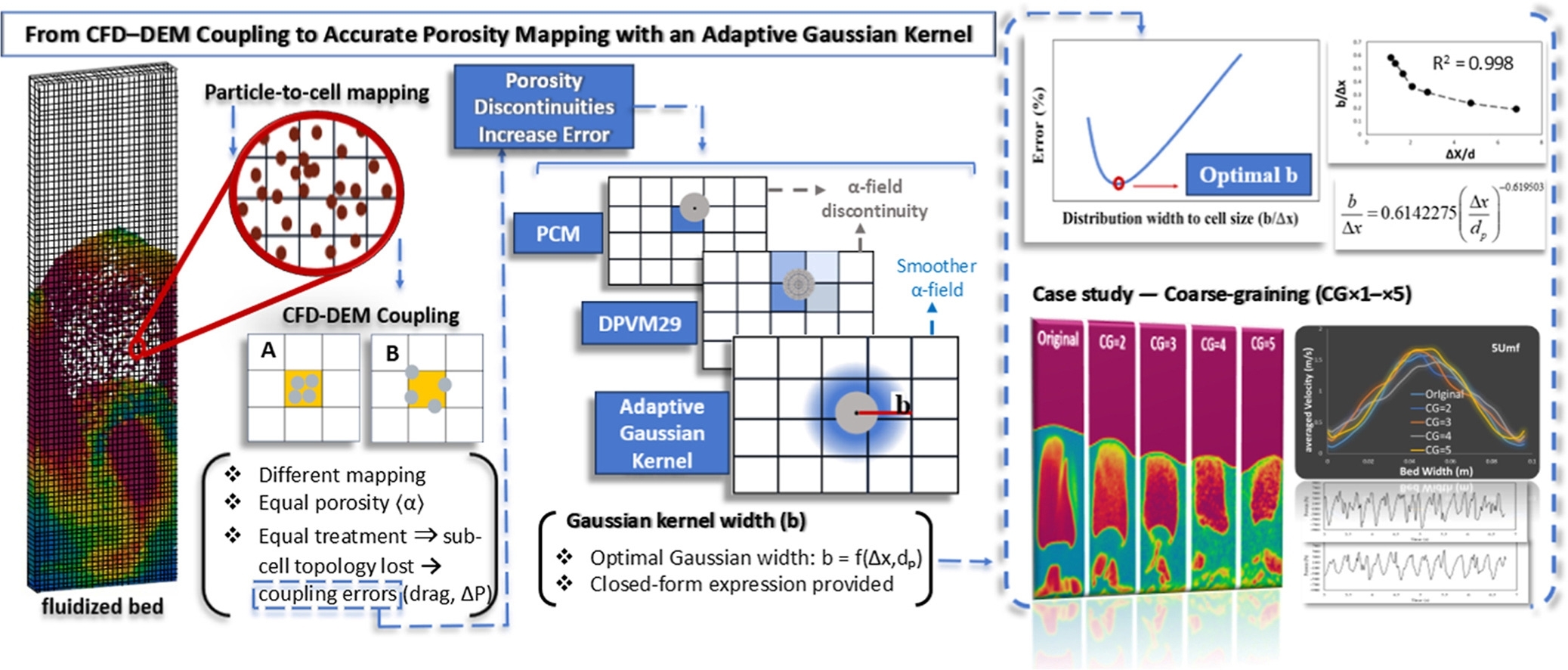
The computational fluid dynamics–discrete element method (CFD-DEM) is widely used for simulating particle–fluid systems. Coupling the fluid and particle phases requires porosity to be calculated, as well as the interphase momentum exchange terms, through mapping the particles into CFD cells. However, in practice, no single mapping approach is suitable for the broad range of CFD cell sizes to particle diameters, particularly when the ratio is close to unity. To address this, a new adaptive Gaussian mapping method has been developed, in which the kernel parameters are automatically adjusted according to the local CFD cell size and particle diameter. The validity of the proposed approach was evaluated under various packing conditions and mesh structures. For orthogonal hexahedral meshes, the mapping error remained below 2% for medium packing density and approximately 2–4% for dense packing (with a cell-to-particle size ratio between 1 and 3). For polyhedral meshes with low non-orthogonality, the error was below 1%. However, highly non-orthogonal meshes exhibited errors of up to 14%, suggesting reduced robustness in these conditions. The method was further validated in coarse-grained fluidized bed simulations, with the ratio of the cell size to the particle diameter varying from 5 to 1. Compared with diffusion-based simulations, the adaptive Gaussian method preserves the hydrodynamic behavior of the bed when coarse-graining is increased. This was achieved by controlling the smoothing locally through adaptive kernel-width adjustment, which avoids excessive smoothing. The results demonstrate that the proposed approach can effectively predict the hydrodynamic behavior of fluidized beds, particularly in coarse-grained CFD-DEM simulations.
Graphical abstract
Keywords
Fluidization; CFD-DEM; Coarse-graining; Porosity; Gaussian distribution
文章导读