
期刊文章
过刊浏览
- Volumes 108-119 (2025)
-
Volumes 96-107 (2025)
-
Volume 107
Pages 1-376 (December 2025)
-
Volume 106
Pages 1-336 (November 2025)
-
Volume 105
Pages 1-356 (October 2025)
-
Volume 104
Pages 1-332 (September 2025)
-
Volume 103
Pages 1-314 (August 2025)
-
Volume 102
Pages 1-276 (July 2025)
-
Volume 101
Pages 1-166 (June 2025)
-
Volume 100
Pages 1-256 (May 2025)
-
Volume 99
Pages 1-242 (April 2025)
-
Volume 98
Pages 1-288 (March 2025)
-
Volume 97
Pages 1-256 (February 2025)
-
Volume 96
Pages 1-340 (January 2025)
-
Volume 107
-
Volumes 84-95 (2024)
-
Volume 95
Pages 1-392 (December 2024)
-
Volume 94
Pages 1-400 (November 2024)
-
Volume 93
Pages 1-376 (October 2024)
-
Volume 92
Pages 1-316 (September 2024)
-
Volume 91
Pages 1-378 (August 2024)
-
Volume 90
Pages 1-580 (July 2024)
-
Volume 89
Pages 1-278 (June 2024)
-
Volume 88
Pages 1-350 (May 2024)
-
Volume 87
Pages 1-338 (April 2024)
-
Volume 86
Pages 1-312 (March 2024)
-
Volume 85
Pages 1-334 (February 2024)
-
Volume 84
Pages 1-308 (January 2024)
-
Volume 95
-
Volumes 72-83 (2023)
-
Volume 83
Pages 1-258 (December 2023)
-
Volume 82
Pages 1-204 (November 2023)
-
Volume 81
Pages 1-188 (October 2023)
-
Volume 80
Pages 1-202 (September 2023)
-
Volume 79
Pages 1-172 (August 2023)
-
Volume 78
Pages 1-146 (July 2023)
-
Volume 77
Pages 1-152 (June 2023)
-
Volume 76
Pages 1-176 (May 2023)
-
Volume 75
Pages 1-228 (April 2023)
-
Volume 74
Pages 1-200 (March 2023)
-
Volume 73
Pages 1-138 (February 2023)
-
Volume 72
Pages 1-144 (January 2023)
-
Volume 83
-
Volumes 60-71 (2022)
-
Volume 71
Pages 1-108 (December 2022)
-
Volume 70
Pages 1-106 (November 2022)
-
Volume 69
Pages 1-122 (October 2022)
-
Volume 68
Pages 1-124 (September 2022)
-
Volume 67
Pages 1-102 (August 2022)
-
Volume 66
Pages 1-112 (July 2022)
-
Volume 65
Pages 1-138 (June 2022)
-
Volume 64
Pages 1-186 (May 2022)
-
Volume 63
Pages 1-124 (April 2022)
-
Volume 62
Pages 1-104 (March 2022)
-
Volume 61
Pages 1-120 (February 2022)
-
Volume 60
Pages 1-124 (January 2022)
-
Volume 71
- Volumes 54-59 (2021)
- Volumes 48-53 (2020)
- Volumes 42-47 (2019)
- Volumes 36-41 (2018)
- Volumes 30-35 (2017)
- Volumes 24-29 (2016)
- Volumes 18-23 (2015)
- Volumes 12-17 (2014)
- Volume 11 (2013)
- Volume 10 (2012)
- Volume 9 (2011)
- Volume 8 (2010)
- Volume 7 (2009)
- Volume 6 (2008)
- Volume 5 (2007)
- Volume 4 (2006)
- Volume 3 (2005)
- Volume 2 (2004)
- Volume 1 (2003)
Volume 117
Coarse-grained CFD-DEM modeling for heat transfer of cylindrical biomass particles in gas–solid fluidized beds
Yuhao Hu a, Yuqi Guo a, Jinlong Wang a, Xiaosong Hu a, Huaqing Ma b, Lianyong Zhou c *, Yongzhi Zhao a *
a Institute of Advanced Equipment, College of Energy Engineering, Zhejiang University, Hangzhou, 310027, China
b School of Qilu Transportation, Shandong University, Jinan, 250061, China
c College of Smart Energy, Shanghai Jiao Tong University, Shanghai, 200240, China
10.1016/j.partic.2026.07.007
Volume 117,
October 2026,
Pages 76-91
Received 14 May 2026, Revised 20 June 2026, Accepted 9 July 2026, Available online 21 July 2026, Version of Record 28 July 2026.
E-mail:
yzzhao@zju.edu.cn
Highlights
• A coarse-grained CFD-DEM model for heat transfer of cylindrical biomass particles.
• Scaling law for cylindrical particles accounting for orientation and neighboring effects.
• Revealed the characteristic correlation between particle orientation and heat transfer.
• Threefold coarse graining achieves a 36.6-fold speedup in DEM-only calculations.
Abstract
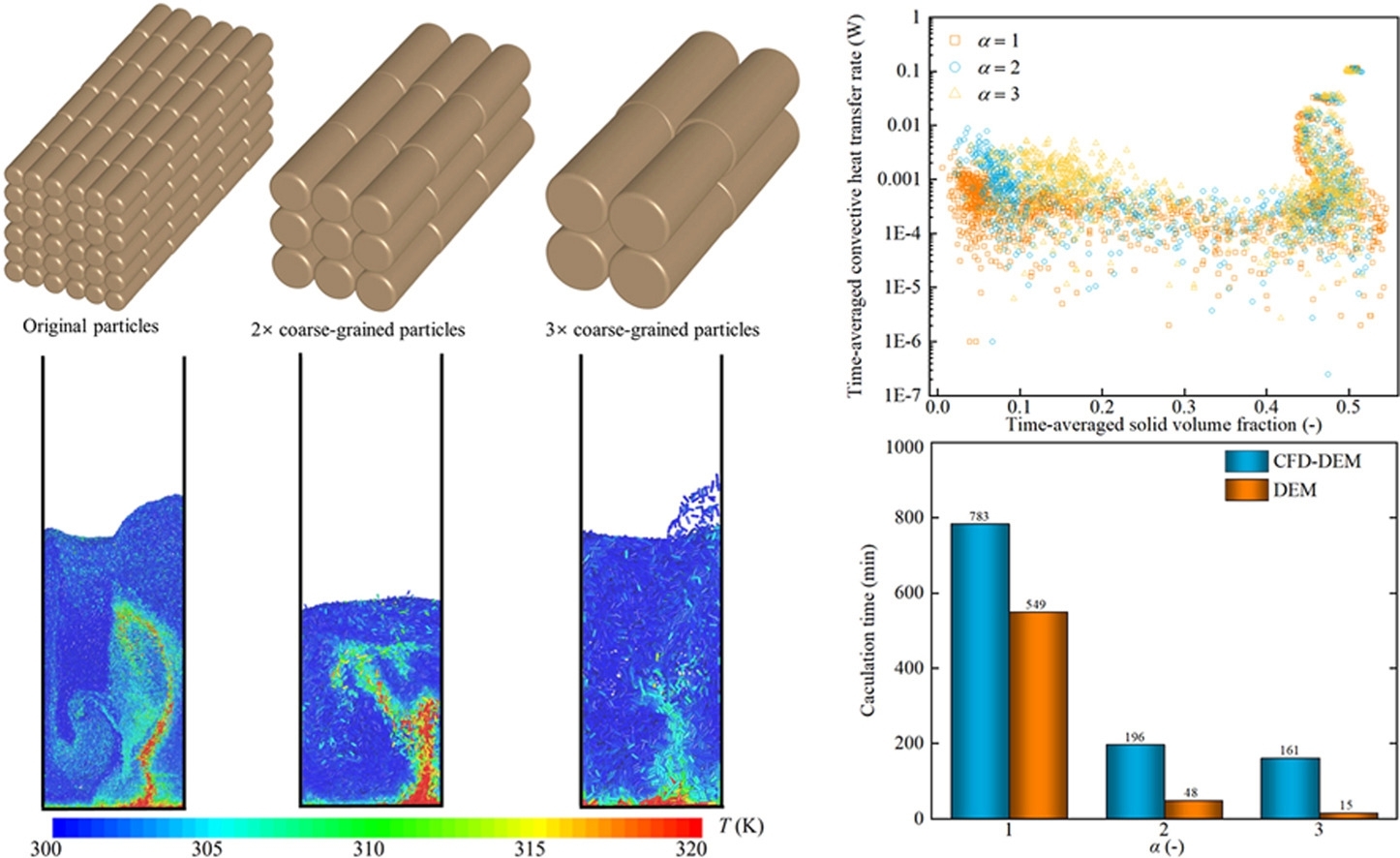
Computational Fluid Dynamics coupled with the Discrete Element Method (CFD–DEM) is widely used to investigate gas–solid flow and heat transfer in fluidized beds. However, its high computational cost restricts large-scale simulations involving cylindrical biomass particles. This study develops a coarse-grained CFD–DEM model for predicting the flow and heat transfer behavior of cylindrical biomass particle systems. Cylindrical particles are represented using a super-ellipsoid model, and a heat transfer scaling law is derived by considering particle orientation, aspect ratio, projected area, and neighboring-particle effects. The model is systematically validated in a gas–solid fluidized bed through comparisons with the original fine-scale system in terms of particle flow patterns, solids distribution, bed expansion, temperature evolution, and transient heat transfer characteristics. The results show that the proposed model accurately reproduces the main hydrodynamic structures, particle distributions, temperature profiles, and overall heat transfer behavior of the fine-scale system. It also preserves the effects of particle shape and orientation on interphase heat transfer. Meanwhile, the coarse-grained model substantially reduces the number of simulated particles and computational cost while maintaining satisfactory predictive accuracy. The developed model therefore provides an efficient and reliable approach for large-scale heat transfer simulations of gas–solid fluidized beds containing cylindrical biomass particles.
Graphical abstract
Keywords
Coarse-grained CFD-DEM; Cylindrical biomass particles; Gas–solid fluidized bed; Convective heat transfer
文章导读