
期刊文章
过刊浏览
- Volumes 108-119 (2025)
-
Volumes 96-107 (2025)
-
Volume 107
Pages 1-376 (December 2025)
-
Volume 106
Pages 1-336 (November 2025)
-
Volume 105
Pages 1-356 (October 2025)
-
Volume 104
Pages 1-332 (September 2025)
-
Volume 103
Pages 1-314 (August 2025)
-
Volume 102
Pages 1-276 (July 2025)
-
Volume 101
Pages 1-166 (June 2025)
-
Volume 100
Pages 1-256 (May 2025)
-
Volume 99
Pages 1-242 (April 2025)
-
Volume 98
Pages 1-288 (March 2025)
-
Volume 97
Pages 1-256 (February 2025)
-
Volume 96
Pages 1-340 (January 2025)
-
Volume 107
-
Volumes 84-95 (2024)
-
Volume 95
Pages 1-392 (December 2024)
-
Volume 94
Pages 1-400 (November 2024)
-
Volume 93
Pages 1-376 (October 2024)
-
Volume 92
Pages 1-316 (September 2024)
-
Volume 91
Pages 1-378 (August 2024)
-
Volume 90
Pages 1-580 (July 2024)
-
Volume 89
Pages 1-278 (June 2024)
-
Volume 88
Pages 1-350 (May 2024)
-
Volume 87
Pages 1-338 (April 2024)
-
Volume 86
Pages 1-312 (March 2024)
-
Volume 85
Pages 1-334 (February 2024)
-
Volume 84
Pages 1-308 (January 2024)
-
Volume 95
-
Volumes 72-83 (2023)
-
Volume 83
Pages 1-258 (December 2023)
-
Volume 82
Pages 1-204 (November 2023)
-
Volume 81
Pages 1-188 (October 2023)
-
Volume 80
Pages 1-202 (September 2023)
-
Volume 79
Pages 1-172 (August 2023)
-
Volume 78
Pages 1-146 (July 2023)
-
Volume 77
Pages 1-152 (June 2023)
-
Volume 76
Pages 1-176 (May 2023)
-
Volume 75
Pages 1-228 (April 2023)
-
Volume 74
Pages 1-200 (March 2023)
-
Volume 73
Pages 1-138 (February 2023)
-
Volume 72
Pages 1-144 (January 2023)
-
Volume 83
-
Volumes 60-71 (2022)
-
Volume 71
Pages 1-108 (December 2022)
-
Volume 70
Pages 1-106 (November 2022)
-
Volume 69
Pages 1-122 (October 2022)
-
Volume 68
Pages 1-124 (September 2022)
-
Volume 67
Pages 1-102 (August 2022)
-
Volume 66
Pages 1-112 (July 2022)
-
Volume 65
Pages 1-138 (June 2022)
-
Volume 64
Pages 1-186 (May 2022)
-
Volume 63
Pages 1-124 (April 2022)
-
Volume 62
Pages 1-104 (March 2022)
-
Volume 61
Pages 1-120 (February 2022)
-
Volume 60
Pages 1-124 (January 2022)
-
Volume 71
- Volumes 54-59 (2021)
- Volumes 48-53 (2020)
- Volumes 42-47 (2019)
- Volumes 36-41 (2018)
- Volumes 30-35 (2017)
- Volumes 24-29 (2016)
- Volumes 18-23 (2015)
- Volumes 12-17 (2014)
- Volume 11 (2013)
- Volume 10 (2012)
- Volume 9 (2011)
- Volume 8 (2010)
- Volume 7 (2009)
- Volume 6 (2008)
- Volume 5 (2007)
- Volume 4 (2006)
- Volume 3 (2005)
- Volume 2 (2004)
- Volume 1 (2003)
Volume 117
A multi-stage DEM-PBM coupling framework for the comparative evaluation of coalescence mechanisms
Dongling Wu a *, Bo Liu a, Ping Zhou a, Zhuo Chen a *, Liu Liu a, Haikun Xu b, Wei Chen c
a School of Energy Science and Engineering, Central South University, Changsha, 410083, China
b Information and Network Center, Central South University, Changsha, 410083, China
c School of Intelligent Manufacturing Ecosystem, Xi'an Jiaotong-Liverpool University, Suzhou, 215123, China
10.1016/j.partic.2026.06.037
Volume 117,
October 2026,
Pages 92-103
Received 29 March 2026, Revised 24 June 2026, Accepted 29 June 2026, Available online 14 July 2026, Version of Record 28 July 2026.
E-mail:
dongling.wu@csu.edu.cn; chenzhuo@csu.edu.cn
Highlights
• Multi-stage coalescence and breakage criteria were developed.
• DEM-PBM coupling method was developed, incorporating both coalescence and breakage kernel functions.
• Two types of mechanism were compared regarding colliding and coalescence behavior.
Abstract
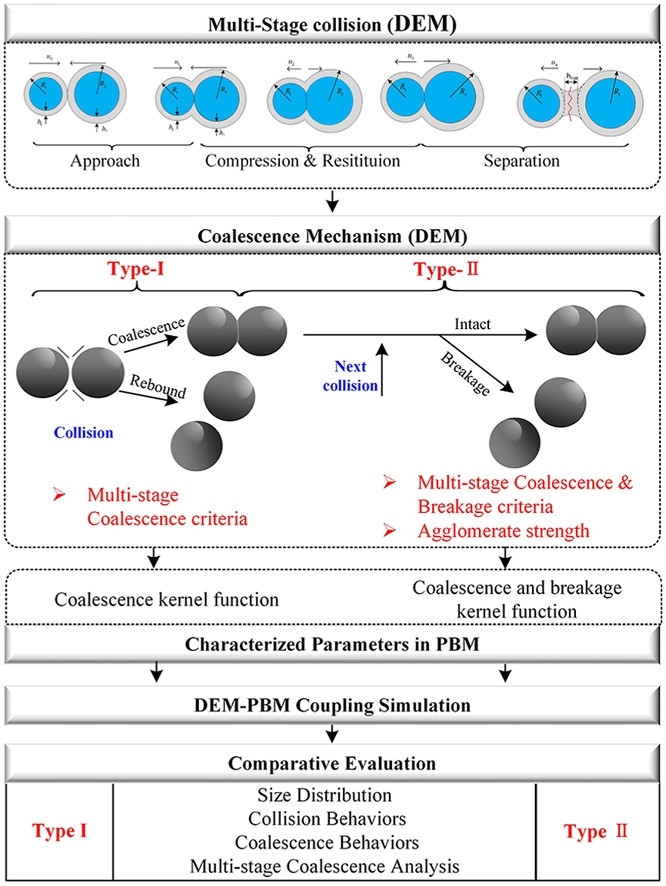
Wet granulation serves as a fundamental unit operation within various industrial sectors for the agglomeration of particulate materials. The process, governed by particle collisions, coalescence, and breakage, directly determines critical granule attributes, most notably size distribution, which dictates final product quality. This study presents a multi-stage theoretical and computational framework to analyze coalescence dynamics. Building upon a soft-sphere model, the particle collision process is deconstructed into three sequential stages, with distinct theoretical criteria established for coalescence and breakage at each phase. Deterministic kernel functions for these events are derived from principles of the Discrete Element Method (DEM). A novel, two-way coupled DEM-Population Balance Model (PBM) is subsequently developed and validated. This integrated model is employed to conduct a comparative analysis of two distinct coalescence mechanisms (designated Type I and Type II), evaluating their influence on predicted granule size evolution and process parameters. The findings demonstrate that the Type II mechanism provides a more reliable representation of granulation dynamics. Specifically, under the Type II framework, coalescence efficiency converges to stable, size-dependent values, suggesting that the assumption of a constant efficiency employed in prior models may hold validity only within limited size ranges. In contrast, the Type I mechanism predicts the formation of fewer agglomerates during the initial approaching and final separation stages, which leads to a systematic overestimation of granule strength.
Graphical abstract
Keywords
Wet granulation; DEM-PBM; Multi-collision stage; Coalescence mechanism; Coalescence; Breakage
文章导读