
期刊文章
过刊浏览
- Volumes 108-119 (2025)
-
Volumes 96-107 (2025)
-
Volume 107
Pages 1-376 (December 2025)
-
Volume 106
Pages 1-336 (November 2025)
-
Volume 105
Pages 1-356 (October 2025)
-
Volume 104
Pages 1-332 (September 2025)
-
Volume 103
Pages 1-314 (August 2025)
-
Volume 102
Pages 1-276 (July 2025)
-
Volume 101
Pages 1-166 (June 2025)
-
Volume 100
Pages 1-256 (May 2025)
-
Volume 99
Pages 1-242 (April 2025)
-
Volume 98
Pages 1-288 (March 2025)
-
Volume 97
Pages 1-256 (February 2025)
-
Volume 96
Pages 1-340 (January 2025)
-
Volume 107
-
Volumes 84-95 (2024)
-
Volume 95
Pages 1-392 (December 2024)
-
Volume 94
Pages 1-400 (November 2024)
-
Volume 93
Pages 1-376 (October 2024)
-
Volume 92
Pages 1-316 (September 2024)
-
Volume 91
Pages 1-378 (August 2024)
-
Volume 90
Pages 1-580 (July 2024)
-
Volume 89
Pages 1-278 (June 2024)
-
Volume 88
Pages 1-350 (May 2024)
-
Volume 87
Pages 1-338 (April 2024)
-
Volume 86
Pages 1-312 (March 2024)
-
Volume 85
Pages 1-334 (February 2024)
-
Volume 84
Pages 1-308 (January 2024)
-
Volume 95
-
Volumes 72-83 (2023)
-
Volume 83
Pages 1-258 (December 2023)
-
Volume 82
Pages 1-204 (November 2023)
-
Volume 81
Pages 1-188 (October 2023)
-
Volume 80
Pages 1-202 (September 2023)
-
Volume 79
Pages 1-172 (August 2023)
-
Volume 78
Pages 1-146 (July 2023)
-
Volume 77
Pages 1-152 (June 2023)
-
Volume 76
Pages 1-176 (May 2023)
-
Volume 75
Pages 1-228 (April 2023)
-
Volume 74
Pages 1-200 (March 2023)
-
Volume 73
Pages 1-138 (February 2023)
-
Volume 72
Pages 1-144 (January 2023)
-
Volume 83
-
Volumes 60-71 (2022)
-
Volume 71
Pages 1-108 (December 2022)
-
Volume 70
Pages 1-106 (November 2022)
-
Volume 69
Pages 1-122 (October 2022)
-
Volume 68
Pages 1-124 (September 2022)
-
Volume 67
Pages 1-102 (August 2022)
-
Volume 66
Pages 1-112 (July 2022)
-
Volume 65
Pages 1-138 (June 2022)
-
Volume 64
Pages 1-186 (May 2022)
-
Volume 63
Pages 1-124 (April 2022)
-
Volume 62
Pages 1-104 (March 2022)
-
Volume 61
Pages 1-120 (February 2022)
-
Volume 60
Pages 1-124 (January 2022)
-
Volume 71
- Volumes 54-59 (2021)
- Volumes 48-53 (2020)
- Volumes 42-47 (2019)
- Volumes 36-41 (2018)
- Volumes 30-35 (2017)
- Volumes 24-29 (2016)
- Volumes 18-23 (2015)
- Volumes 12-17 (2014)
- Volume 11 (2013)
- Volume 10 (2012)
- Volume 9 (2011)
- Volume 8 (2010)
- Volume 7 (2009)
- Volume 6 (2008)
- Volume 5 (2007)
- Volume 4 (2006)
- Volume 3 (2005)
- Volume 2 (2004)
- Volume 1 (2003)
Volume 117
High-pressure fluidization technology and applications
Feng Lu a b 1, Yaxiong Yu a f 1, Liping Li c 1, Xin Liu c, Dongqi Liu c, Jie Miao c, Fei Wei a c, Chenxi Zhang a c d e *
a Beijing Key Laboratory of Green Chemical Reaction Engineering and Technology, Department of Chemical Engineering, Tsinghua University, Beijing, 100084, China
b School of Chemical Engineering, Sichuan University, Chengdu, 610065, China
c Ordos Laboratory, Ordos, 017010, China
d State Key Laboratory of Chemical Engineering and Low-Carbon Technology, Department of Chemical Engineering, Tsinghua University, Beijing, 100084, China
e Institute for Carbon Neutrality, Tsinghua University, Beijing, 100084, China
f School of Energy Science and Engineering, Central South University, Changsha, 410083, China
10.1016/j.partic.2026.07.006
Volume 117,
October 2026,
Pages 104-121
Received 30 April 2026, Revised 7 July 2026, Accepted 12 July 2026, Available online 21 July 2026, Version of Record 28 July 2026.
E-mail:
cxzhang@mail.tsinghua.edu.cn
Highlights
• Systematically reviewed 70-year industrial milestones of pressurized fluidization.
• Clarified pressure-driven regulation on particle-scale dynamics in fluidized systems.
• Defined applicability boundaries of two mainstream fluidization instability theories.
Abstract
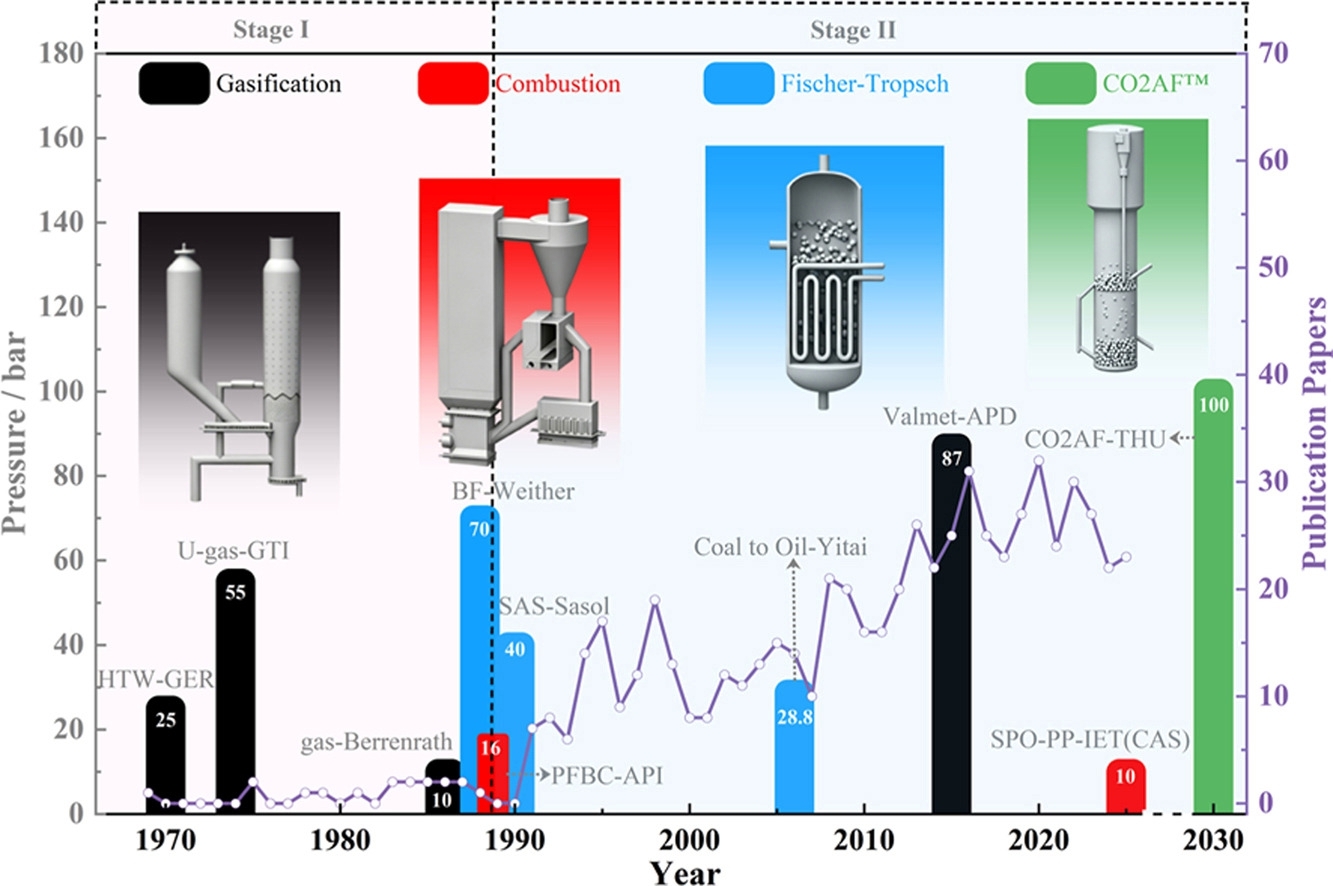
High-pressure fluidized bed reactors are core equipment for process intensification in the energy and chemical industries, and have been widely commercialized in key industrial processes including pressurized fluidized bed combustion, coal and biomass gasification, Fischer-Tropsch synthesis, and show great application potential in the emerging field of CO2 hydrogenation to high-value chemicals and fuels. A comprehensive understanding of high-pressure fluidization fundamentals is essential for the reliable design, scale-up and stable operation of industrial high-pressure fluidized bed systems, while the underlying hydrodynamic mechanisms and instability criteria of high-pressure fluidization have not yet been fully elucidated, restricting the further development and industrial application of this technology. This paper systematically reviews the 70-year development of high-pressure fluidization technology, with a focus on state-of-the-art industrial applications and fundamental research advances. We compile key industrialization milestones in core application fields, and systematically analyze the pressure-dependent evolution of key fluidization characteristics, including minimum fluidization and bubbling velocities, two-phase separation behavior, gas-solid mixing patterns and heat transfer performance. We systematically evaluate two mainstream theoretical frameworks for fluidization instability, clarify their applicability boundaries and key challenges in current research, and assess the validated design correlations in the literature to bridge the gap between fundamental fluidization research and industrial application. This review offers a comprehensive reference for academic research and industrial development of high-pressure fluidization technology.
Graphical abstract
Keywords
High-pressure fluidized bed reactors; Industrial application; Gas-solid multiphase flow; Two-phase separation; Transport behavior
文章导读