
期刊文章
过刊浏览
- Volumes 108-119 (2025)
-
Volumes 96-107 (2025)
-
Volume 107
Pages 1-376 (December 2025)
-
Volume 106
Pages 1-336 (November 2025)
-
Volume 105
Pages 1-356 (October 2025)
-
Volume 104
Pages 1-332 (September 2025)
-
Volume 103
Pages 1-314 (August 2025)
-
Volume 102
Pages 1-276 (July 2025)
-
Volume 101
Pages 1-166 (June 2025)
-
Volume 100
Pages 1-256 (May 2025)
-
Volume 99
Pages 1-242 (April 2025)
-
Volume 98
Pages 1-288 (March 2025)
-
Volume 97
Pages 1-256 (February 2025)
-
Volume 96
Pages 1-340 (January 2025)
-
Volume 107
-
Volumes 84-95 (2024)
-
Volume 95
Pages 1-392 (December 2024)
-
Volume 94
Pages 1-400 (November 2024)
-
Volume 93
Pages 1-376 (October 2024)
-
Volume 92
Pages 1-316 (September 2024)
-
Volume 91
Pages 1-378 (August 2024)
-
Volume 90
Pages 1-580 (July 2024)
-
Volume 89
Pages 1-278 (June 2024)
-
Volume 88
Pages 1-350 (May 2024)
-
Volume 87
Pages 1-338 (April 2024)
-
Volume 86
Pages 1-312 (March 2024)
-
Volume 85
Pages 1-334 (February 2024)
-
Volume 84
Pages 1-308 (January 2024)
-
Volume 95
-
Volumes 72-83 (2023)
-
Volume 83
Pages 1-258 (December 2023)
-
Volume 82
Pages 1-204 (November 2023)
-
Volume 81
Pages 1-188 (October 2023)
-
Volume 80
Pages 1-202 (September 2023)
-
Volume 79
Pages 1-172 (August 2023)
-
Volume 78
Pages 1-146 (July 2023)
-
Volume 77
Pages 1-152 (June 2023)
-
Volume 76
Pages 1-176 (May 2023)
-
Volume 75
Pages 1-228 (April 2023)
-
Volume 74
Pages 1-200 (March 2023)
-
Volume 73
Pages 1-138 (February 2023)
-
Volume 72
Pages 1-144 (January 2023)
-
Volume 83
-
Volumes 60-71 (2022)
-
Volume 71
Pages 1-108 (December 2022)
-
Volume 70
Pages 1-106 (November 2022)
-
Volume 69
Pages 1-122 (October 2022)
-
Volume 68
Pages 1-124 (September 2022)
-
Volume 67
Pages 1-102 (August 2022)
-
Volume 66
Pages 1-112 (July 2022)
-
Volume 65
Pages 1-138 (June 2022)
-
Volume 64
Pages 1-186 (May 2022)
-
Volume 63
Pages 1-124 (April 2022)
-
Volume 62
Pages 1-104 (March 2022)
-
Volume 61
Pages 1-120 (February 2022)
-
Volume 60
Pages 1-124 (January 2022)
-
Volume 71
- Volumes 54-59 (2021)
- Volumes 48-53 (2020)
- Volumes 42-47 (2019)
- Volumes 36-41 (2018)
- Volumes 30-35 (2017)
- Volumes 24-29 (2016)
- Volumes 18-23 (2015)
- Volumes 12-17 (2014)
- Volume 11 (2013)
- Volume 10 (2012)
- Volume 9 (2011)
- Volume 8 (2010)
- Volume 7 (2009)
- Volume 6 (2008)
- Volume 5 (2007)
- Volume 4 (2006)
- Volume 3 (2005)
- Volume 2 (2004)
- Volume 1 (2003)
Volume 117
Advancing a 3D pore-informed continuum particle model through combined numerical analysis and experimental characterization: Application to particle heating (Open Access)
Fabienne Ryll a, Andrea Dernbecher a, Abdolreza Kharaghani b, Alba Dieguez-Alonso a *
a Laboratory of Transport Processes, Department of Biochemical and Chemical Engineering, Technical University Dortmund, Emil-Figge-Strasse 68, Dortmund, 44227, Germany
b Thermal Process Engineering, Otto-von-Guericke-Universität Magdeburg, Universitätsplatz 2, Magdeburg, 39106, Germany
10.1016/j.partic.2026.06.040
Volume 117,
October 2026,
Pages 122-139
Received 12 January 2026, Revised 30 May 2026, Accepted 24 June 2026, Available online 16 July 2026, Version of Record 28 July 2026.
E-mail:
alba.dieguez@tu-dortmund.de
Highlights
• Pore-resolved transport tensors incorporated into a 3D effective continuum model.
• Surface temperature measurements during pyrolysis using phosphor thermometry.
• Influence of intra-particle structure and shape on internal temperature distributions.
Abstract
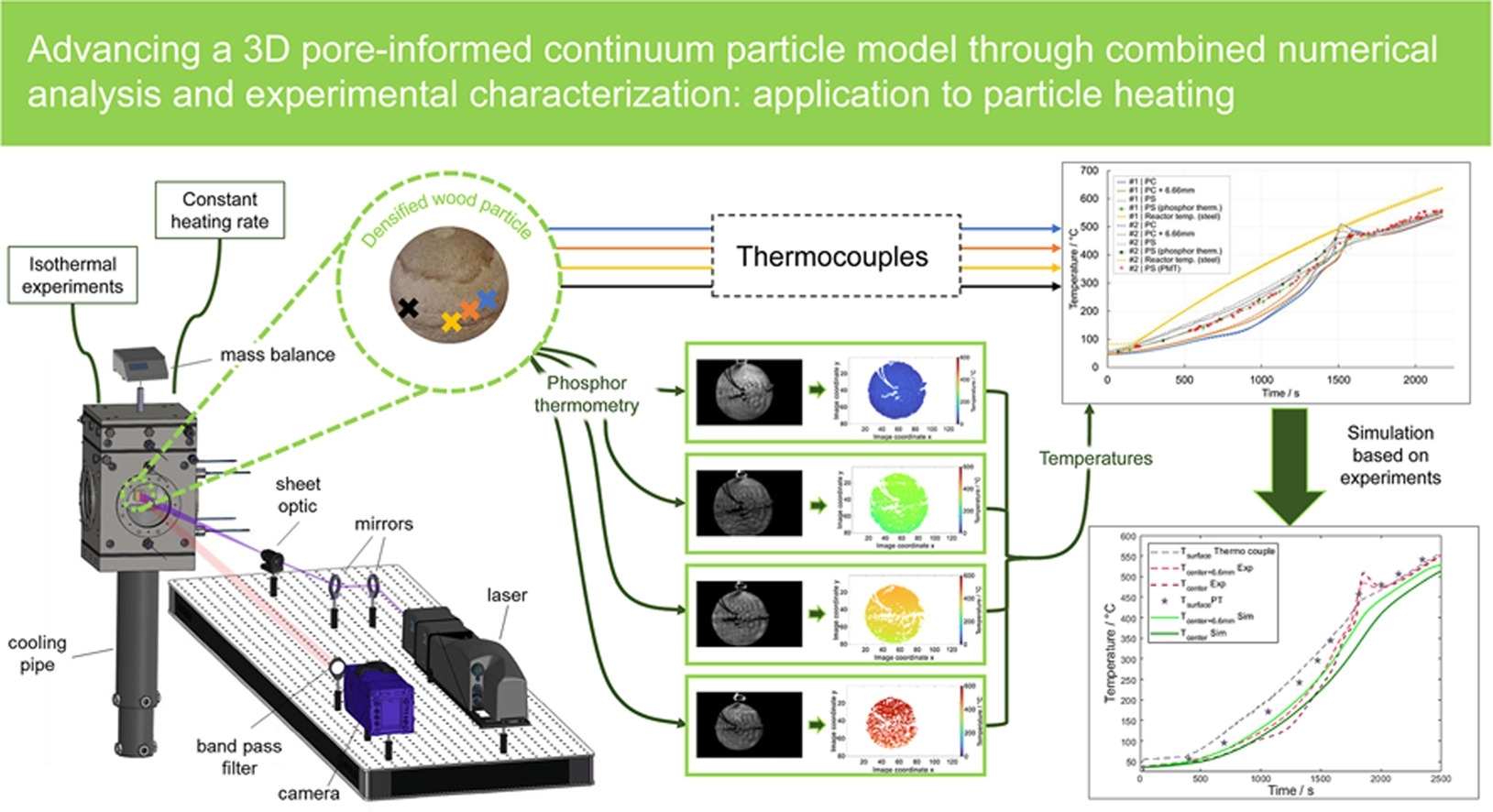
Accurate modeling of biomass pyrolysis requires particle-scale approaches that capture the influence of intra-particle structure and morphology on transport processes while remaining computationally tractable. In this work, a three-dimensional pore-informed continuum particle model was developed to investigate the effects of intra-particle structure and particle shape on particle heating. The model is supported by time-resolved measurements of internal and surface temperatures under constant heating rate and near-isothermal reactor conditions at approximately 600 °C. Experiments were conducted using natural beech wood particles (spheres and cubes), densified beech wood particles (spheres and cubes), and non-reactive aluminium oxide particles (cubes). The particle model incorporates permeability coefficients derived from pore-resolved simulations for natural wood, densified wood, and aluminium oxide particles. A thermal conductivity tensor was also derived from pore-resolved simulations for natural wood, while values from literature were used for densified wood and aluminium oxide particles. Intra-particle temperatures were measured using embedded thermocouples, while surface temperatures were obtained using a surface thermocouple and lifetime-based phosphor thermometry. The experiments revealed differences in the intra-particle temperature evolution of natural wood particles, consistent with anisotropic intra-particle transport, with less pronounced shape-induced effects. For densified particles, shape-dependent differences were also small. Using phosphor thermometry-based surface temperatures as thermal boundary conditions, the model reproduced the experimental intra-particle temperatures for aluminium oxide and for wood particles during the heat-up phase, above which pyrolysis reactions become significant, not included in the present model. The simulated temperature fields showed only weak anisotropic effects, likely partly due to the spatially uniform thermal boundary condition. Overall, the proposed numerical–experimental framework provides a basis for future extensions including reactive conversion, evolving particle morphology, and dynamically changing transport properties.
Graphical abstract
Keywords
Continuum particle model; Pore-informed transport properties; Biomass pyrolysis; Phosphor thermometry; Particle scale
文章导读