
期刊文章
过刊浏览
- Volumes 108-119 (2025)
-
Volumes 96-107 (2025)
-
Volume 107
Pages 1-376 (December 2025)
-
Volume 106
Pages 1-336 (November 2025)
-
Volume 105
Pages 1-356 (October 2025)
-
Volume 104
Pages 1-332 (September 2025)
-
Volume 103
Pages 1-314 (August 2025)
-
Volume 102
Pages 1-276 (July 2025)
-
Volume 101
Pages 1-166 (June 2025)
-
Volume 100
Pages 1-256 (May 2025)
-
Volume 99
Pages 1-242 (April 2025)
-
Volume 98
Pages 1-288 (March 2025)
-
Volume 97
Pages 1-256 (February 2025)
-
Volume 96
Pages 1-340 (January 2025)
-
Volume 107
-
Volumes 84-95 (2024)
-
Volume 95
Pages 1-392 (December 2024)
-
Volume 94
Pages 1-400 (November 2024)
-
Volume 93
Pages 1-376 (October 2024)
-
Volume 92
Pages 1-316 (September 2024)
-
Volume 91
Pages 1-378 (August 2024)
-
Volume 90
Pages 1-580 (July 2024)
-
Volume 89
Pages 1-278 (June 2024)
-
Volume 88
Pages 1-350 (May 2024)
-
Volume 87
Pages 1-338 (April 2024)
-
Volume 86
Pages 1-312 (March 2024)
-
Volume 85
Pages 1-334 (February 2024)
-
Volume 84
Pages 1-308 (January 2024)
-
Volume 95
-
Volumes 72-83 (2023)
-
Volume 83
Pages 1-258 (December 2023)
-
Volume 82
Pages 1-204 (November 2023)
-
Volume 81
Pages 1-188 (October 2023)
-
Volume 80
Pages 1-202 (September 2023)
-
Volume 79
Pages 1-172 (August 2023)
-
Volume 78
Pages 1-146 (July 2023)
-
Volume 77
Pages 1-152 (June 2023)
-
Volume 76
Pages 1-176 (May 2023)
-
Volume 75
Pages 1-228 (April 2023)
-
Volume 74
Pages 1-200 (March 2023)
-
Volume 73
Pages 1-138 (February 2023)
-
Volume 72
Pages 1-144 (January 2023)
-
Volume 83
-
Volumes 60-71 (2022)
-
Volume 71
Pages 1-108 (December 2022)
-
Volume 70
Pages 1-106 (November 2022)
-
Volume 69
Pages 1-122 (October 2022)
-
Volume 68
Pages 1-124 (September 2022)
-
Volume 67
Pages 1-102 (August 2022)
-
Volume 66
Pages 1-112 (July 2022)
-
Volume 65
Pages 1-138 (June 2022)
-
Volume 64
Pages 1-186 (May 2022)
-
Volume 63
Pages 1-124 (April 2022)
-
Volume 62
Pages 1-104 (March 2022)
-
Volume 61
Pages 1-120 (February 2022)
-
Volume 60
Pages 1-124 (January 2022)
-
Volume 71
- Volumes 54-59 (2021)
- Volumes 48-53 (2020)
- Volumes 42-47 (2019)
- Volumes 36-41 (2018)
- Volumes 30-35 (2017)
- Volumes 24-29 (2016)
- Volumes 18-23 (2015)
- Volumes 12-17 (2014)
- Volume 11 (2013)
- Volume 10 (2012)
- Volume 9 (2011)
- Volume 8 (2010)
- Volume 7 (2009)
- Volume 6 (2008)
- Volume 5 (2007)
- Volume 4 (2006)
- Volume 3 (2005)
- Volume 2 (2004)
- Volume 1 (2003)
Volume 117
Intermediate dual-site confinement recognition in a Cu-based metal–organic framework for efficient capture of trace SO2 over CO2
Jiao Yin a, Yuanyuan Bai a, Xiaoyu Zhang a, Yifan Gu a b *
a College of Environmental Science and Engineering, State Key Laboratory of Water Pollution Control and Green Resource Recycling, Shanghai Institute of Pollution Control and Ecological Security, Tongji University, Shanghai, 200092, China
b Key Laboratory of Cities' Mitigation and Adaptation to Climate Change in Shanghai, China Meteorological Administration (CMA), Tongji University, Shanghai, 200092, China
10.1016/j.partic.2026.07.010
Volume 117,
October 2026,
Pages 156-163
Received 22 June 2026, Revised 13 July 2026, Accepted 22 July 2026, Available online 22 July 2026, Version of Record 30 July 2026.
E-mail:
159219yifan_gu@tongji.edu.cn
Highlights
• A MOF with ultra-microporous channels and two oppositely aligned open Cu(II) sites was prepared for trace SO2 capture.
• Cu-tpo-tpt exhibits excellent IAST selectivity of 264 for SO2/CO2 (0.2/99.8, v/v) at 298 K.
• Cu-tpo-tpt exhibits efficient dynamic separation performance and regeneration capacity for trace SO2 capture.
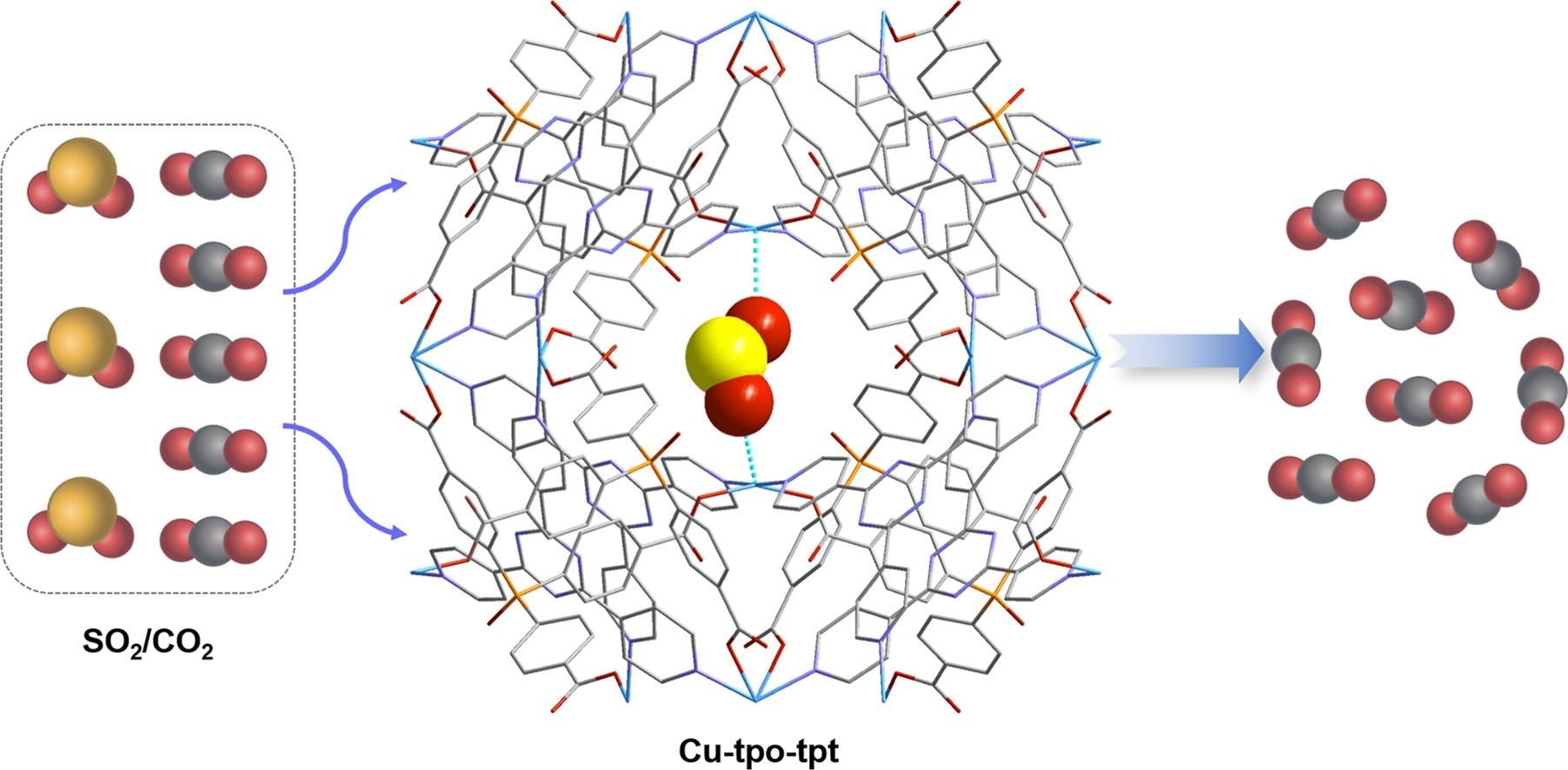
• Mechanistic analysis reveals V-shaped SO2 geometrically matches dual Cu(II) sites, enhancing SO2/CO2 selectivity.
Abstract
Effective removal of SO2 from flue gas is critical for the environment, human health, and the following CO2 capture process. Conventional flue-gas desulfurization technologies are energy-intensive and insufficient for deep removal of such trace SO2. However, even a low concentration of SO2 (ca. 2000 ppm) can significantly degrade the performance of adsorbents employed in CO2 capture from flue gas, thus demanding its deep removal from CO2-rich gas streams. Herein, we report a metal-organic framework, Cu-tpo-tpt, which possesses ultra-microporous channels functionalized with two oppositely aligned open Cu(II) sites. Upon activation, the geometrically complementary spatial arrangement of two opposing open Cu(II) sites within the channel perfectly fits the bent V-shaped SO2 molecule, while linear CO2 exhibits a molecular size exceeding the aperture distance between the dual Cu(II) sites. Benefiting from the geometrically matched dual-site confinement recognition strategy, Cu-tpo-tpt exhibits preferential adsorption of SO2 over CO2. At 298 K and 0.1 bar, the SO2 adsorption capacity (2.7 mmol g−1) is considerably higher than that for CO2 (1.0 mmol g−1), leading to an exceptional IAST selectivity of 264 for SO2/CO2 (0.2/99.8, v/v). Dynamic breakthrough experiment further confirms its outstanding separation performance. Mechanistic analysis reveals that the precise geometric matching between SO2 and the Cu(II) sites enhances host-guest interactions, facilitating highly selective recognition of trace SO2 over abundant CO2. This finding not only addresses a critical challenge for trace SO2 capture, but also provides new insights for the rational design of advanced adsorbents targeting industrial gas separation processes.
Graphical abstract
Keywords
Metal-organic framework; Flue gas desulfurization; SO2/CO2 separation; Geometric matching; Open metal sites
文章导读