
期刊文章
过刊浏览
- Volumes 108-119 (2025)
-
Volumes 96-107 (2025)
-
Volume 107
Pages 1-376 (December 2025)
-
Volume 106
Pages 1-336 (November 2025)
-
Volume 105
Pages 1-356 (October 2025)
-
Volume 104
Pages 1-332 (September 2025)
-
Volume 103
Pages 1-314 (August 2025)
-
Volume 102
Pages 1-276 (July 2025)
-
Volume 101
Pages 1-166 (June 2025)
-
Volume 100
Pages 1-256 (May 2025)
-
Volume 99
Pages 1-242 (April 2025)
-
Volume 98
Pages 1-288 (March 2025)
-
Volume 97
Pages 1-256 (February 2025)
-
Volume 96
Pages 1-340 (January 2025)
-
Volume 107
-
Volumes 84-95 (2024)
-
Volume 95
Pages 1-392 (December 2024)
-
Volume 94
Pages 1-400 (November 2024)
-
Volume 93
Pages 1-376 (October 2024)
-
Volume 92
Pages 1-316 (September 2024)
-
Volume 91
Pages 1-378 (August 2024)
-
Volume 90
Pages 1-580 (July 2024)
-
Volume 89
Pages 1-278 (June 2024)
-
Volume 88
Pages 1-350 (May 2024)
-
Volume 87
Pages 1-338 (April 2024)
-
Volume 86
Pages 1-312 (March 2024)
-
Volume 85
Pages 1-334 (February 2024)
-
Volume 84
Pages 1-308 (January 2024)
-
Volume 95
-
Volumes 72-83 (2023)
-
Volume 83
Pages 1-258 (December 2023)
-
Volume 82
Pages 1-204 (November 2023)
-
Volume 81
Pages 1-188 (October 2023)
-
Volume 80
Pages 1-202 (September 2023)
-
Volume 79
Pages 1-172 (August 2023)
-
Volume 78
Pages 1-146 (July 2023)
-
Volume 77
Pages 1-152 (June 2023)
-
Volume 76
Pages 1-176 (May 2023)
-
Volume 75
Pages 1-228 (April 2023)
-
Volume 74
Pages 1-200 (March 2023)
-
Volume 73
Pages 1-138 (February 2023)
-
Volume 72
Pages 1-144 (January 2023)
-
Volume 83
-
Volumes 60-71 (2022)
-
Volume 71
Pages 1-108 (December 2022)
-
Volume 70
Pages 1-106 (November 2022)
-
Volume 69
Pages 1-122 (October 2022)
-
Volume 68
Pages 1-124 (September 2022)
-
Volume 67
Pages 1-102 (August 2022)
-
Volume 66
Pages 1-112 (July 2022)
-
Volume 65
Pages 1-138 (June 2022)
-
Volume 64
Pages 1-186 (May 2022)
-
Volume 63
Pages 1-124 (April 2022)
-
Volume 62
Pages 1-104 (March 2022)
-
Volume 61
Pages 1-120 (February 2022)
-
Volume 60
Pages 1-124 (January 2022)
-
Volume 71
- Volumes 54-59 (2021)
- Volumes 48-53 (2020)
- Volumes 42-47 (2019)
- Volumes 36-41 (2018)
- Volumes 30-35 (2017)
- Volumes 24-29 (2016)
- Volumes 18-23 (2015)
- Volumes 12-17 (2014)
- Volume 11 (2013)
- Volume 10 (2012)
- Volume 9 (2011)
- Volume 8 (2010)
- Volume 7 (2009)
- Volume 6 (2008)
- Volume 5 (2007)
- Volume 4 (2006)
- Volume 3 (2005)
- Volume 2 (2004)
- Volume 1 (2003)
Volume 117
Visibility drivers and light extinction apportionment in Urumqi: Integrating chemical reconstruction with machine learning
Wenyu Bai a b, Yingying Liu a b, Xueyan Zhao a *, Chunmei Geng a *, Wen Yang a
a State Key Laboratory of Environmental Criteria and Risk Assessment, Chinese Research Academy of Environmental Sciences, Beijing, 100012, China
b NEAC Key Laboratory of Ecology and Environment in Minority Areas, College of Life and Environmental Sciences, Minzu University of China, Beijing, 100081, China
10.1016/j.partic.2026.08.014
Volume 117,
October 2026,
Pages 366-379
Received 11 April 2026, Revised 8 August 2026, Accepted 11 August 2026, Available online 12 August 2026, Version of Record 20 August 2026.
E-mail:
zhaoxy@craes.org.cn; gengcm@craes.org.cn
Highlights
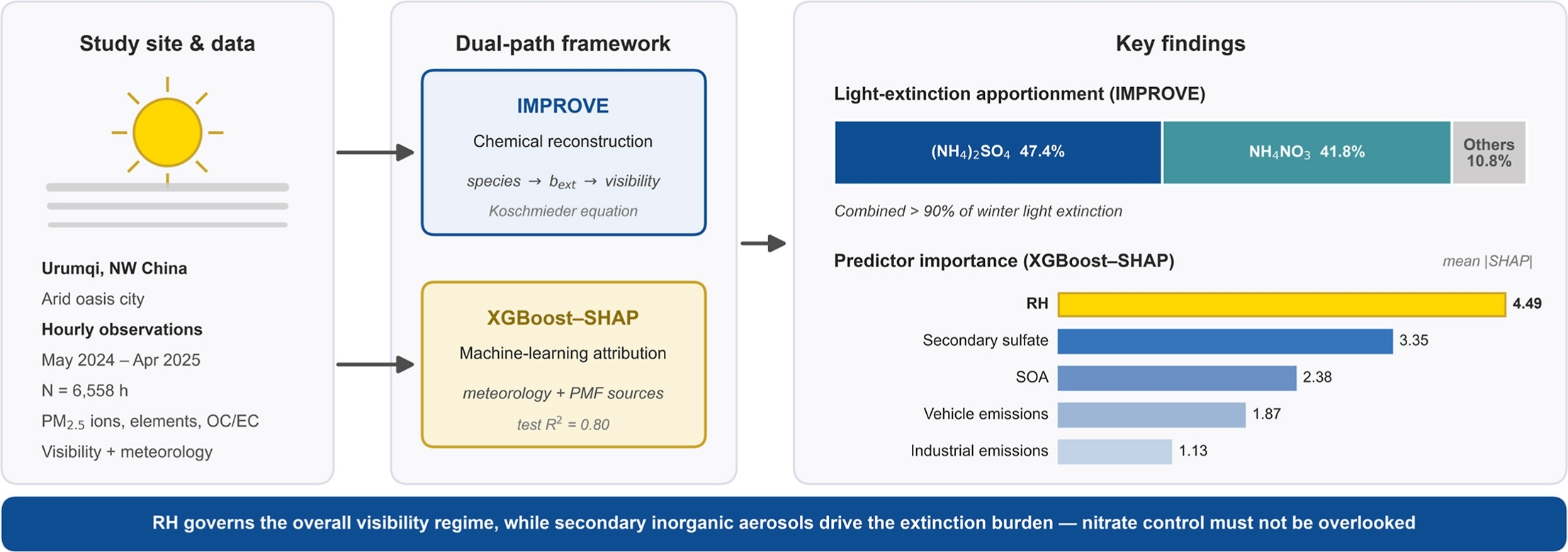
• Reveals relative humidity as the dominant meteorological predictor of visibility (mean |SHAP| = 4.49).
• Quantifies winter light extinction dominated by secondary (NH4)2SO4 and NH4NO3 (combined > 90%).
• Provides the first machine learning based visibility source apportionment in arid western China.
Abstract
Identifying the key factors influencing atmospheric visibility is essential for improving urban air quality. This study analyzed high time-resolution observational data from Urumqi, an arid oasis city in northwestern China, from May 2024 to April 2025. PM2.5 sources were apportioned using Positive Matrix Factorization (PMF), and the revised IMPROVE algorithm and XGBoost-SHAP (Shapley Additive Explanations) model were applied to identify the chemical components and source categories responsible for visibility impairment, respectively. Monthly visibility peaked in June (33 km) and reached its lowest in December (5 km). The IMPROVE algorithm identified ammonium sulfate and ammonium nitrate as the dominant contributors to light extinction, with their combined contribution exceeding 90% in winter. The XGBoost-SHAP model identified relative humidity (RH) as the most critical predictor of visibility (mean |SHAP| = 4.49 km), followed by secondary sulfate, secondary organic aerosol (SOA), and vehicle emissions. Although ammonium nitrate contributed comparably to ammonium sulfate in the IMPROVE extinction budget, its predictive importance was lower in the machine learning model, reflecting the non-linear mediation of RH on sulfate-driven hygroscopic growth. These findings provide scientific evidence for targeted air pollution control in arid urban environments.
Graphical abstract
Keywords
Visibility; Sulfate; IMPROVE algorithm; XGBoost-SHAP model; Urumqi
文章导读