
期刊文章
过刊浏览
- Volumes 108-119 (2025)
-
Volumes 96-107 (2025)
-
Volume 107
Pages 1-376 (December 2025)
-
Volume 106
Pages 1-336 (November 2025)
-
Volume 105
Pages 1-356 (October 2025)
-
Volume 104
Pages 1-332 (September 2025)
-
Volume 103
Pages 1-314 (August 2025)
-
Volume 102
Pages 1-276 (July 2025)
-
Volume 101
Pages 1-166 (June 2025)
-
Volume 100
Pages 1-256 (May 2025)
-
Volume 99
Pages 1-242 (April 2025)
-
Volume 98
Pages 1-288 (March 2025)
-
Volume 97
Pages 1-256 (February 2025)
-
Volume 96
Pages 1-340 (January 2025)
-
Volume 107
-
Volumes 84-95 (2024)
-
Volume 95
Pages 1-392 (December 2024)
-
Volume 94
Pages 1-400 (November 2024)
-
Volume 93
Pages 1-376 (October 2024)
-
Volume 92
Pages 1-316 (September 2024)
-
Volume 91
Pages 1-378 (August 2024)
-
Volume 90
Pages 1-580 (July 2024)
-
Volume 89
Pages 1-278 (June 2024)
-
Volume 88
Pages 1-350 (May 2024)
-
Volume 87
Pages 1-338 (April 2024)
-
Volume 86
Pages 1-312 (March 2024)
-
Volume 85
Pages 1-334 (February 2024)
-
Volume 84
Pages 1-308 (January 2024)
-
Volume 95
-
Volumes 72-83 (2023)
-
Volume 83
Pages 1-258 (December 2023)
-
Volume 82
Pages 1-204 (November 2023)
-
Volume 81
Pages 1-188 (October 2023)
-
Volume 80
Pages 1-202 (September 2023)
-
Volume 79
Pages 1-172 (August 2023)
-
Volume 78
Pages 1-146 (July 2023)
-
Volume 77
Pages 1-152 (June 2023)
-
Volume 76
Pages 1-176 (May 2023)
-
Volume 75
Pages 1-228 (April 2023)
-
Volume 74
Pages 1-200 (March 2023)
-
Volume 73
Pages 1-138 (February 2023)
-
Volume 72
Pages 1-144 (January 2023)
-
Volume 83
-
Volumes 60-71 (2022)
-
Volume 71
Pages 1-108 (December 2022)
-
Volume 70
Pages 1-106 (November 2022)
-
Volume 69
Pages 1-122 (October 2022)
-
Volume 68
Pages 1-124 (September 2022)
-
Volume 67
Pages 1-102 (August 2022)
-
Volume 66
Pages 1-112 (July 2022)
-
Volume 65
Pages 1-138 (June 2022)
-
Volume 64
Pages 1-186 (May 2022)
-
Volume 63
Pages 1-124 (April 2022)
-
Volume 62
Pages 1-104 (March 2022)
-
Volume 61
Pages 1-120 (February 2022)
-
Volume 60
Pages 1-124 (January 2022)
-
Volume 71
- Volumes 54-59 (2021)
- Volumes 48-53 (2020)
- Volumes 42-47 (2019)
- Volumes 36-41 (2018)
- Volumes 30-35 (2017)
- Volumes 24-29 (2016)
- Volumes 18-23 (2015)
- Volumes 12-17 (2014)
- Volume 11 (2013)
- Volume 10 (2012)
- Volume 9 (2011)
- Volume 8 (2010)
- Volume 7 (2009)
- Volume 6 (2008)
- Volume 5 (2007)
- Volume 4 (2006)
- Volume 3 (2005)
- Volume 2 (2004)
- Volume 1 (2003)
Volume 117
Transverse particle motion analysis as a basis for heat transfer investigations in rotary kilns with flights. Part II: Influence of operational parameters on heat transfer surfaces (Open Access)
Claudia Meitzner *, Jakob Seidenbecher, Fabian Herz
Anhalt University of Applied Sciences, Köthen, 06366, Germany
10.1016/j.partic.2026.08.012
Volume 117,
October 2026,
Pages 380-389
Received 18 March 2026, Revised 24 July 2026, Accepted 11 August 2026, Available online 13 August 2026, Version of Record 20 August 2026.
E-mail:
claudia.meitzner@hs-anhalt.de
Highlights
• Operational parameters determine heat transfer-relevant surfaces in kilns.
• Optical analysis quantifies particle curtains and hydraulic cross-sections.
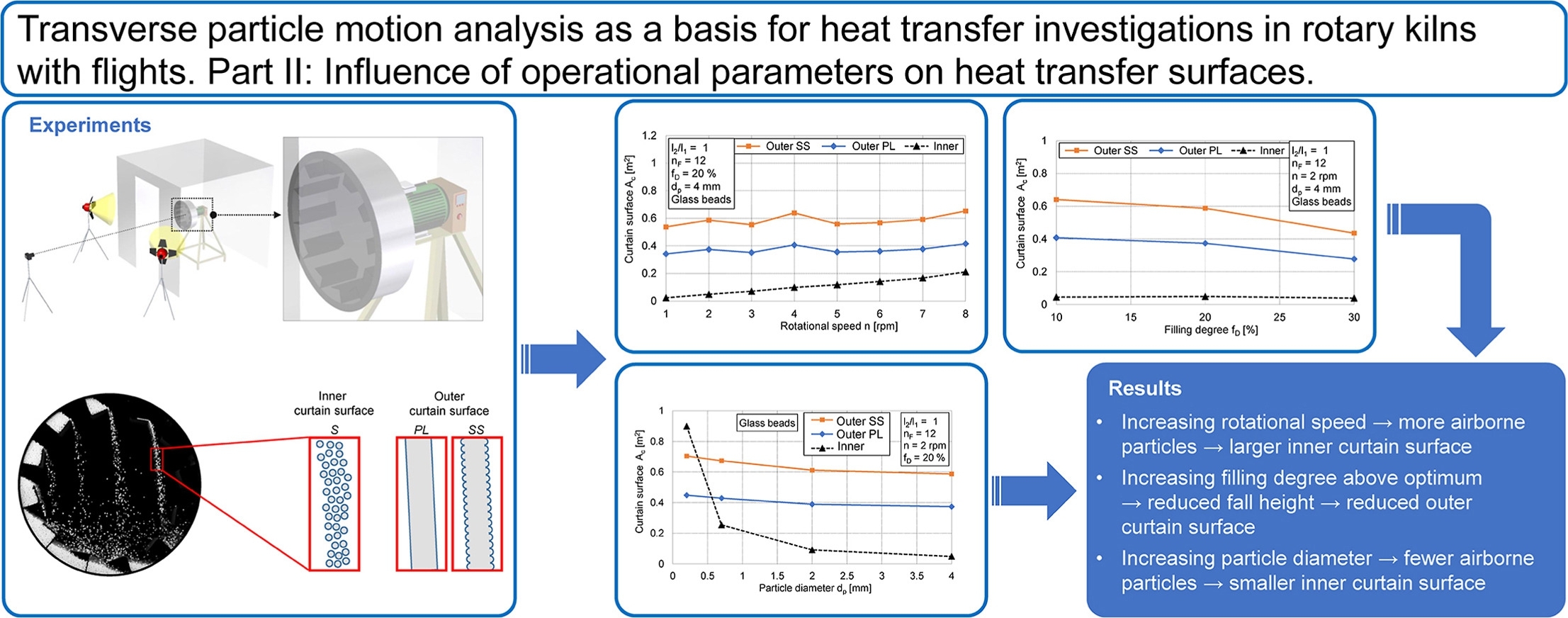
• Rotational speed increases airborne particles and inner curtain surface.
• Higher filling degree reduces particle fall height and inner curtain surface.
• Particle diameter strongly influences particle curtain formation.
Abstract
The knowledge about quantitative heat transfer processes in rotary kilns is important in order to achieve an optimal product quality. To determine the heat transfer, the corresponding surfaces, as well as the hydraulic cross-sectional area are necessary to know. Three surfaces are essential for the heat transfer; the covered rotary wall, the free rotary kiln wall and the surface between the free packed bed and gas phase. Flights are very beneficial to reduce segregation effects, but also to increase the heat transfer as the contact surface between particles and gas phase is increased through the creation of falling particle curtains.
In Part I of this investigation, the experimental setup and the determination of the relevant parameters required to quantify the inner and outer curtain surface were presented.
This paper highlights the influence of material and operating parameters on the heat transfer surfaces. It is shown that the inner curtain surface increases with rotational speed due to the higher particle discharge rate. Increasing the filling degree above the optimum reduces the inner curtain surface because of the decreasing particle fall height. Larger particle diameters result in smaller inner curtain surfaces, while the outer curtain surface is mainly affected by the filling degree.
Graphical abstract
Keywords
Flighted rotary kiln; Transverse particle motion; Particle curtains; Heat transfer surfaces; Image-based analysis
文章导读