
期刊文章
过刊浏览
- Volumes 108-119 (2025)
-
Volumes 96-107 (2025)
-
Volume 107
Pages 1-376 (December 2025)
-
Volume 106
Pages 1-336 (November 2025)
-
Volume 105
Pages 1-356 (October 2025)
-
Volume 104
Pages 1-332 (September 2025)
-
Volume 103
Pages 1-314 (August 2025)
-
Volume 102
Pages 1-276 (July 2025)
-
Volume 101
Pages 1-166 (June 2025)
-
Volume 100
Pages 1-256 (May 2025)
-
Volume 99
Pages 1-242 (April 2025)
-
Volume 98
Pages 1-288 (March 2025)
-
Volume 97
Pages 1-256 (February 2025)
-
Volume 96
Pages 1-340 (January 2025)
-
Volume 107
-
Volumes 84-95 (2024)
-
Volume 95
Pages 1-392 (December 2024)
-
Volume 94
Pages 1-400 (November 2024)
-
Volume 93
Pages 1-376 (October 2024)
-
Volume 92
Pages 1-316 (September 2024)
-
Volume 91
Pages 1-378 (August 2024)
-
Volume 90
Pages 1-580 (July 2024)
-
Volume 89
Pages 1-278 (June 2024)
-
Volume 88
Pages 1-350 (May 2024)
-
Volume 87
Pages 1-338 (April 2024)
-
Volume 86
Pages 1-312 (March 2024)
-
Volume 85
Pages 1-334 (February 2024)
-
Volume 84
Pages 1-308 (January 2024)
-
Volume 95
-
Volumes 72-83 (2023)
-
Volume 83
Pages 1-258 (December 2023)
-
Volume 82
Pages 1-204 (November 2023)
-
Volume 81
Pages 1-188 (October 2023)
-
Volume 80
Pages 1-202 (September 2023)
-
Volume 79
Pages 1-172 (August 2023)
-
Volume 78
Pages 1-146 (July 2023)
-
Volume 77
Pages 1-152 (June 2023)
-
Volume 76
Pages 1-176 (May 2023)
-
Volume 75
Pages 1-228 (April 2023)
-
Volume 74
Pages 1-200 (March 2023)
-
Volume 73
Pages 1-138 (February 2023)
-
Volume 72
Pages 1-144 (January 2023)
-
Volume 83
-
Volumes 60-71 (2022)
-
Volume 71
Pages 1-108 (December 2022)
-
Volume 70
Pages 1-106 (November 2022)
-
Volume 69
Pages 1-122 (October 2022)
-
Volume 68
Pages 1-124 (September 2022)
-
Volume 67
Pages 1-102 (August 2022)
-
Volume 66
Pages 1-112 (July 2022)
-
Volume 65
Pages 1-138 (June 2022)
-
Volume 64
Pages 1-186 (May 2022)
-
Volume 63
Pages 1-124 (April 2022)
-
Volume 62
Pages 1-104 (March 2022)
-
Volume 61
Pages 1-120 (February 2022)
-
Volume 60
Pages 1-124 (January 2022)
-
Volume 71
- Volumes 54-59 (2021)
- Volumes 48-53 (2020)
- Volumes 42-47 (2019)
- Volumes 36-41 (2018)
- Volumes 30-35 (2017)
- Volumes 24-29 (2016)
- Volumes 18-23 (2015)
- Volumes 12-17 (2014)
- Volume 11 (2013)
- Volume 10 (2012)
- Volume 9 (2011)
- Volume 8 (2010)
- Volume 7 (2009)
- Volume 6 (2008)
- Volume 5 (2007)
- Volume 4 (2006)
- Volume 3 (2005)
- Volume 2 (2004)
- Volume 1 (2003)
Volume 117
Impact of internal geometries on granular flow regimes in a moving bed for chemical looping combustion: A mesoscopic force network perspective
Lei Pang a, Wei Dai b, Yali Shao b *
a Avic Jincheng Nanjing Engineering Institute of Aircraft Systems, Aviation Key Laboratory of Science and Technology on Aero Electromechanical System Integration, Nanjing, 211106, China
b School of Energy Science and Engineering, Nanjing Normal University, Nanjing, 210096, China
10.1016/j.partic.2026.07.015
Volume 117,
October 2026,
Pages 397-410
Received 1 May 2026, Revised 8 July 2026, Accepted 20 July 2026, Available online 28 July 2026, Version of Record 20 August 2026.
E-mail:
yalishao@njnu.edu.cn
Highlights
• Internals affect macro-flow and meso-force networks in moving bed ARs.
• Grooved internals induce periodic stick-slip flow via cyclic force chains buckling.
• Cylindrical internals maintain continuous flow via reduced network anisotropy.
• Wider particle size distribution weakens overall force network integrity.
Abstract
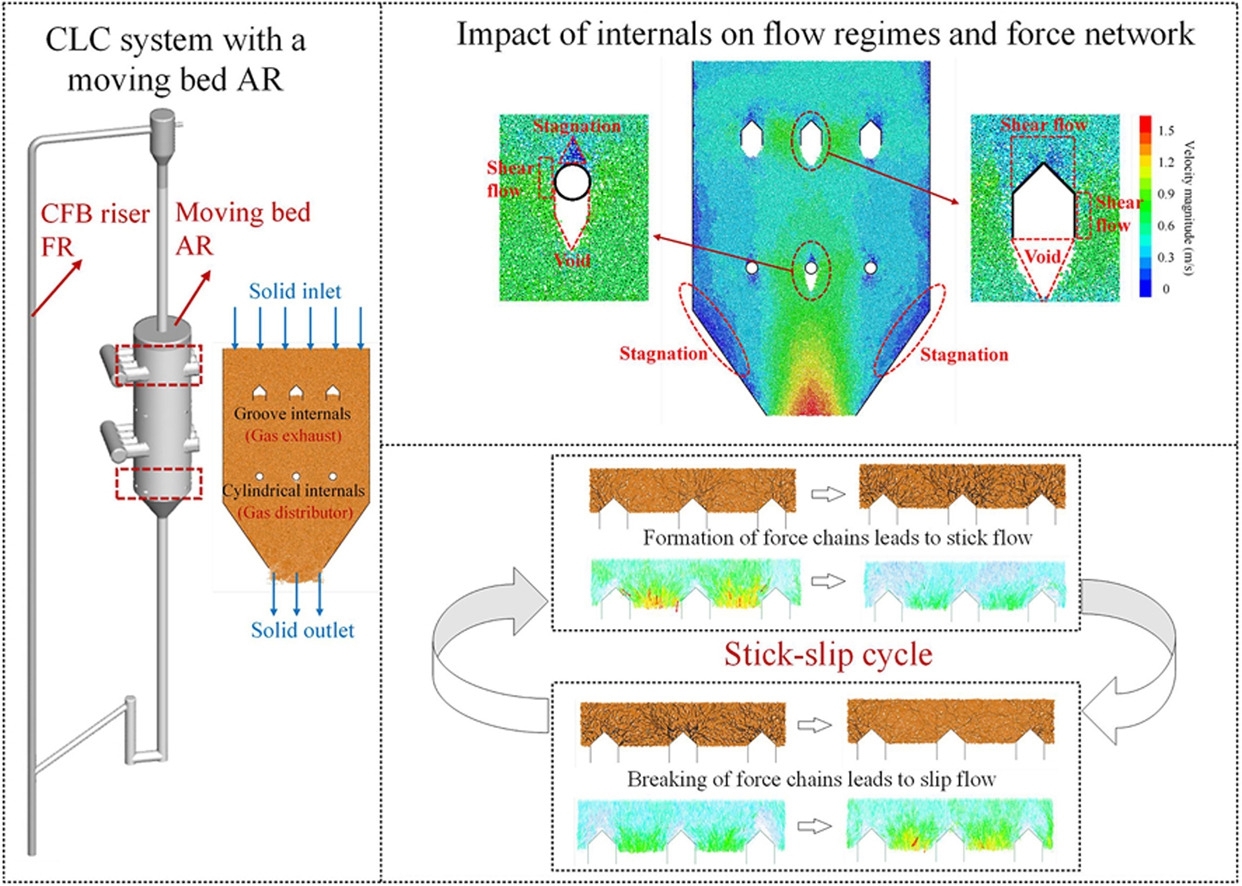
Moving bed air reactors (AR) offer distinct advantages for chemical looping combustion, yet the formation of localized stagnant zones severely impedes efficient heat and mass transfer, frequently causing the sintering and agglomeration of oxygen carriers. While previous studies have examined contact mechanics in simplified geometries, the underlying mesoscopic mechanisms governing the complex flow regimes induced by reactor internals remain unresolved. In this study, Discrete Element Method (DEM) simulations are employed to elucidate the multi-scale hydrodynamics in a moving bed AR by correlating macroscopic flow transitions with the spatiotemporal evolution of mesoscopic force chain networks. Macro-scale analysis reveals the formation of distinct stagnation, shear, and void zones around cylindrical internals, whereas shear and void zones are identified around grooved internals. The grooved internals induce a highly non-linear, periodic stick-slip dynamic, synchronized with the cyclical densification, high collimation, and subsequent abrupt yielding of strong force chains. In contrast, cylindrical internals facilitate a continuous flow regime by maintaining a force network with lower peak strength and reduced anisotropy, which effectively attenuates upstream flow instabilities. Furthermore, investigating the effect of particle size distribution (PSD) demonstrates that widening the PSD introduces geometric heterogeneity, disrupting the linear alignment of contact forces and weakening the overall network integrity. By explicitly correlating mesoscopic force topologies with macroscopic flow fields, this study provides a robust theoretical foundation for the structural optimization of moving bed ARs.
Graphical abstract
Keywords
Moving bed; Internals; Force chain network; DEM; Chemical looping combustion
文章导读