
期刊文章
过刊浏览
- Volumes 108-119 (2025)
-
Volumes 96-107 (2025)
-
Volume 107
Pages 1-376 (December 2025)
-
Volume 106
Pages 1-336 (November 2025)
-
Volume 105
Pages 1-356 (October 2025)
-
Volume 104
Pages 1-332 (September 2025)
-
Volume 103
Pages 1-314 (August 2025)
-
Volume 102
Pages 1-276 (July 2025)
-
Volume 101
Pages 1-166 (June 2025)
-
Volume 100
Pages 1-256 (May 2025)
-
Volume 99
Pages 1-242 (April 2025)
-
Volume 98
Pages 1-288 (March 2025)
-
Volume 97
Pages 1-256 (February 2025)
-
Volume 96
Pages 1-340 (January 2025)
-
Volume 107
-
Volumes 84-95 (2024)
-
Volume 95
Pages 1-392 (December 2024)
-
Volume 94
Pages 1-400 (November 2024)
-
Volume 93
Pages 1-376 (October 2024)
-
Volume 92
Pages 1-316 (September 2024)
-
Volume 91
Pages 1-378 (August 2024)
-
Volume 90
Pages 1-580 (July 2024)
-
Volume 89
Pages 1-278 (June 2024)
-
Volume 88
Pages 1-350 (May 2024)
-
Volume 87
Pages 1-338 (April 2024)
-
Volume 86
Pages 1-312 (March 2024)
-
Volume 85
Pages 1-334 (February 2024)
-
Volume 84
Pages 1-308 (January 2024)
-
Volume 95
-
Volumes 72-83 (2023)
-
Volume 83
Pages 1-258 (December 2023)
-
Volume 82
Pages 1-204 (November 2023)
-
Volume 81
Pages 1-188 (October 2023)
-
Volume 80
Pages 1-202 (September 2023)
-
Volume 79
Pages 1-172 (August 2023)
-
Volume 78
Pages 1-146 (July 2023)
-
Volume 77
Pages 1-152 (June 2023)
-
Volume 76
Pages 1-176 (May 2023)
-
Volume 75
Pages 1-228 (April 2023)
-
Volume 74
Pages 1-200 (March 2023)
-
Volume 73
Pages 1-138 (February 2023)
-
Volume 72
Pages 1-144 (January 2023)
-
Volume 83
-
Volumes 60-71 (2022)
-
Volume 71
Pages 1-108 (December 2022)
-
Volume 70
Pages 1-106 (November 2022)
-
Volume 69
Pages 1-122 (October 2022)
-
Volume 68
Pages 1-124 (September 2022)
-
Volume 67
Pages 1-102 (August 2022)
-
Volume 66
Pages 1-112 (July 2022)
-
Volume 65
Pages 1-138 (June 2022)
-
Volume 64
Pages 1-186 (May 2022)
-
Volume 63
Pages 1-124 (April 2022)
-
Volume 62
Pages 1-104 (March 2022)
-
Volume 61
Pages 1-120 (February 2022)
-
Volume 60
Pages 1-124 (January 2022)
-
Volume 71
- Volumes 54-59 (2021)
- Volumes 48-53 (2020)
- Volumes 42-47 (2019)
- Volumes 36-41 (2018)
- Volumes 30-35 (2017)
- Volumes 24-29 (2016)
- Volumes 18-23 (2015)
- Volumes 12-17 (2014)
- Volume 11 (2013)
- Volume 10 (2012)
- Volume 9 (2011)
- Volume 8 (2010)
- Volume 7 (2009)
- Volume 6 (2008)
- Volume 5 (2007)
- Volume 4 (2006)
- Volume 3 (2005)
- Volume 2 (2004)
- Volume 1 (2003)
Volume 117
Influence of fines content on the evolution of fabric anisotropy in granular materials: DEM simulations and theoretical modelling
Chaofa Zhao a, Yunfei Jiang a, Aoxi Zhang a *, Yuxuan Wen b
a State Key Laboratory of Soil Pollution Control and Safety, Department of Civil Engineering, Zhejiang University, Hangzhou, 310058, China
b State Key Laboratory for Safety and Resilience of Civil Engineering in Mountain Areas, East China Jiaotong University, Nanchang, 330013, China
10.1016/j.partic.2026.08.003
Volume 117,
October 2026,
Pages 411-425
Received 17 June 2026, Revised 21 July 2026, Accepted 6 August 2026, Available online 12 August 2026, Version of Record 20 August 2026.
E-mail:
aoxi.zhang@zju.edu.cn
Highlights
• DEM undrained triaxial tests span a broad fines content range (0–60%).
• A threshold fines content marks the coarse- to fines-dominated transition.
• Fabric anisotropy varies non-monotonically with increasing fines content.
• A fabric evolution law explicitly incorporating fines content is proposed.
Abstract
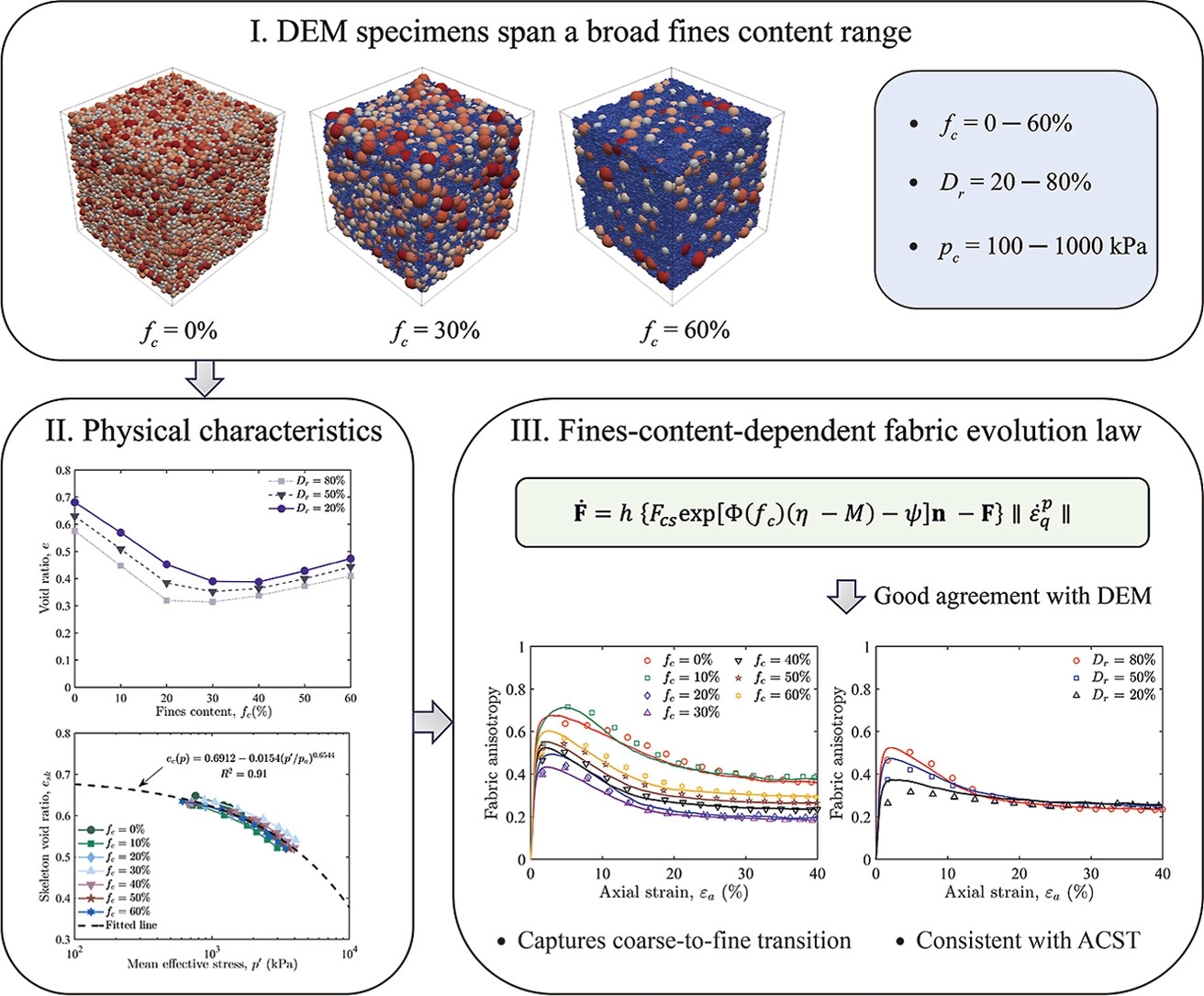
Granular soils encountered in engineering practice are commonly composed of mixtures of coarse and fine particles, for which fines content plays a critical role in governing the mechanical behaviour. While previous studies have shown that fabric anisotropy significantly influences the macroscopic response of granular materials, its evolution in fines-containing soils remains insufficiently understood. In particular, existing fabric evolution laws have been primarily developed for well-graded soils and do not explicitly account for the influence of fines content. To address this limitation, this study investigates the influence of fines content on the evolution of fabric anisotropy using the Discrete Element Method (DEM) and formulates a fabric evolution law considering a broad range of fines content. A series of undrained triaxial compression simulations has been conducted on granular assemblies with varying fines contents, initial densities, and confining pressures. The evolution of both macroscopic behaviour and microstructural characteristics is systematically analysed. The results reveal that fines content governs a clear transition in both mechanical behaviour and fabric evolution, characterised by a threshold fines content. Fabric anisotropy exhibits a characteristic evolution pattern during shearing and shows a non-monotonic dependence on fines content. Based on these observations, a fines content-dependent fabric evolution law has been proposed. The proposed model shows good agreement with DEM results across a wide range of conditions, demonstrating its capability to capture the influence of fines content on fabric evolution. The findings provide new insights into the micro-mechanical behaviour of fines-containing granular materials and offer a basis for developing advanced constitutive models incorporating fabric effects.
Graphical abstract
Keywords
Granular material; Fines content; Fabric anisotropy; DEM simulation
文章导读