
期刊文章
过刊浏览
- Volumes 108-119 (2025)
-
Volumes 96-107 (2025)
-
Volume 107
Pages 1-376 (December 2025)
-
Volume 106
Pages 1-336 (November 2025)
-
Volume 105
Pages 1-356 (October 2025)
-
Volume 104
Pages 1-332 (September 2025)
-
Volume 103
Pages 1-314 (August 2025)
-
Volume 102
Pages 1-276 (July 2025)
-
Volume 101
Pages 1-166 (June 2025)
-
Volume 100
Pages 1-256 (May 2025)
-
Volume 99
Pages 1-242 (April 2025)
-
Volume 98
Pages 1-288 (March 2025)
-
Volume 97
Pages 1-256 (February 2025)
-
Volume 96
Pages 1-340 (January 2025)
-
Volume 107
-
Volumes 84-95 (2024)
-
Volume 95
Pages 1-392 (December 2024)
-
Volume 94
Pages 1-400 (November 2024)
-
Volume 93
Pages 1-376 (October 2024)
-
Volume 92
Pages 1-316 (September 2024)
-
Volume 91
Pages 1-378 (August 2024)
-
Volume 90
Pages 1-580 (July 2024)
-
Volume 89
Pages 1-278 (June 2024)
-
Volume 88
Pages 1-350 (May 2024)
-
Volume 87
Pages 1-338 (April 2024)
-
Volume 86
Pages 1-312 (March 2024)
-
Volume 85
Pages 1-334 (February 2024)
-
Volume 84
Pages 1-308 (January 2024)
-
Volume 95
-
Volumes 72-83 (2023)
-
Volume 83
Pages 1-258 (December 2023)
-
Volume 82
Pages 1-204 (November 2023)
-
Volume 81
Pages 1-188 (October 2023)
-
Volume 80
Pages 1-202 (September 2023)
-
Volume 79
Pages 1-172 (August 2023)
-
Volume 78
Pages 1-146 (July 2023)
-
Volume 77
Pages 1-152 (June 2023)
-
Volume 76
Pages 1-176 (May 2023)
-
Volume 75
Pages 1-228 (April 2023)
-
Volume 74
Pages 1-200 (March 2023)
-
Volume 73
Pages 1-138 (February 2023)
-
Volume 72
Pages 1-144 (January 2023)
-
Volume 83
-
Volumes 60-71 (2022)
-
Volume 71
Pages 1-108 (December 2022)
-
Volume 70
Pages 1-106 (November 2022)
-
Volume 69
Pages 1-122 (October 2022)
-
Volume 68
Pages 1-124 (September 2022)
-
Volume 67
Pages 1-102 (August 2022)
-
Volume 66
Pages 1-112 (July 2022)
-
Volume 65
Pages 1-138 (June 2022)
-
Volume 64
Pages 1-186 (May 2022)
-
Volume 63
Pages 1-124 (April 2022)
-
Volume 62
Pages 1-104 (March 2022)
-
Volume 61
Pages 1-120 (February 2022)
-
Volume 60
Pages 1-124 (January 2022)
-
Volume 71
- Volumes 54-59 (2021)
- Volumes 48-53 (2020)
- Volumes 42-47 (2019)
- Volumes 36-41 (2018)
- Volumes 30-35 (2017)
- Volumes 24-29 (2016)
- Volumes 18-23 (2015)
- Volumes 12-17 (2014)
- Volume 11 (2013)
- Volume 10 (2012)
- Volume 9 (2011)
- Volume 8 (2010)
- Volume 7 (2009)
- Volume 6 (2008)
- Volume 5 (2007)
- Volume 4 (2006)
- Volume 3 (2005)
- Volume 2 (2004)
- Volume 1 (2003)
Volume 117
Ni-Co-Mn synergy on microstructure and electrochemical performance of NCM523 and NCM613 based on DFT calculation and Li+ diffusion experiments
Jing Li a, Yunhui Du a, Weiyi Zhang b, Dan Liu a, Da Wang a, Xinchi Jin a, Peng Zhang a *
a School of Mechanical, Electronic and Control Engineering, Beijing Jiaotong University, Beijing, 100044, China
b Department of Mechanical Engineering, Stanford University, Stanford, CA, 94305, United States
10.1016/j.partic.2026.08.005
Volume 117,
October 2026,
Pages 426-439
Received 15 June 2026, Revised 2 August 2026, Accepted 7 August 2026, Available online 8 August 2026, Version of Record 20 August 2026.
E-mail:
pzhang1@bjtu.edu.cn
Highlights
• Medium-nickel NCM cathode materials (NCM523 and NCM613) are selected and prepared.
• Ni-Co-Mn synergy is introduced to explore the effect on microstructure and electrochemical performance.
• DFT and Li+ diffusion experiments are researched together to analyze Ni-Co-Mn synergy.
• Quantified changes in microstructure and performance are obtained as the content changes of Ni, Co and Mn elements.
Abstract
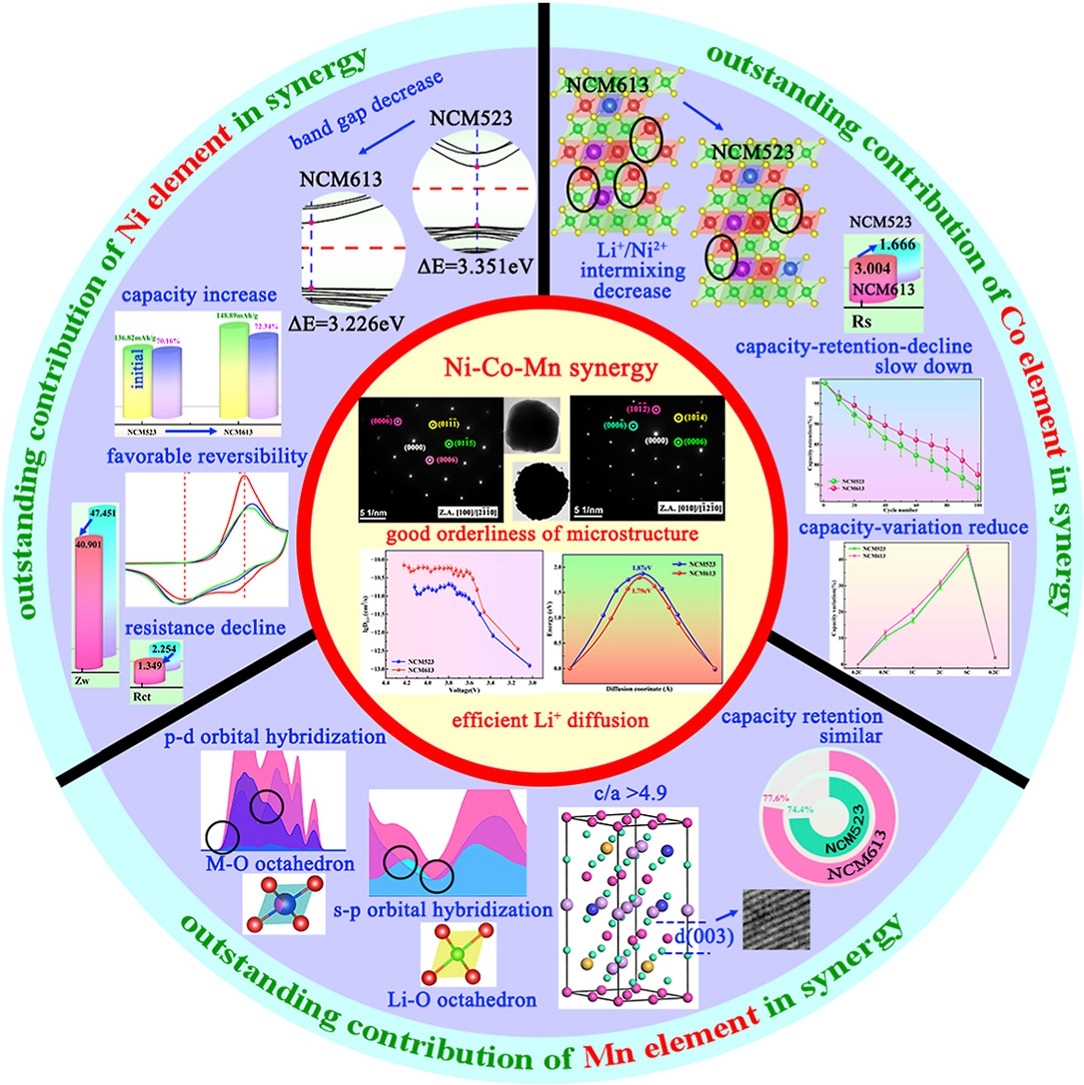
Ni-Co-Mn synergy is crucial in Li+ diffusion behavior, and medium-nickel cathode materials have advantages in balancing capacity and cycle-stability. LiNi0.5Co0.2Mn0.3O2(NCM523) and LiNi0.6Co0.1Mn0.3O2(NCM613) are obtained by co-precipitation and two-step calcination, and Ni-Co-Mn synergies on microstructure, DFT calculation and performance are investigated. Main results show that c/a in NCM523 and NCM613 are both greater than 4.9, and M3d-O2p orbital hybridizations are the similar, which cause the resembling structure-stability and capacity-retention. Compared with NCM523, in NCM613, the bandgap is smaller, DOS and conductivity are higher, (003)-interlayer-spacing is increased by 0.21%, and Rct and Zw are decreased by 40.15% and 13.81%, resulting in capacities higher at each cycle and rate, especially increased by 12.07 and 12.21 mAh/g at 1st discharge and 5C. In addition, NCM523 exhibits the greater I(003)/I(104) to be the lower Li+/Ni2+ intermixing, and the better capacity-recovery under long-cycle and high-rate, with the decline in capacity-retention from 80 to 100 cycles and the capacity-variation at 5C separately decreased by 1.9% and 1.88% than those of NCM613. Besides, Ni-Co-Mn synergy also makes the lower energy-barrier and the greater DLi+ in NCM613. Therefore, it is beneficial for designing the meticulous values of x and y in LiNixCoyMn1-x-yO2 to meet the multiple requirements.
Graphical abstract
Keywords
Ni-Co-Mn synergy; Li+ diffusion behavior; Medium-nickel cathode materials; DFT calculation
文章导读