
期刊文章
过刊浏览
- Volumes 108-119 (2025)
-
Volumes 96-107 (2025)
-
Volume 107
Pages 1-376 (December 2025)
-
Volume 106
Pages 1-336 (November 2025)
-
Volume 105
Pages 1-356 (October 2025)
-
Volume 104
Pages 1-332 (September 2025)
-
Volume 103
Pages 1-314 (August 2025)
-
Volume 102
Pages 1-276 (July 2025)
-
Volume 101
Pages 1-166 (June 2025)
-
Volume 100
Pages 1-256 (May 2025)
-
Volume 99
Pages 1-242 (April 2025)
-
Volume 98
Pages 1-288 (March 2025)
-
Volume 97
Pages 1-256 (February 2025)
-
Volume 96
Pages 1-340 (January 2025)
-
Volume 107
-
Volumes 84-95 (2024)
-
Volume 95
Pages 1-392 (December 2024)
-
Volume 94
Pages 1-400 (November 2024)
-
Volume 93
Pages 1-376 (October 2024)
-
Volume 92
Pages 1-316 (September 2024)
-
Volume 91
Pages 1-378 (August 2024)
-
Volume 90
Pages 1-580 (July 2024)
-
Volume 89
Pages 1-278 (June 2024)
-
Volume 88
Pages 1-350 (May 2024)
-
Volume 87
Pages 1-338 (April 2024)
-
Volume 86
Pages 1-312 (March 2024)
-
Volume 85
Pages 1-334 (February 2024)
-
Volume 84
Pages 1-308 (January 2024)
-
Volume 95
-
Volumes 72-83 (2023)
-
Volume 83
Pages 1-258 (December 2023)
-
Volume 82
Pages 1-204 (November 2023)
-
Volume 81
Pages 1-188 (October 2023)
-
Volume 80
Pages 1-202 (September 2023)
-
Volume 79
Pages 1-172 (August 2023)
-
Volume 78
Pages 1-146 (July 2023)
-
Volume 77
Pages 1-152 (June 2023)
-
Volume 76
Pages 1-176 (May 2023)
-
Volume 75
Pages 1-228 (April 2023)
-
Volume 74
Pages 1-200 (March 2023)
-
Volume 73
Pages 1-138 (February 2023)
-
Volume 72
Pages 1-144 (January 2023)
-
Volume 83
-
Volumes 60-71 (2022)
-
Volume 71
Pages 1-108 (December 2022)
-
Volume 70
Pages 1-106 (November 2022)
-
Volume 69
Pages 1-122 (October 2022)
-
Volume 68
Pages 1-124 (September 2022)
-
Volume 67
Pages 1-102 (August 2022)
-
Volume 66
Pages 1-112 (July 2022)
-
Volume 65
Pages 1-138 (June 2022)
-
Volume 64
Pages 1-186 (May 2022)
-
Volume 63
Pages 1-124 (April 2022)
-
Volume 62
Pages 1-104 (March 2022)
-
Volume 61
Pages 1-120 (February 2022)
-
Volume 60
Pages 1-124 (January 2022)
-
Volume 71
- Volumes 54-59 (2021)
- Volumes 48-53 (2020)
- Volumes 42-47 (2019)
- Volumes 36-41 (2018)
- Volumes 30-35 (2017)
- Volumes 24-29 (2016)
- Volumes 18-23 (2015)
- Volumes 12-17 (2014)
- Volume 11 (2013)
- Volume 10 (2012)
- Volume 9 (2011)
- Volume 8 (2010)
- Volume 7 (2009)
- Volume 6 (2008)
- Volume 5 (2007)
- Volume 4 (2006)
- Volume 3 (2005)
- Volume 2 (2004)
- Volume 1 (2003)
Volume 117
Dual-driven battery life prediction based on data augmentation and capacity recovery identification
Zhongyang Liu a, Yukun Wang a, Jinxiu Chen a, Jinhao Meng b *, Long Kong a *
a Institute of Flexible Electronics, Northwestern Polytechnical University, Xi'an, 710129, China
b School of Electrical Engineering, Xi'an Jiao Tong University, Xi'an, 710049, China
10.1016/j.partic.2026.08.006
Volume 117,
October 2026,
Pages 440-452
Received 18 July 2026, Revised 29 July 2026, Accepted 7 August 2026, Available online 8 August 2026, Version of Record 20 August 2026.
E-mail:
jinhao@xjtu.edu.cn; iamlkong@nwpu.edu.cn
Highlights
• Proposing RUL prediction framework for lithium-ion batteries.
• Incorporating CR dynamic identification and data augmentation.
• Addressing capacity fluctuation and few-shot scenario.
• Enhancing RUL prediction accuracy and robustness.
Abstract
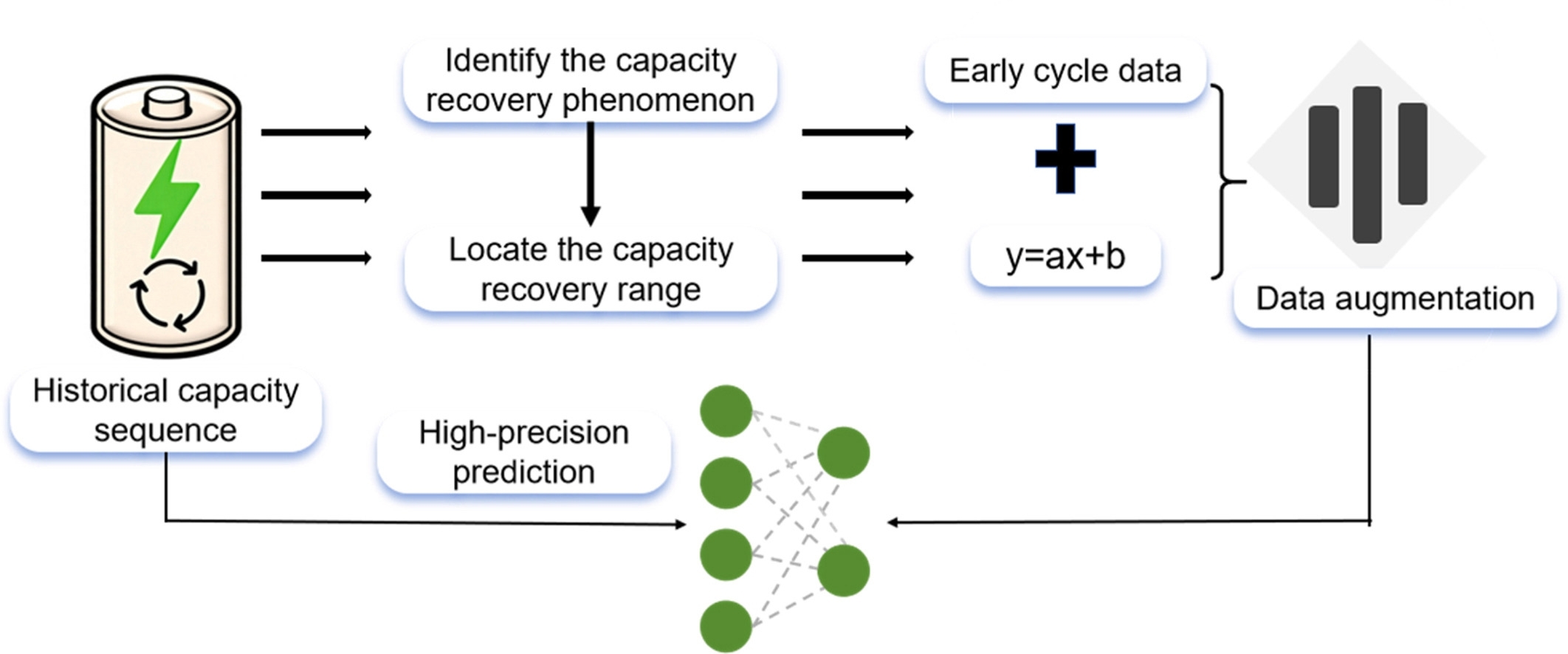
Accurate prediction of the remaining useful life (RUL) of lithium-ion batteries is a critical prerequisite for predictive maintenance, optimizing charge-discharge strategies, and ensuring their long-term safe operation. However, during the cell resting, side reactions among cell components, especially on electrolyte/electrode interface, lead to an unwanted temporary capacity recovery (CR). This phenomenon poses significant challenges to the accurate prediction of RUL. This study proposes a RUL prediction framework that incorporates dynamic identification of CR and data augmentation to concurrently address capacity fluctuation and few-shot scenario. In this study, input data purification is achieved through an innovative quasi-online identification and CR quantitative correction strategy, and training sample expansion is accomplished by conducting strategic data augmentation based on early-cycle data. The proposed framework can significantly improve the prediction accuracy of RUL for application scenarios with CR interference and limited early-cycle data.
Graphical abstract
Keywords
Lithium-ion battery; Remaining useful life; Gated recurrent unit; Data augmentation; Capacity recovery
文章导读