
期刊文章
过刊浏览
- Volumes 108-119 (2025)
-
Volumes 96-107 (2025)
-
Volume 107
Pages 1-376 (December 2025)
-
Volume 106
Pages 1-336 (November 2025)
-
Volume 105
Pages 1-356 (October 2025)
-
Volume 104
Pages 1-332 (September 2025)
-
Volume 103
Pages 1-314 (August 2025)
-
Volume 102
Pages 1-276 (July 2025)
-
Volume 101
Pages 1-166 (June 2025)
-
Volume 100
Pages 1-256 (May 2025)
-
Volume 99
Pages 1-242 (April 2025)
-
Volume 98
Pages 1-288 (March 2025)
-
Volume 97
Pages 1-256 (February 2025)
-
Volume 96
Pages 1-340 (January 2025)
-
Volume 107
-
Volumes 84-95 (2024)
-
Volume 95
Pages 1-392 (December 2024)
-
Volume 94
Pages 1-400 (November 2024)
-
Volume 93
Pages 1-376 (October 2024)
-
Volume 92
Pages 1-316 (September 2024)
-
Volume 91
Pages 1-378 (August 2024)
-
Volume 90
Pages 1-580 (July 2024)
-
Volume 89
Pages 1-278 (June 2024)
-
Volume 88
Pages 1-350 (May 2024)
-
Volume 87
Pages 1-338 (April 2024)
-
Volume 86
Pages 1-312 (March 2024)
-
Volume 85
Pages 1-334 (February 2024)
-
Volume 84
Pages 1-308 (January 2024)
-
Volume 95
-
Volumes 72-83 (2023)
-
Volume 83
Pages 1-258 (December 2023)
-
Volume 82
Pages 1-204 (November 2023)
-
Volume 81
Pages 1-188 (October 2023)
-
Volume 80
Pages 1-202 (September 2023)
-
Volume 79
Pages 1-172 (August 2023)
-
Volume 78
Pages 1-146 (July 2023)
-
Volume 77
Pages 1-152 (June 2023)
-
Volume 76
Pages 1-176 (May 2023)
-
Volume 75
Pages 1-228 (April 2023)
-
Volume 74
Pages 1-200 (March 2023)
-
Volume 73
Pages 1-138 (February 2023)
-
Volume 72
Pages 1-144 (January 2023)
-
Volume 83
-
Volumes 60-71 (2022)
-
Volume 71
Pages 1-108 (December 2022)
-
Volume 70
Pages 1-106 (November 2022)
-
Volume 69
Pages 1-122 (October 2022)
-
Volume 68
Pages 1-124 (September 2022)
-
Volume 67
Pages 1-102 (August 2022)
-
Volume 66
Pages 1-112 (July 2022)
-
Volume 65
Pages 1-138 (June 2022)
-
Volume 64
Pages 1-186 (May 2022)
-
Volume 63
Pages 1-124 (April 2022)
-
Volume 62
Pages 1-104 (March 2022)
-
Volume 61
Pages 1-120 (February 2022)
-
Volume 60
Pages 1-124 (January 2022)
-
Volume 71
- Volumes 54-59 (2021)
- Volumes 48-53 (2020)
- Volumes 42-47 (2019)
- Volumes 36-41 (2018)
- Volumes 30-35 (2017)
- Volumes 24-29 (2016)
- Volumes 18-23 (2015)
- Volumes 12-17 (2014)
- Volume 11 (2013)
- Volume 10 (2012)
- Volume 9 (2011)
- Volume 8 (2010)
- Volume 7 (2009)
- Volume 6 (2008)
- Volume 5 (2007)
- Volume 4 (2006)
- Volume 3 (2005)
- Volume 2 (2004)
- Volume 1 (2003)
Volume 117
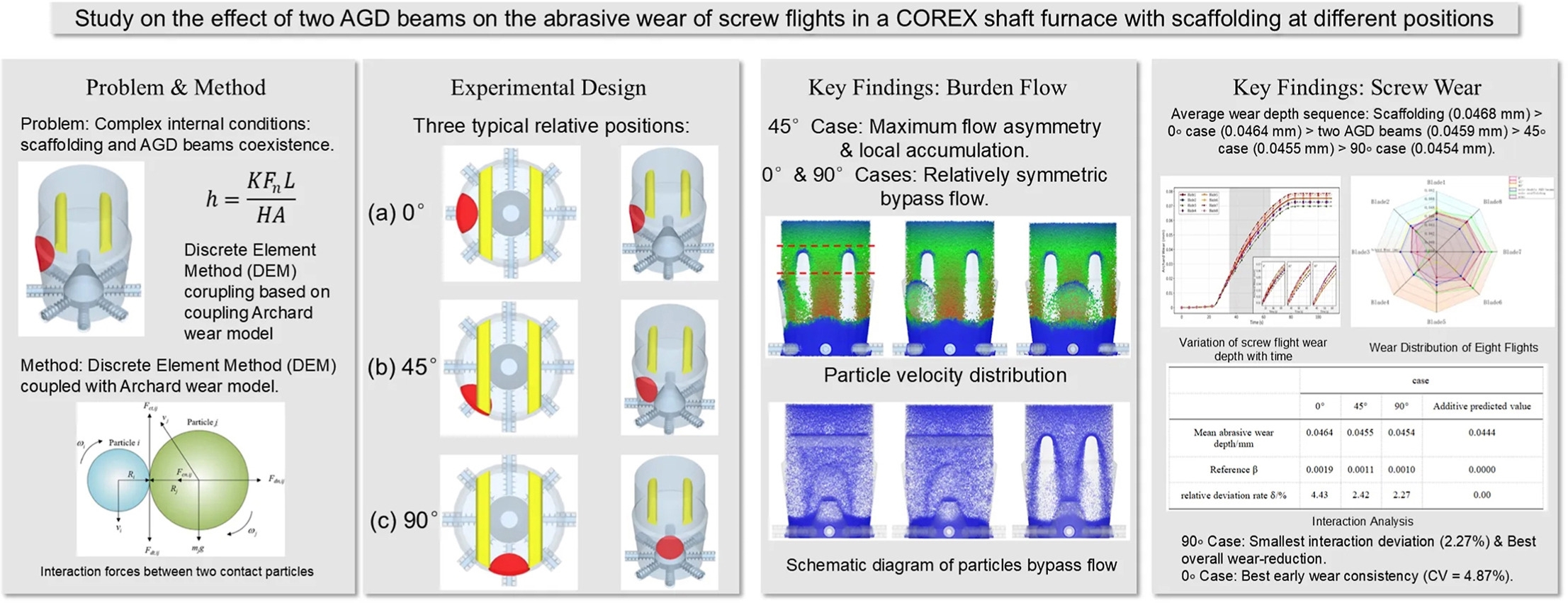
Study on the effect of two AGD beams on the abrasive wear of screw flights in a COREX shaft furnace with scaffolding at different positions
Xinlei Yin, Yi Zhong, Wenjie Rong *, Shuoning Cui, Jiashuo Li
School of Metallurgy, Northeastern University, Shenyang, 110819, China
10.1016/j.partic.2026.08.004
Volume 117,
October 2026,
Pages 453-462
Received 22 May 2026, Revised 19 July 2026, Accepted 6 August 2026, Available online 6 August 2026, Version of Record 21 August 2026.
E-mail:
rongwenjie@smm.neu.edu.cn
Highlights
• Effects of gas distribution beams and scaffolds on burden flow and screw wear were investigated.
• Scaffolds force particle bypass, while a 45-degree beam layout causes maximum flow asymmetry.
• Adding two gas distribution beams effectively reduces screw flight wear caused by scaffolding.
• A 90-degree relative position minimizes average wear depth and provides optimal wear reduction.
Abstract
The layout of Areal Gas Distribution (AGD) beams in COREX shaft furnaces influences burden motion and screw flight abrasion. High-temperature conditions easily trigger scaffold formation, further complicating internal furnace flow when scaffolds interact with AGD beams. This work adopts the Discrete Element Method (DEM) with Hertz-Mindlin no-slip contact and Archard wear model to investigate coupled impacts of AGD beams and scaffolds at various relative positions on burden flow and screw wear. Five conditions, two AGD beams, scaffolding, and three typical relative positions (0°, 45°, and 90°) between two AGD beams and scaffolding are compared. The results demonstrate that the burden flow presents distinct zonal characteristics. Particle bypass around scaffolding is relatively symmetric at 0° and 90°, while the 45° arrangement shows the most significant asymmetry in flow and accumulation. The average wear depth under all three combined conditions is lower than that under the scaffolding condition, indicating that the adoption of two AGD beams can partly alleviate scaffolding-induced wear aggravation. The 90° case presents the minimum average wear depth and the 0° case provides a more uniform wear distribution among different flights. Furthermore, the interaction analysis based on the standard 22 full-factor fixed-effects model indicates that the 90° case has the smallest interaction deviation and the best overall wear-reduction performance.
Graphical abstract
Keywords
COREX shaft furnace; AGD beams; Scaffolding; Archard wear model; Abrasive wear of screw flights
文章导读