
期刊文章
过刊浏览
- Volumes 108-119 (2025)
-
Volumes 96-107 (2025)
-
Volume 107
Pages 1-376 (December 2025)
-
Volume 106
Pages 1-336 (November 2025)
-
Volume 105
Pages 1-356 (October 2025)
-
Volume 104
Pages 1-332 (September 2025)
-
Volume 103
Pages 1-314 (August 2025)
-
Volume 102
Pages 1-276 (July 2025)
-
Volume 101
Pages 1-166 (June 2025)
-
Volume 100
Pages 1-256 (May 2025)
-
Volume 99
Pages 1-242 (April 2025)
-
Volume 98
Pages 1-288 (March 2025)
-
Volume 97
Pages 1-256 (February 2025)
-
Volume 96
Pages 1-340 (January 2025)
-
Volume 107
-
Volumes 84-95 (2024)
-
Volume 95
Pages 1-392 (December 2024)
-
Volume 94
Pages 1-400 (November 2024)
-
Volume 93
Pages 1-376 (October 2024)
-
Volume 92
Pages 1-316 (September 2024)
-
Volume 91
Pages 1-378 (August 2024)
-
Volume 90
Pages 1-580 (July 2024)
-
Volume 89
Pages 1-278 (June 2024)
-
Volume 88
Pages 1-350 (May 2024)
-
Volume 87
Pages 1-338 (April 2024)
-
Volume 86
Pages 1-312 (March 2024)
-
Volume 85
Pages 1-334 (February 2024)
-
Volume 84
Pages 1-308 (January 2024)
-
Volume 95
-
Volumes 72-83 (2023)
-
Volume 83
Pages 1-258 (December 2023)
-
Volume 82
Pages 1-204 (November 2023)
-
Volume 81
Pages 1-188 (October 2023)
-
Volume 80
Pages 1-202 (September 2023)
-
Volume 79
Pages 1-172 (August 2023)
-
Volume 78
Pages 1-146 (July 2023)
-
Volume 77
Pages 1-152 (June 2023)
-
Volume 76
Pages 1-176 (May 2023)
-
Volume 75
Pages 1-228 (April 2023)
-
Volume 74
Pages 1-200 (March 2023)
-
Volume 73
Pages 1-138 (February 2023)
-
Volume 72
Pages 1-144 (January 2023)
-
Volume 83
-
Volumes 60-71 (2022)
-
Volume 71
Pages 1-108 (December 2022)
-
Volume 70
Pages 1-106 (November 2022)
-
Volume 69
Pages 1-122 (October 2022)
-
Volume 68
Pages 1-124 (September 2022)
-
Volume 67
Pages 1-102 (August 2022)
-
Volume 66
Pages 1-112 (July 2022)
-
Volume 65
Pages 1-138 (June 2022)
-
Volume 64
Pages 1-186 (May 2022)
-
Volume 63
Pages 1-124 (April 2022)
-
Volume 62
Pages 1-104 (March 2022)
-
Volume 61
Pages 1-120 (February 2022)
-
Volume 60
Pages 1-124 (January 2022)
-
Volume 71
- Volumes 54-59 (2021)
- Volumes 48-53 (2020)
- Volumes 42-47 (2019)
- Volumes 36-41 (2018)
- Volumes 30-35 (2017)
- Volumes 24-29 (2016)
- Volumes 18-23 (2015)
- Volumes 12-17 (2014)
- Volume 11 (2013)
- Volume 10 (2012)
- Volume 9 (2011)
- Volume 8 (2010)
- Volume 7 (2009)
- Volume 6 (2008)
- Volume 5 (2007)
- Volume 4 (2006)
- Volume 3 (2005)
- Volume 2 (2004)
- Volume 1 (2003)
Volume 117
Deciphering process-morphology relationships in magnesite-derived nesquehonite crystallization using interpretable machine learning
Fengling Weng a, Yulian Wang a b *, Jiayi Liu c d, Hanghuan Yu a, Mufan Xiao a, Hongbo Cheng a, Yining Zhang a, Ben Han a
a School of Materials Science and Engineering, Shenyang Ligong University, Shenyang, 110159, China
b Liaoning, Provincial Engineering, Research Center for High-Value Utilization of Magnesite, Yingkou, 115014, China
c School of Resources & Civil Engineering, Northeastern University, Shenyang, 110819, China
d KU Leuven Bruges, Department of Materials Engineering, Surface and Interface Engineered Materials, 8200, Bruges, Belgium
10.1016/j.partic.2026.08.007
Volume 117,
October 2026,
Pages 463-476
Received 14 June 2026, Revised 25 July 2026, Accepted 9 August 2026, Available online 13 August 2026, Version of Record 21 August 2026.
E-mail:
wangyulian@sylu.edu.cn
Highlights
• Nesquehonite was prepared from low-grade magnesite-derived Mg(HCO3)2 solution.
• Five regression models were compared for predicting nesquehonite aspect ratio.
• SVR showed the best prediction accuracy among the tested models.
• SHAP identified stirring rate as the dominant variable controlling aspect ratio.
• Favorable ranges for high-aspect-ratio nesquehonite were clarified.
Abstract
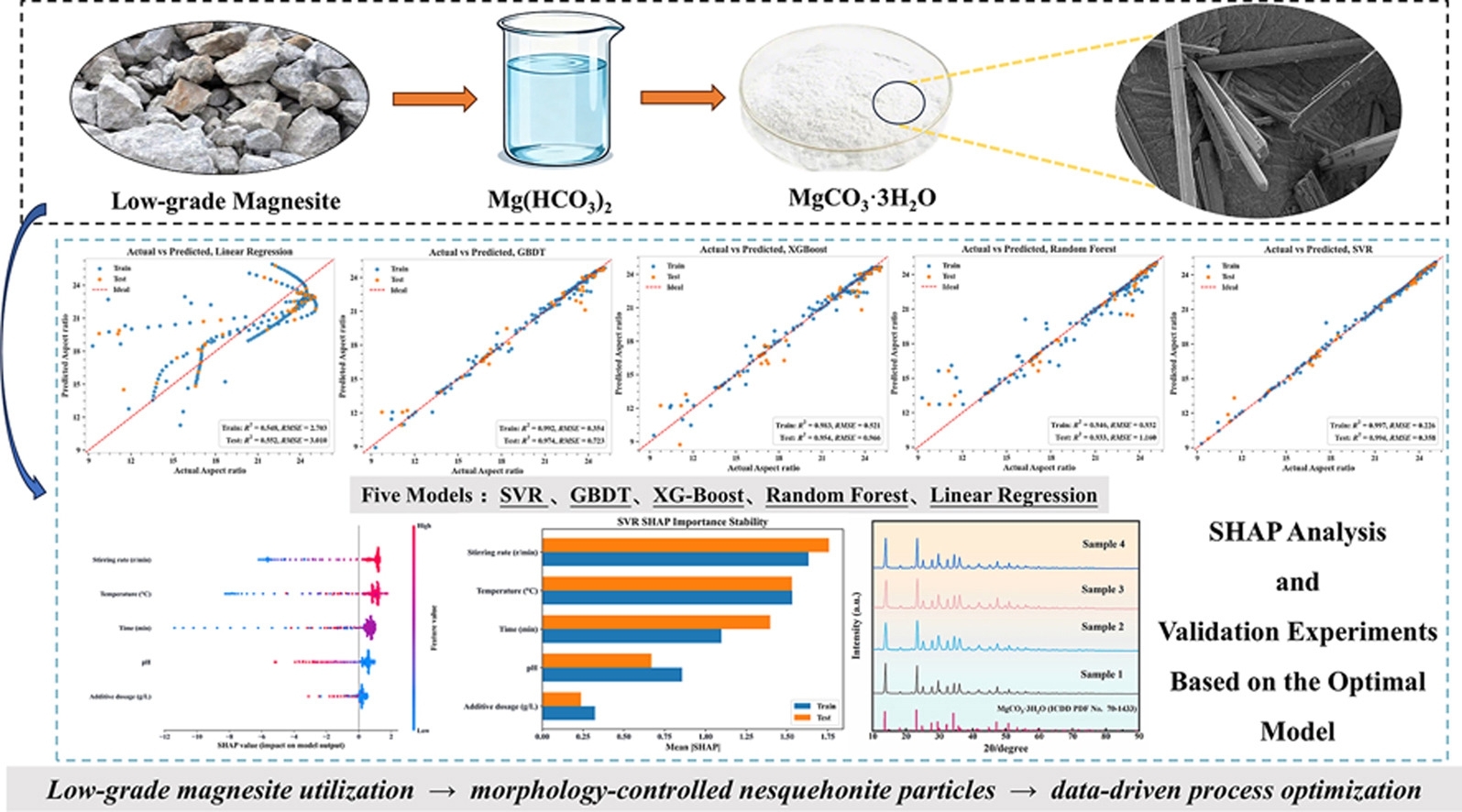
The aspect ratio of nesquehonite is critical to its morphology-dependent applications, yet its nonlinear dependence on coupled crystallization parameters remains poorly understood. Here, an interpretable machine-learning framework was developed using 212 valid experimental records of nesquehonite prepared from low-grade magnesite-derived Mg(HCO3)2. Five regression models, namely support vector regression (SVR), gradient boosting decision tree (GBDT), XGBoost, random forest and linear regression, were evaluated. Among them, SVR achieved the best performance, with a held-out test-set R2 of 0.9937 and RMSE of 0.3568, together with a repeated cross-validation R2 of 0.9070 ± 0.0512. Four validation experiments conducted under previously unseen process conditions yielded a mean relative prediction error of 3.11%, with all errors below 5%. SHAP analysis ranked the influential variables as stirring rate > reaction temperature > reaction time > pH > MgCl2 dosage and indicated that high stirring rates, moderate temperatures and reaction times, near-neutral pH, and moderate MgCl2 dosages favored high-aspect-ratio crystals. This framework provides a quantitative and interpretable tool for screening nesquehonite crystallization conditions within the investigated process domain.
Graphical abstract
Keywords
Nesquehonite; Aspect ratio; Magnesite; Mg(HCO3)2; Machine learning; SVR; SHAP
文章导读