
期刊文章
过刊浏览
- Volumes 108-119 (2025)
-
Volumes 96-107 (2025)
-
Volume 107
Pages 1-376 (December 2025)
-
Volume 106
Pages 1-336 (November 2025)
-
Volume 105
Pages 1-356 (October 2025)
-
Volume 104
Pages 1-332 (September 2025)
-
Volume 103
Pages 1-314 (August 2025)
-
Volume 102
Pages 1-276 (July 2025)
-
Volume 101
Pages 1-166 (June 2025)
-
Volume 100
Pages 1-256 (May 2025)
-
Volume 99
Pages 1-242 (April 2025)
-
Volume 98
Pages 1-288 (March 2025)
-
Volume 97
Pages 1-256 (February 2025)
-
Volume 96
Pages 1-340 (January 2025)
-
Volume 107
-
Volumes 84-95 (2024)
-
Volume 95
Pages 1-392 (December 2024)
-
Volume 94
Pages 1-400 (November 2024)
-
Volume 93
Pages 1-376 (October 2024)
-
Volume 92
Pages 1-316 (September 2024)
-
Volume 91
Pages 1-378 (August 2024)
-
Volume 90
Pages 1-580 (July 2024)
-
Volume 89
Pages 1-278 (June 2024)
-
Volume 88
Pages 1-350 (May 2024)
-
Volume 87
Pages 1-338 (April 2024)
-
Volume 86
Pages 1-312 (March 2024)
-
Volume 85
Pages 1-334 (February 2024)
-
Volume 84
Pages 1-308 (January 2024)
-
Volume 95
-
Volumes 72-83 (2023)
-
Volume 83
Pages 1-258 (December 2023)
-
Volume 82
Pages 1-204 (November 2023)
-
Volume 81
Pages 1-188 (October 2023)
-
Volume 80
Pages 1-202 (September 2023)
-
Volume 79
Pages 1-172 (August 2023)
-
Volume 78
Pages 1-146 (July 2023)
-
Volume 77
Pages 1-152 (June 2023)
-
Volume 76
Pages 1-176 (May 2023)
-
Volume 75
Pages 1-228 (April 2023)
-
Volume 74
Pages 1-200 (March 2023)
-
Volume 73
Pages 1-138 (February 2023)
-
Volume 72
Pages 1-144 (January 2023)
-
Volume 83
-
Volumes 60-71 (2022)
-
Volume 71
Pages 1-108 (December 2022)
-
Volume 70
Pages 1-106 (November 2022)
-
Volume 69
Pages 1-122 (October 2022)
-
Volume 68
Pages 1-124 (September 2022)
-
Volume 67
Pages 1-102 (August 2022)
-
Volume 66
Pages 1-112 (July 2022)
-
Volume 65
Pages 1-138 (June 2022)
-
Volume 64
Pages 1-186 (May 2022)
-
Volume 63
Pages 1-124 (April 2022)
-
Volume 62
Pages 1-104 (March 2022)
-
Volume 61
Pages 1-120 (February 2022)
-
Volume 60
Pages 1-124 (January 2022)
-
Volume 71
- Volumes 54-59 (2021)
- Volumes 48-53 (2020)
- Volumes 42-47 (2019)
- Volumes 36-41 (2018)
- Volumes 30-35 (2017)
- Volumes 24-29 (2016)
- Volumes 18-23 (2015)
- Volumes 12-17 (2014)
- Volume 11 (2013)
- Volume 10 (2012)
- Volume 9 (2011)
- Volume 8 (2010)
- Volume 7 (2009)
- Volume 6 (2008)
- Volume 5 (2007)
- Volume 4 (2006)
- Volume 3 (2005)
- Volume 2 (2004)
- Volume 1 (2003)
Volume 117
In-situ dynamic characterisation of flow deterioration and caking of hygroscopic powder under controlled temperature and humidity
Jiale Wang a, Suqing Wang a, Wenguang Nan a *, Jinfeng Bi b, Qinqin Chen b
a School of Mechanical and Power Engineering, Nanjing Tech University, Nanjing, 211816, China
b Institute of Food Science and Technology, Chinese Academy of Agricultural Sciences (CAAS), Key Laboratory of Agro-Products Processing, Ministry of Agriculture and Rural Affairs, Beijing, 100193, China
10.1016/j.partic.2026.08.015
Volume 117,
Received 1 June 2026, Revised 29 July 2026, Accepted 12 August 2026, Available online 13 August 2026, Version of Record 21 August 2026.,
Pages 477-487
Received 1 June 2026, Revised 29 July 2026, Accepted 12 August 2026, Available online 13 August 2026, Version of Record 21 August 2026.
E-mail:
nanwg@njtech.edu.cn
Highlights
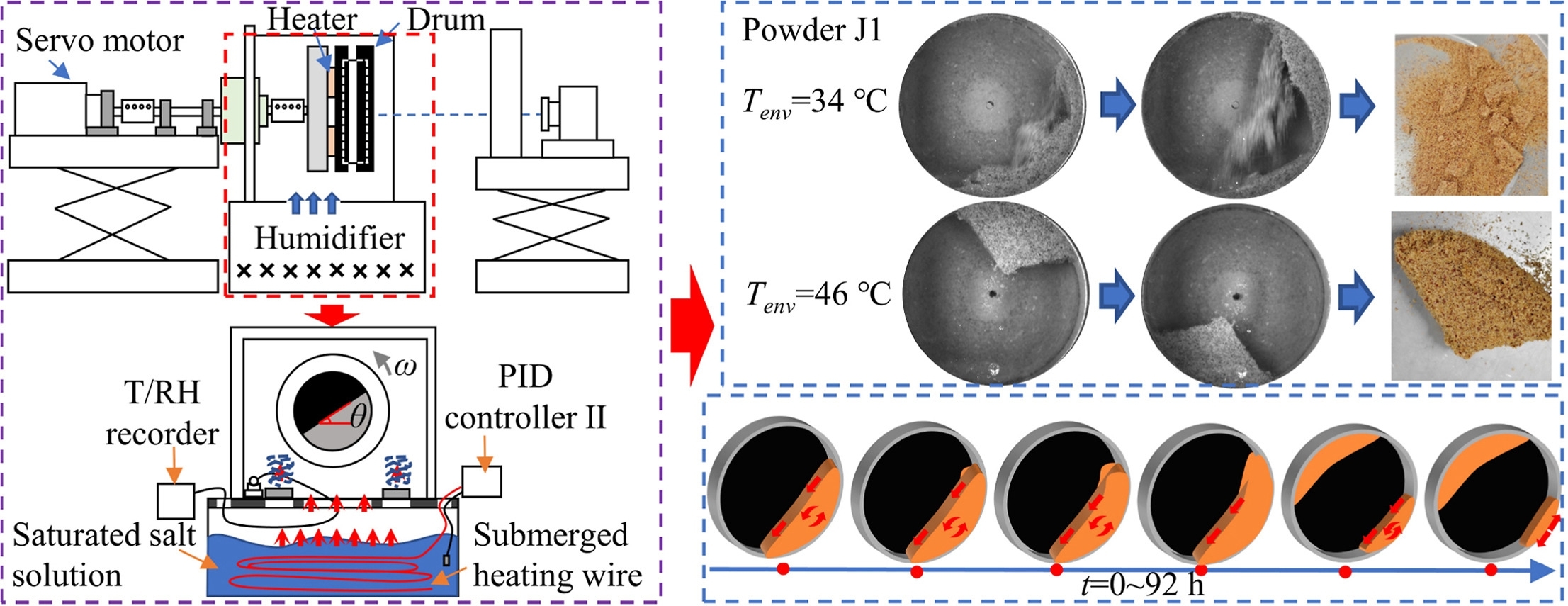
• A temperature-humidity-controlled rotating drum is developed for dynamic testing.
• Flowability and caking of hygroscopic powders are dynamically characterised.
• Evolution of powder behaviour is governed by relationship between Tg and Tenv.
• A mathematical model is proposed to estimate the critical caking strength.
• Full transition from free flow to caking-induced segregation is captured in situ.
Abstract
A dynamic characterisation method is developed to investigate the flowability and caking of hygroscopic powders under controlled temperature–humidity conditions. The method enables continuous monitoring of powder flow, agglomeration and caking evolution with minimal disturbance. Two hygroscopic jujube powders are used as model materials to examine their dynamic behaviours during moisture absorption at different environmental temperatures. The results show that powder flowability is highly affected by the relationship between the glass transition temperature (Tg) and the environmental temperature (Tenv). As moisture uptake proceeds, Tg progressively decreases toward Tenv, leading to reduced flowability and even a markedly increased risk of caking once Tg falls to or below Tenv. Although the two powders exhibit similar initial flowability, they display markedly different behaviours during long-period moisture absorption, indicating that initial flowability alone is insufficient to assess storage stability. Different caking modes are directly captured under different environmental temperatures, and a mathematical model is further introduced to estimate the critical apparent caking strength. Moreover, glass transition does not occur uniformly throughout the whole powder heap, leading to spatially non-uniform plasticisation and eventually caking-induced segregation. The proposed method provides an effective route for understanding and controlling moisture-induced flow deterioration and caking in hygroscopic powders.
Graphical abstract
Keywords
Dynamic characterisation; Flowability; Caking; Controlled temperature and humidity; Glass transition temperature; Caking-induced segregation
文章导读