
期刊文章
过刊浏览
- Volumes 108-119 (2025)
-
Volumes 96-107 (2025)
-
Volume 107
Pages 1-376 (December 2025)
-
Volume 106
Pages 1-336 (November 2025)
-
Volume 105
Pages 1-356 (October 2025)
-
Volume 104
Pages 1-332 (September 2025)
-
Volume 103
Pages 1-314 (August 2025)
-
Volume 102
Pages 1-276 (July 2025)
-
Volume 101
Pages 1-166 (June 2025)
-
Volume 100
Pages 1-256 (May 2025)
-
Volume 99
Pages 1-242 (April 2025)
-
Volume 98
Pages 1-288 (March 2025)
-
Volume 97
Pages 1-256 (February 2025)
-
Volume 96
Pages 1-340 (January 2025)
-
Volume 107
-
Volumes 84-95 (2024)
-
Volume 95
Pages 1-392 (December 2024)
-
Volume 94
Pages 1-400 (November 2024)
-
Volume 93
Pages 1-376 (October 2024)
-
Volume 92
Pages 1-316 (September 2024)
-
Volume 91
Pages 1-378 (August 2024)
-
Volume 90
Pages 1-580 (July 2024)
-
Volume 89
Pages 1-278 (June 2024)
-
Volume 88
Pages 1-350 (May 2024)
-
Volume 87
Pages 1-338 (April 2024)
-
Volume 86
Pages 1-312 (March 2024)
-
Volume 85
Pages 1-334 (February 2024)
-
Volume 84
Pages 1-308 (January 2024)
-
Volume 95
-
Volumes 72-83 (2023)
-
Volume 83
Pages 1-258 (December 2023)
-
Volume 82
Pages 1-204 (November 2023)
-
Volume 81
Pages 1-188 (October 2023)
-
Volume 80
Pages 1-202 (September 2023)
-
Volume 79
Pages 1-172 (August 2023)
-
Volume 78
Pages 1-146 (July 2023)
-
Volume 77
Pages 1-152 (June 2023)
-
Volume 76
Pages 1-176 (May 2023)
-
Volume 75
Pages 1-228 (April 2023)
-
Volume 74
Pages 1-200 (March 2023)
-
Volume 73
Pages 1-138 (February 2023)
-
Volume 72
Pages 1-144 (January 2023)
-
Volume 83
-
Volumes 60-71 (2022)
-
Volume 71
Pages 1-108 (December 2022)
-
Volume 70
Pages 1-106 (November 2022)
-
Volume 69
Pages 1-122 (October 2022)
-
Volume 68
Pages 1-124 (September 2022)
-
Volume 67
Pages 1-102 (August 2022)
-
Volume 66
Pages 1-112 (July 2022)
-
Volume 65
Pages 1-138 (June 2022)
-
Volume 64
Pages 1-186 (May 2022)
-
Volume 63
Pages 1-124 (April 2022)
-
Volume 62
Pages 1-104 (March 2022)
-
Volume 61
Pages 1-120 (February 2022)
-
Volume 60
Pages 1-124 (January 2022)
-
Volume 71
- Volumes 54-59 (2021)
- Volumes 48-53 (2020)
- Volumes 42-47 (2019)
- Volumes 36-41 (2018)
- Volumes 30-35 (2017)
- Volumes 24-29 (2016)
- Volumes 18-23 (2015)
- Volumes 12-17 (2014)
- Volume 11 (2013)
- Volume 10 (2012)
- Volume 9 (2011)
- Volume 8 (2010)
- Volume 7 (2009)
- Volume 6 (2008)
- Volume 5 (2007)
- Volume 4 (2006)
- Volume 3 (2005)
- Volume 2 (2004)
- Volume 1 (2003)
Volume 117
Numerical study on solar-driven biomass gasification in a novel dual fluidized bed using particle heat carriers
Zhang Bai, Binzhong Xi, Xiaoli Zhu *, Chuangchuang Ding, Xiao Ren, Pengcheng Dai, Liqiang Zhang
College of New Energy, China University of Petroleum (East China), Qingdao, 266580, China
10.1016/j.partic.2026.08.011
Volume 117,
October 2026,
Pages 488-501
Received 27 May 2026, Revised 19 July 2026, Accepted 11 August 2026, Available online 14 August 2026, Version of Record 22 August 2026.
E-mail:
zhuxiaoli@upc.edu.cn
Highlights
• A novel solar-driven dual fluidized bed system with particle heat carriers is proposed for biomass gasification.
• Continuous circulation of particle heat carriers enables efficient heat transfer between the solar absorber and gasifier.
• CPFD simulations reveal coupled gas-solid flow behavior and thermochemical conversion characteristics.
• Optimal syngas performance is achieved at S/B = 1.0 and a biomass particle size of 350 μm.
• Maximum syngas quality reaches LHVgas of 7.2 MJ/Nm3 with a cold gas efficiency of up to 0.80.
Abstract
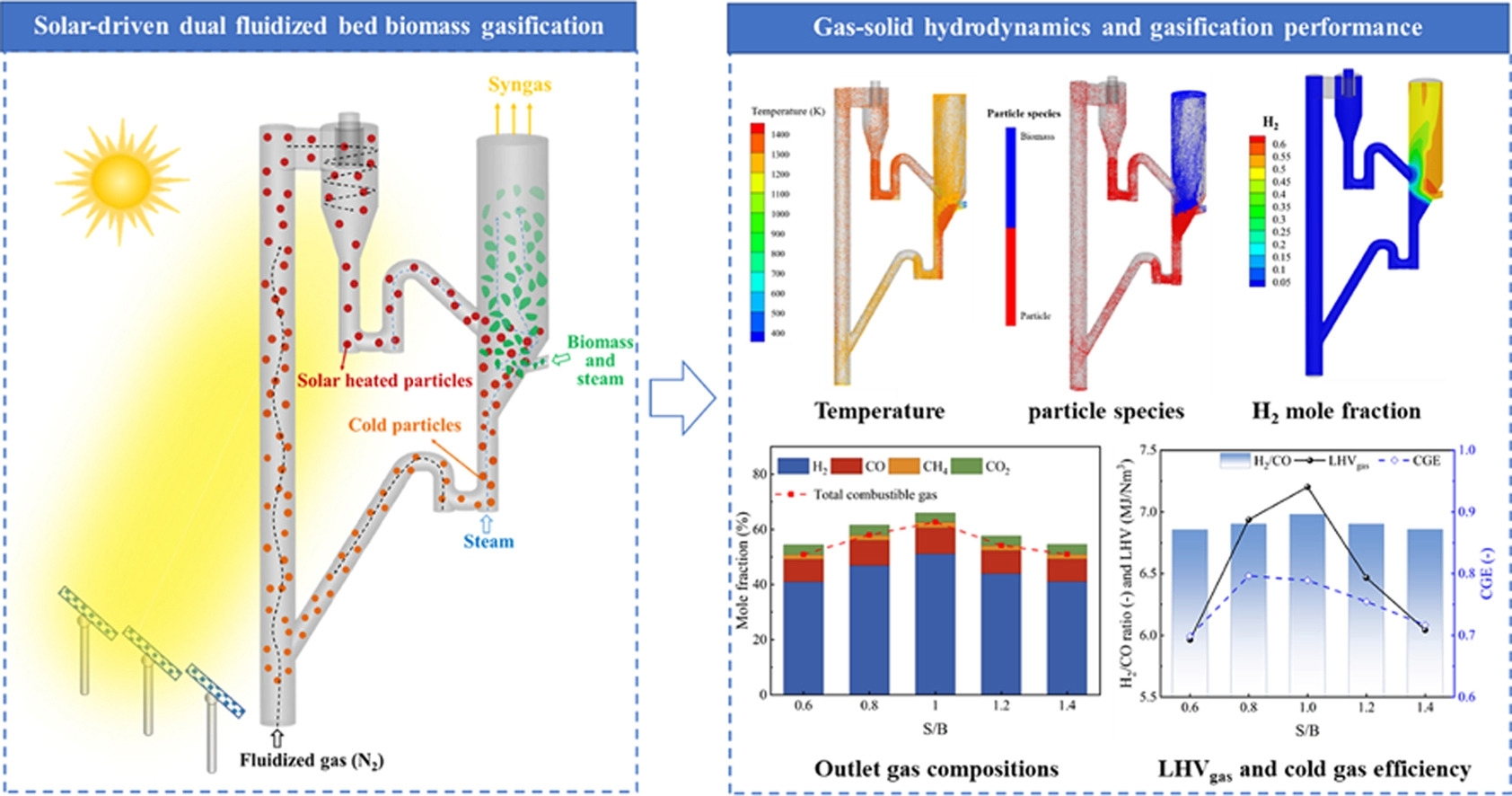
Biomass, as a renewable and carbon-neutral energy source, provides a promising pathway to mitigate the intermittency of solar energy when coupled with high-temperature solar thermal technologies. To address localized surface overheating caused by direct solar irradiation, this study proposes a novel dual fluidized bed system comprising a solar absorber and a biomass gasifier. Heat transfer between the two reactors is facilitated by the continuous circulation of particle heat carriers, enabling efficient delivery of high-temperature solar energy to the endothermic biomass gasification process. The multiphase particle-in-cell (MP-PIC) method was employed to investigate the gas-solid flow behavior within the dual fluidized bed and the effects of operating parameters on gasification performance. Simulation results demonstrate effective circulation of particle heat carriers between the two reactors, with a circulation flux of 0.08 kg/s, ensuring efficient heat transfer from the solar absorber to the gasifier. As the steam-to-biomass mass ratio (S/B) increases from 0.6 to 1.4, the mole fractions of H2 and CO reach their maxima at S/B = 1.0, where the syngas lower heating value (LHVgas) is 7.2 MJ/Nm3 and the cold gas efficiency (CGE) reaches 0.79. For biomass particle sizes ranging from 300 to 500 μm, optimal syngas composition is achieved at 350 μm, yielding the highest H2 and CO concentrations, with an LHVgas of 6.72 MJ/Nm3 and a CGE of 0.80. These findings provide a theoretical basis for the design and operational optimization of solar-driven biomass gasification systems based on dual fluidized bed reactors.
Graphical abstract
Keywords
Solar utilization; Biomass gasification; Dual fluidized bed reactor; Particle heat carrier; MP-PIC simulation
文章导读