
期刊文章
过刊浏览
- Volumes 108-119 (2025)
-
Volumes 96-107 (2025)
-
Volume 107
Pages 1-376 (December 2025)
-
Volume 106
Pages 1-336 (November 2025)
-
Volume 105
Pages 1-356 (October 2025)
-
Volume 104
Pages 1-332 (September 2025)
-
Volume 103
Pages 1-314 (August 2025)
-
Volume 102
Pages 1-276 (July 2025)
-
Volume 101
Pages 1-166 (June 2025)
-
Volume 100
Pages 1-256 (May 2025)
-
Volume 99
Pages 1-242 (April 2025)
-
Volume 98
Pages 1-288 (March 2025)
-
Volume 97
Pages 1-256 (February 2025)
-
Volume 96
Pages 1-340 (January 2025)
-
Volume 107
-
Volumes 84-95 (2024)
-
Volume 95
Pages 1-392 (December 2024)
-
Volume 94
Pages 1-400 (November 2024)
-
Volume 93
Pages 1-376 (October 2024)
-
Volume 92
Pages 1-316 (September 2024)
-
Volume 91
Pages 1-378 (August 2024)
-
Volume 90
Pages 1-580 (July 2024)
-
Volume 89
Pages 1-278 (June 2024)
-
Volume 88
Pages 1-350 (May 2024)
-
Volume 87
Pages 1-338 (April 2024)
-
Volume 86
Pages 1-312 (March 2024)
-
Volume 85
Pages 1-334 (February 2024)
-
Volume 84
Pages 1-308 (January 2024)
-
Volume 95
-
Volumes 72-83 (2023)
-
Volume 83
Pages 1-258 (December 2023)
-
Volume 82
Pages 1-204 (November 2023)
-
Volume 81
Pages 1-188 (October 2023)
-
Volume 80
Pages 1-202 (September 2023)
-
Volume 79
Pages 1-172 (August 2023)
-
Volume 78
Pages 1-146 (July 2023)
-
Volume 77
Pages 1-152 (June 2023)
-
Volume 76
Pages 1-176 (May 2023)
-
Volume 75
Pages 1-228 (April 2023)
-
Volume 74
Pages 1-200 (March 2023)
-
Volume 73
Pages 1-138 (February 2023)
-
Volume 72
Pages 1-144 (January 2023)
-
Volume 83
-
Volumes 60-71 (2022)
-
Volume 71
Pages 1-108 (December 2022)
-
Volume 70
Pages 1-106 (November 2022)
-
Volume 69
Pages 1-122 (October 2022)
-
Volume 68
Pages 1-124 (September 2022)
-
Volume 67
Pages 1-102 (August 2022)
-
Volume 66
Pages 1-112 (July 2022)
-
Volume 65
Pages 1-138 (June 2022)
-
Volume 64
Pages 1-186 (May 2022)
-
Volume 63
Pages 1-124 (April 2022)
-
Volume 62
Pages 1-104 (March 2022)
-
Volume 61
Pages 1-120 (February 2022)
-
Volume 60
Pages 1-124 (January 2022)
-
Volume 71
- Volumes 54-59 (2021)
- Volumes 48-53 (2020)
- Volumes 42-47 (2019)
- Volumes 36-41 (2018)
- Volumes 30-35 (2017)
- Volumes 24-29 (2016)
- Volumes 18-23 (2015)
- Volumes 12-17 (2014)
- Volume 11 (2013)
- Volume 10 (2012)
- Volume 9 (2011)
- Volume 8 (2010)
- Volume 7 (2009)
- Volume 6 (2008)
- Volume 5 (2007)
- Volume 4 (2006)
- Volume 3 (2005)
- Volume 2 (2004)
- Volume 1 (2003)
Volume 117
The effect of rotational speed on particle motion characteristics in a helical-bladed multiphase pump
Wenjuan Lv a b, Guangtai Shi a b *, Haigang Wen a b, Zongliu Huang a b, Xi Yang a
a Key Laboratory of Fluid and Power Machinery, Ministry of Education, Xihua University, Chengdu, 610039, China
b Key Laboratory of Fluid Machinery and Engineering, Xihua University, Sichuan Province, Chengdu, 610039, China
10.1016/j.partic.2026.08.010
Volume 117,
October 2026,
Pages 502-515
Received 18 July 2026, Revised 3 August 2026, Accepted 11 August 2026, Available online 14 August 2026, Version of Record 22 August 2026.
E-mail:
sgtmailxhu@163.com
Highlights
• Particle enrichment zones are identified in a helical-bladed multiphase pump.
• Rotational speed shifts particle velocity distribution toward high-velocity regimes.
• Impeller-region collisions account for over 80% of total particle-wall impacts.
• Particle-wall contact force increases nonlinearly with rotational speed.
• CFD–DEM coupled with high-speed photography validates particle dynamics predictions.
Abstract
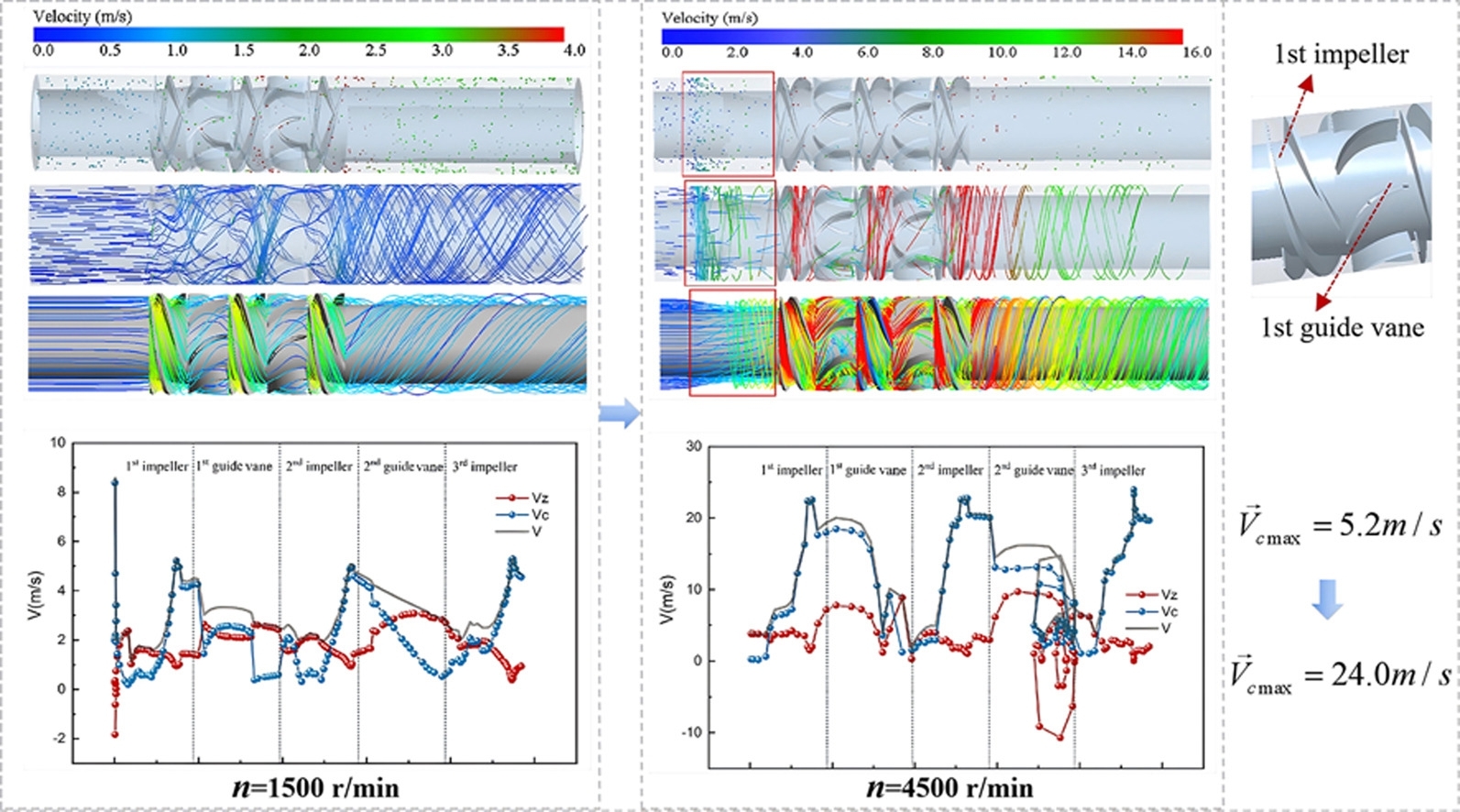
Rotational speed is a critical parameter governing particle dynamics in helical-bladed multiphase pumps; however, its quantitative characterization and evolutionary mechanisms under variable speeds remain unclear. This study investigates a self-developed three-stage helical-bladed multiphase pump using numerical simulations complemented by high-speed photography experiments, systematically analyzing particle dynamic behaviors at 1500, 3000, and 4500 r/min. Results reveal non-uniform particle distributions, primarily on the pressure sides of impeller/guide vane blades and within the impeller mid-passage. Increasing speed enlarges the recirculation zone at the first-stage impeller inlet and intensifies particle clustering. As speed rises from 1500 to 4500 r/min, the peak circumferential velocity in impeller passages increases from 5.2 to 24.0 m/s (≈362% rise), while the peak axial velocity rises from 2.5 to 6.4 m/s; in guide vane passages, circumferential velocity attenuates markedly, whereas axial velocity compensatorily increases. Particle absolute velocity increases axially along each impeller stage and decreases along each guide vane stage; elevated rotational speed progressively shifts the particle velocity distribution toward mid-to-high ranges, accompanied by a marked rise in the proportion of high-velocity particles. Regarding collision characteristics, impeller-region collisions account for over 80% at medium and high speeds, with wall collisions predominantly occurring at the blade shroud (≈80%). The total particle–wall contact force exhibits a nonlinear increase with speed (0.211 N → 0.918 N → 1.220 N), and impeller wall contact forces exceed those on guide vane walls. These findings serve as critical references for optimizing pump performance and matching operating conditions.
Graphical abstract
Keywords
Particle motion characteristics; CFD-DEM; Rotational speed; Solid-liquid two-phase flow; Helical-bladed multiphase pump
文章导读