
期刊文章
过刊浏览
- Volumes 108-119 (2025)
-
Volumes 96-107 (2025)
-
Volume 107
Pages 1-376 (December 2025)
-
Volume 106
Pages 1-336 (November 2025)
-
Volume 105
Pages 1-356 (October 2025)
-
Volume 104
Pages 1-332 (September 2025)
-
Volume 103
Pages 1-314 (August 2025)
-
Volume 102
Pages 1-276 (July 2025)
-
Volume 101
Pages 1-166 (June 2025)
-
Volume 100
Pages 1-256 (May 2025)
-
Volume 99
Pages 1-242 (April 2025)
-
Volume 98
Pages 1-288 (March 2025)
-
Volume 97
Pages 1-256 (February 2025)
-
Volume 96
Pages 1-340 (January 2025)
-
Volume 107
-
Volumes 84-95 (2024)
-
Volume 95
Pages 1-392 (December 2024)
-
Volume 94
Pages 1-400 (November 2024)
-
Volume 93
Pages 1-376 (October 2024)
-
Volume 92
Pages 1-316 (September 2024)
-
Volume 91
Pages 1-378 (August 2024)
-
Volume 90
Pages 1-580 (July 2024)
-
Volume 89
Pages 1-278 (June 2024)
-
Volume 88
Pages 1-350 (May 2024)
-
Volume 87
Pages 1-338 (April 2024)
-
Volume 86
Pages 1-312 (March 2024)
-
Volume 85
Pages 1-334 (February 2024)
-
Volume 84
Pages 1-308 (January 2024)
-
Volume 95
-
Volumes 72-83 (2023)
-
Volume 83
Pages 1-258 (December 2023)
-
Volume 82
Pages 1-204 (November 2023)
-
Volume 81
Pages 1-188 (October 2023)
-
Volume 80
Pages 1-202 (September 2023)
-
Volume 79
Pages 1-172 (August 2023)
-
Volume 78
Pages 1-146 (July 2023)
-
Volume 77
Pages 1-152 (June 2023)
-
Volume 76
Pages 1-176 (May 2023)
-
Volume 75
Pages 1-228 (April 2023)
-
Volume 74
Pages 1-200 (March 2023)
-
Volume 73
Pages 1-138 (February 2023)
-
Volume 72
Pages 1-144 (January 2023)
-
Volume 83
-
Volumes 60-71 (2022)
-
Volume 71
Pages 1-108 (December 2022)
-
Volume 70
Pages 1-106 (November 2022)
-
Volume 69
Pages 1-122 (October 2022)
-
Volume 68
Pages 1-124 (September 2022)
-
Volume 67
Pages 1-102 (August 2022)
-
Volume 66
Pages 1-112 (July 2022)
-
Volume 65
Pages 1-138 (June 2022)
-
Volume 64
Pages 1-186 (May 2022)
-
Volume 63
Pages 1-124 (April 2022)
-
Volume 62
Pages 1-104 (March 2022)
-
Volume 61
Pages 1-120 (February 2022)
-
Volume 60
Pages 1-124 (January 2022)
-
Volume 71
- Volumes 54-59 (2021)
- Volumes 48-53 (2020)
- Volumes 42-47 (2019)
- Volumes 36-41 (2018)
- Volumes 30-35 (2017)
- Volumes 24-29 (2016)
- Volumes 18-23 (2015)
- Volumes 12-17 (2014)
- Volume 11 (2013)
- Volume 10 (2012)
- Volume 9 (2011)
- Volume 8 (2010)
- Volume 7 (2009)
- Volume 6 (2008)
- Volume 5 (2007)
- Volume 4 (2006)
- Volume 3 (2005)
- Volume 2 (2004)
- Volume 1 (2003)
Volume 117
Bridging battery manufacture and performance: Particle structure assembly as a governing state variable (Open Access)
Jundong Zhang a, Chenzi Zhao a b c, Kexuan Liao a b, Rui Zhang d, Jiangkui Hu c, Xiang Chen a b c, Chen Ling e, Daiwei Wang a f, Qiang Zhang a b c g *
a State Key Laboratory of Chemical Engineering and Low-Carbon Technology, Beijing Key Laboratory of Complex Solid-State Batteries, Department of Chemical Engineering, Tsinghua University, Beijing, 100084, China
b Institute for Carbon Neutrality, Tsinghua University, Beijing, 100084, China
c AI Solid-State Battery Innovation Center, Yibin, 644002, China
d Beijing Huairou Laboratory, Beijing, 101400, China
e School of Interdisciplinary Science, Beijing Institute of Technology, Beijing, 100081, China
f Department of Mechanical Engineering, Southern Methodist University, Dallas, 75205, TX, United States
g Shanxi Research Institute for Clean Energy, Tsinghua University, Taiyuan, 030032, China
10.1016/j.partic.2026.07.021
Volume 117,
October 2026,
Pages 516-523
Received 29 April 2026, Revised 11 June 2026, Accepted 1 July 2026, Available online 12 August 2026, Version of Record 24 August 2026.
E-mail:
zhang-qiang@mails.tsinghua.edu.cn
Highlights
• Particle structure assembly (PSA) is proposed as a governing state variable.
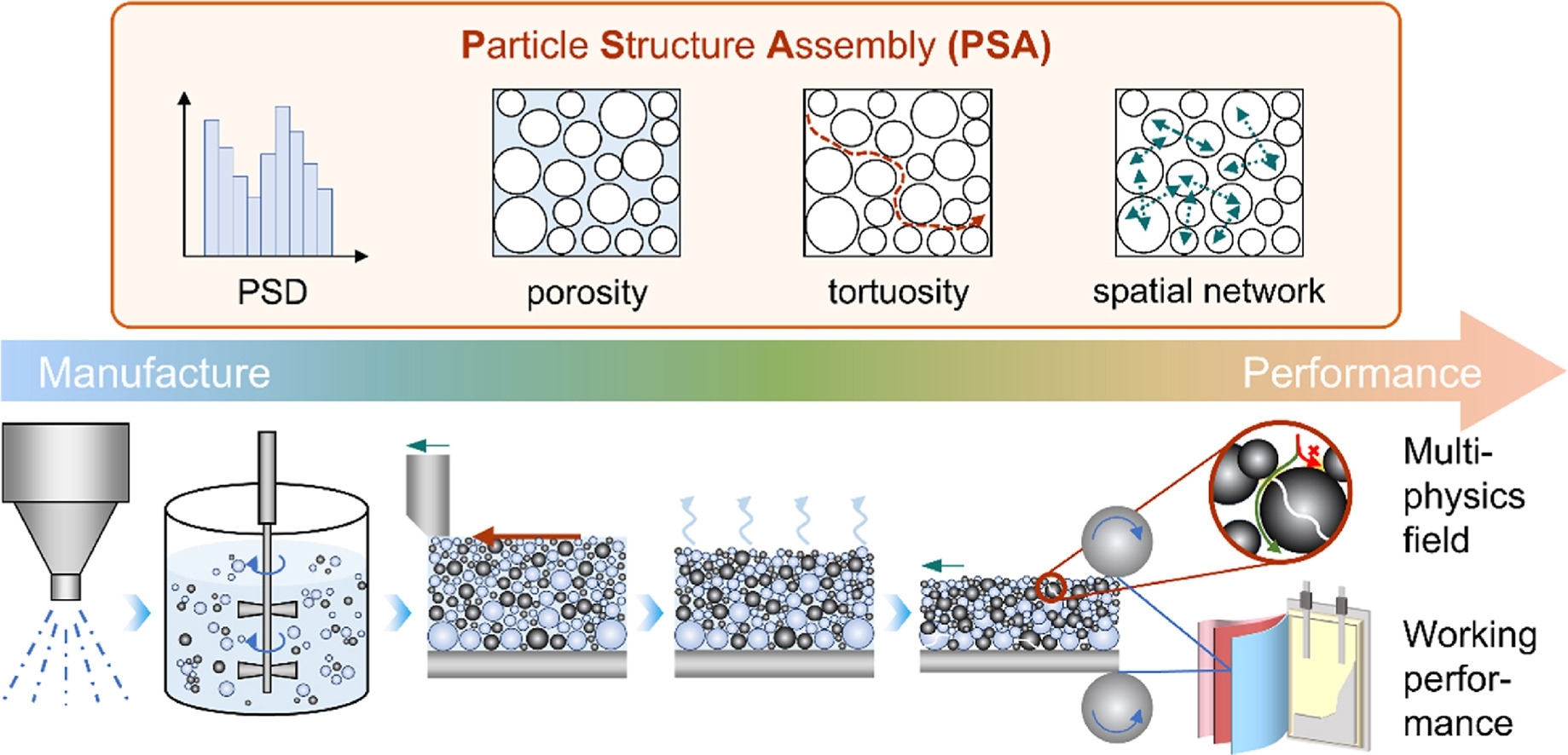
• PSA integrates the particle-scale characteristics: particle size distribution, porosity, tortuosity, and contact networks.
• PSA affords a universal framework for rational design in battery systems.
Abstract
Rechargeable batteries play an indispensable role in contemporary energy storage. Within battery components such as electrodes, the manner in which particles are arranged into functional structures critically governs electrochemical performance. Although particle-scale electrode design has received increasing attention, its role is still often discussed through isolated descriptors or specific processes rather than as an integrated assembly state. Here we propose that particle structure assembly (PSA), which encompasses particle size distribution, porosity, tortuosity, and interparticle contact networks, should be identified as an integrated governing state variable that bridges manufacture processes and battery performance. PSA is not a static descriptor but an evolving structural state shaped sequentially by powder preparation, slurry processing, and calendering during cell fabrication. PSA determines structural configuration and interfacial connectivity, thereby dictating the distribution of concentration fields, electric potentials, and mechanical stresses, highlighting its core scientific position. The PSA-constrained multi-physics landscape defines the accessible performance space of a working battery. Recognizing PSA as a central state variable enables the shift from isolated chemistry-centric design to integrated particle-engineering strategies, offering a unified framework to accelerate next-generation battery technologies.
Graphical abstract
Keywords
Particle structure assembly; Battery energy particles; Battery manufacture; Particle-scale evolution; Multi-physics coupling
文章导读